
Gustavs Filipsons
In the shifting landscape of contemporary abstraction, few painters have forged a path as insistently introspective and as fiercely committed to the revelation of the unseen as Gustavs Filipsons. The Latvian-born, award-winning artist, whose work has traveled from Riga to Italy, Japan and the United States and has appeared in international publications, has built a practice that resists the easy consolations of surface. His painting does not decorate experience, it interrogates it. At the core of his work stands a conviction that art exists to communicate with the unknown regions of the human mind, and that abstraction is the most exact language for that task.
From the beginning, Filipsons has treated painting as a way to speak to the inner realm, to cross the boundaries of rational thought and to touch what he calls the true self. Raised in Riga during the late Soviet period, he was less impressed by ideology than by the city itself. The old architecture of Riga, with its dark Art Nouveau facades, shifting seasonal moods and flickering lamplight, became his first teacher. As a child he watched the feeble light swinging above narrow streets and felt that the houses themselves were alive, that the carved ornaments, masks and floral motifs contained spirits. These mythical silhouettes had greater influence on him than the political order surrounding them. They taught him to read the world as a network of signs, to sense life in inert surfaces, to experience the built environment as an emotional and spiritual field rather than a neutral backdrop.
Later, at the Latvian Academy of Art where he completed a master degree in painting, this intuitive sensitivity was sharpened into conscious practice. Yet his artistic identity did not follow the path of local tradition. In a culture dominated by figurative realism, Filipsons recognized early that his direction would be abstraction, not as stylistic fashion but as existential necessity. He felt that only abstract form could hold the complexity of the subconscious images and sensations that filled his inner life, those messages from dreams and from what he describes as a spiritual universe that speaks through symbolic events.
The biography of Filipsons is marked by persistence in the face of indifference. After graduating he chose to follow the call of abstraction despite a lack of institutional support in his homeland. He worked in construction in order to survive while reserving his true strength for painting. For many years his work was scarcely recognized in Latvia, yet he continued to paint, to layer canvas upon canvas, to search for the visual configuration in which the energy of the inner realm would finally become visible. The path was long and demanding. He speaks candidly of depression, of feeling like an outcast, of being told by local authorities that his work did not fit national culture. Yet he held to his mission, convinced that the urgency that had led him to art would eventually find resonance. That resonance came from beyond its borders, with invitations to international projects, exhibitions in Italy, Japan and the United States and representation in galleries in New York. In this sense his career mirrors the trajectory of his paintings themselves, which often hides several buried canvases beneath the final image. Recognition, like the surface, is just one visible layer in a much deeper process.
To understand Filipsons one must first understand his conception of painting. For him, the canvas is not a window onto the world but a field where forces interact, collide and crystallise. The process begins long before the first mark. He carefully tunes his mental state, opening himself to the flow of images, signs and sensations that rise from the subconscious. He has long been attentive to the language of dreams, and at one time practiced conscious dreaming in order to navigate that terrain with more clarity. Dreams, coincidences, the mysterious logic of everyday events all become raw material. When he paints, he strives to match the intensity of that inner flow, to become almost a medium through which the unseen can speak.
Yet this is not romantic abandon. Filipsons is acutely aware that chance in art must be guided. His working method allows unintentional configurations to arise, then patiently clarifies them. He applies oil, acrylic, spray paint and gloss with brushes, knives, rollers and stencils. He scratches, scrapes and carves the surface, sometimes painting over entire finished images to reach a deeper, more essential one. In this way, unplanned forms acquire a precise internal logic. The painting session may be quick and intense, like a volcanic eruption as he himself says, but the finishing stage can be long, involving careful withdrawal and accentuation of gestures until the image attains unity and a palpable charge. The work is complete only when he feels that the canvas has begun to speak back to him, when it radiates energy and seems to possess its own life.
The resulting paintings formed a coherent world. They are at once gestural and rigorously composed, violent and meditative, opaque and luminous. Rather than organize space around a classical center, Filipsons allows their forms to take on a life of their own. They traverse the field, break it, stitch it back together, or align themselves with hidden diagonals that cut across the surface. The background often operates as an active depth, pushing and pulling against the foreground. Texture is not ornament but structure. Scratches and incisions, ridges of paint and veils of spray all contribute to an intricate topography that feels less like a picture and more like a cross section of psychic terrain.
Among the works that crystallise this language, Confronteers from 2023 occupies a central place. At one meter square, the painting is dense with collisions of red, orange, maroon and black, interrupted here and there by sharp flashes of yellow. There is no resting place for the eye. Rectangular slabs of dark pigment slice through feverish fields of scarlet, while diagonal scratches weave across the whole, like traces of previous movements still inscribed in the body of the work. The composition refuses a stable center, instead orchestrating a network of interlocking tensions that pull the viewer in multiple directions at once.
What emerges is the sensation of confrontation, not between two external figures, but within the mind itself. One can almost feel opposing impulses crash against each other, flare up, recede and reappear transformed. The yellow intervals act like sudden insights that cut through confusion, yet they are immediately surrounded by darker masses. The painting does not illustrate a narrative of conflict; it enacts the very process by which consciousness grapples with what rises from below. Energy is not resolved into harmony, but held in a state of charged suspension.
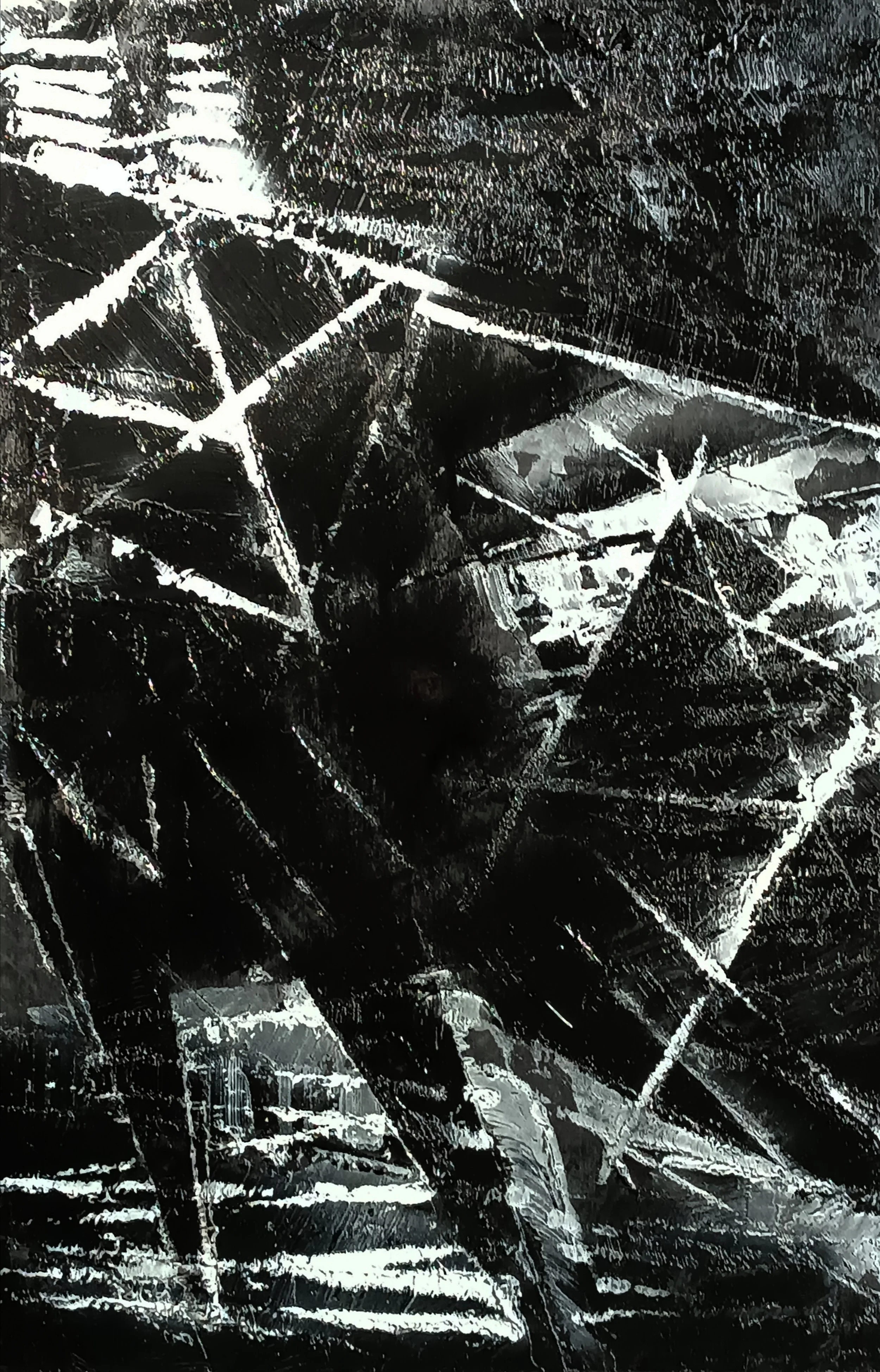
Where Confronteers burns, Envy from 2021 chills. This large square canvas in black, white and dense gray turns away from chromatic heat and concentrates entirely on gesture. Broad strokes whip diagonally across the surface, some opaque, others transparent, forming layers that feel almost geological. Sections of the painting resemble eroded rock or charred wood, as if some searing emotional climate had left its mark. White streaks break through the darkness, but they do not bring clarity; they are more like flashes of cold light in a stormy sky.
Envy, as emotion, is corrosive and ambivalent, and Filipsons translates that interior corrosion into a field where nothing fully settles. Forms slide over each other, melt at the edges and reconstitute themselves. The viewer senses an instability that is not simply compositional but psychological. The painting suggests a mind fixed on comparison, unable to stand still, constantly measuring itself against some absent others and finding itself lacking. Again, Filipsons refuses literal symbolism. Instead, he constructs a visual situation that makes one feel the condition that the title names.
In Ghost from 2025, a different register appears. Here a very dark, almost nocturnal ground of deep blue, black and muted rust hosts a web of fine white lines that traverse the surface in angular trajectories. These lines suggest both drawing and architecture. They recall scaffolding, skeletal frames or the outlines of a structure that has never been built. Bits of turquoise emerge behind them, hinting at depth, as if another luminous space lay just beneath the skin of the painting.
The ghost of the title is not a literal figure. It is a pattern, a diagram, a presence defined by its own elusiveness. The white linear scaffold seems to hover between manifestation and disappearance. The image resembles the memory of a place rather than the place itself, or the residue of a form that has been removed from visibility. In his handling of line and void, Filipsons demonstrates that the subconscious is not always chaotic; it also generates delicate, fragile architectures that can evaporate at the slightest touch.
A kind of silent psychological portrait appears in In Silence from 2025. The painting presents a flat, saturated red field upon which a dense mesh of black lines gathers into a head shaped mass. There are no facial features, no indication of eyes or mouth, yet the form unmistakably suggests a human presence turned slightly away from the viewer. The black lines are nervous and looping, at times almost scribbled, as if recording a frantic inner monologue.
Silence, here, is not absence of thought; it is the solid wall that keeps words from escaping. Filipsons captures the paradox of a mind crowded with unspoken messages, a consciousness that vibrates with intensity while remaining outwardly mute. The red ground has an ambiguous status. It can be read as an alarm, a background of emotional heat against which the figure like form trembles, or as a kind of inner illumination that both contains and exposes the tangle of lines. Either way, the work testifies to the ability of abstraction to render psychological states with an immediacy that representation might dilute.
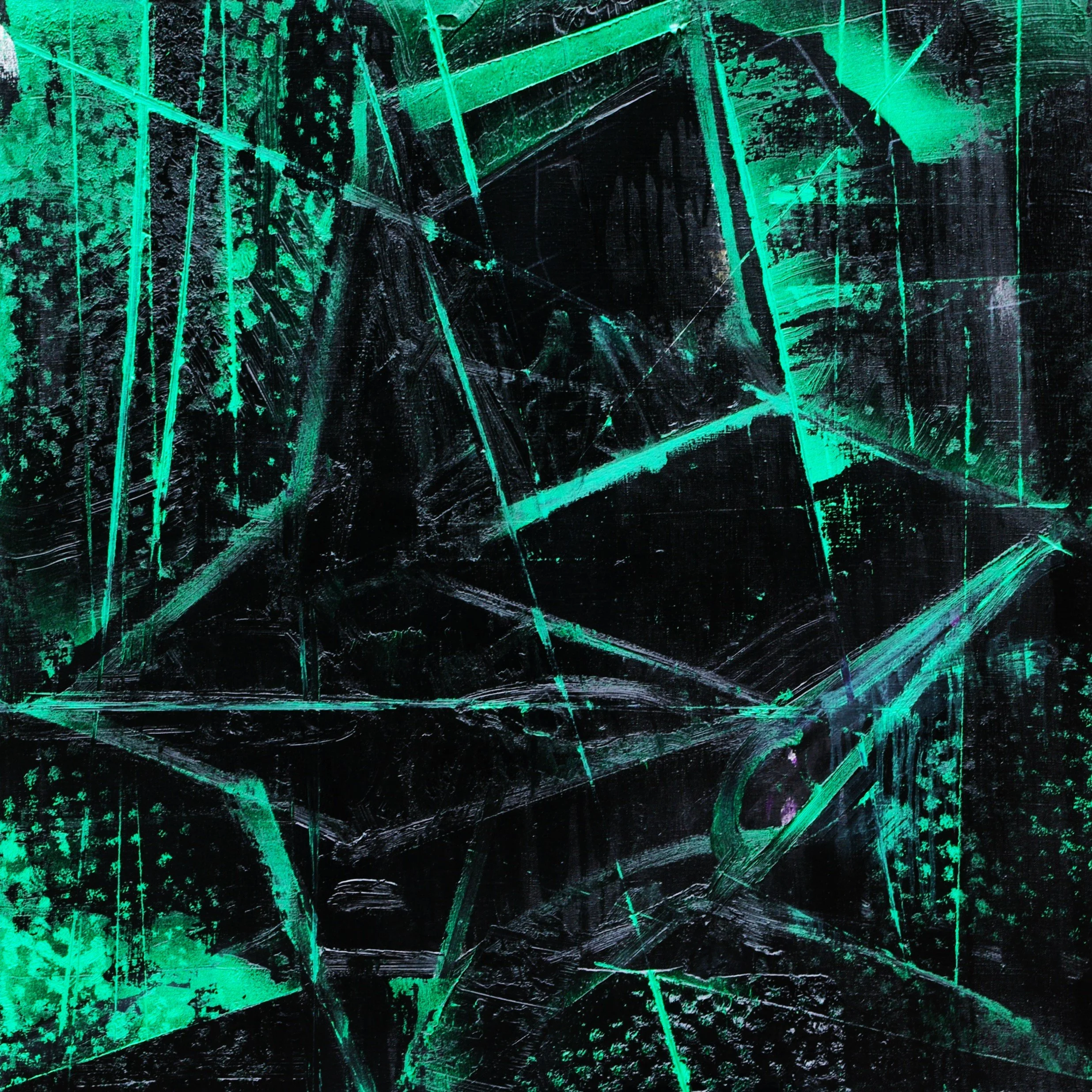
With Night Sky from 2023, Filipsons extends the field from the intimate to the cosmic while remaining inside abstraction. A black ground, richly worked with subtle variations, becomes the stage for luminous stripes of emerald and turquoise that strike across the surface at oblique angles. Some passages are built from a matrix of tiny dots, others from translucent layers that reveal traces of earlier gestures. The painting evokes the experience of looking up at a night sky far from any city, where stars and nebulous clusters fill the darkness with quiet density.
Yet this is not astronomy but inner cosmos. The lines and constellated textures imply networks and crossings, mental routes rather than celestial coordinates. It is as if the subconscious were charted like a map of interconnected lights, each junction a point of potential revelation. In this work, Filipsons shifts from the volcanic and tumultuous to a more contemplative mode. The paint is still energetic, but the emotional tone is cooler, more observant, as if the painter had stepped back slightly in order to contemplate the vast architecture of his own inner universe.
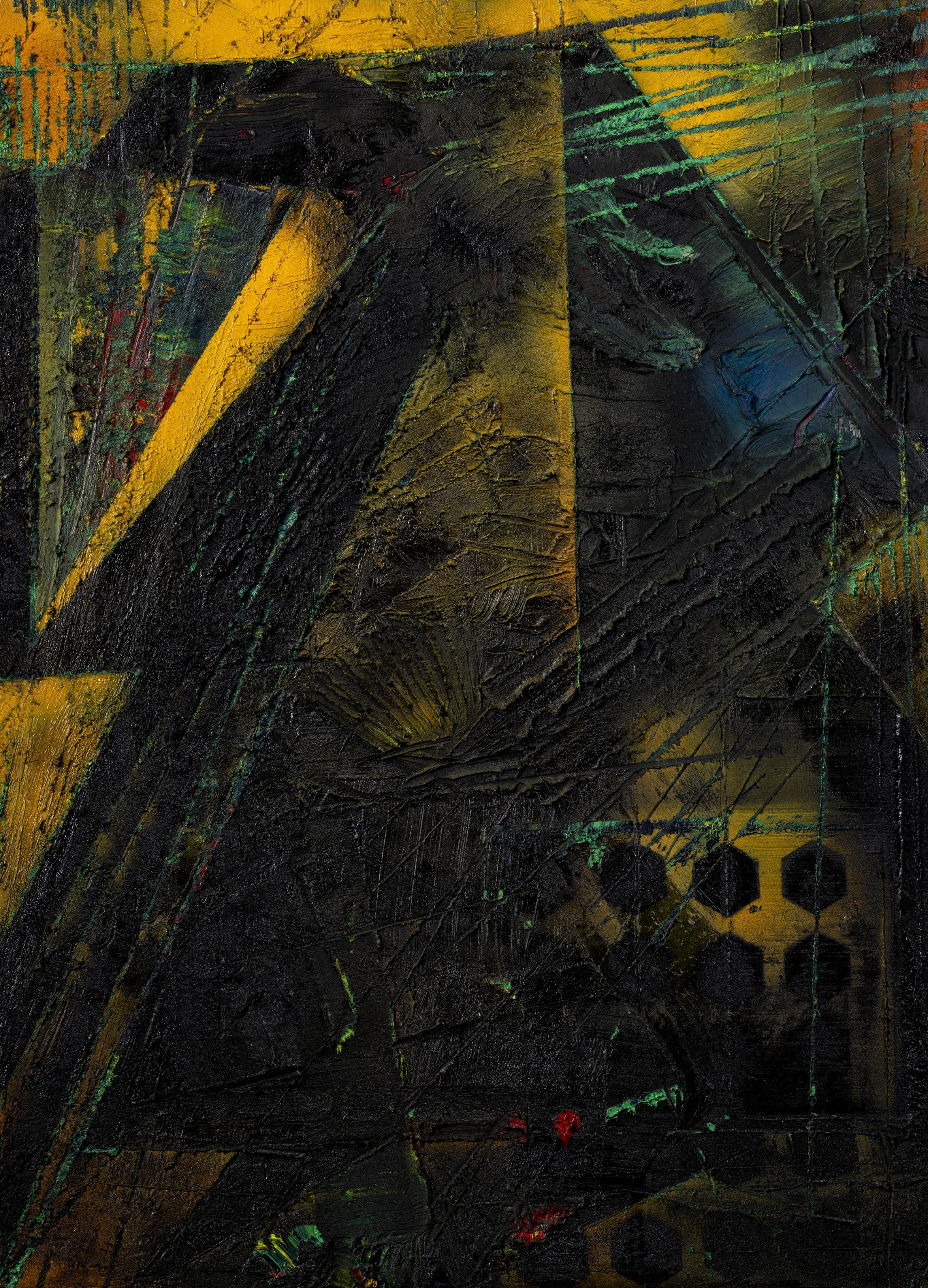
The work entitled Pyramid from 2025 introduces a different support, plywood instead of canvas, which brings additional physicality. The surface is thick with pigment, scratched and incised, the tactile relief pushing forward toward the viewer. Angular shapes in ochre and black, intersected by subtle streaks of green and blue, suggest a fractured geometric structure, a monument partially buried and partially emerging. The title points to an ancient symbol of spiritual ascent and hidden chambers, and Filipsons treats it not as a literal triangle but as a fragmentary presence.
Here, excavation is the dominant metaphor. The viewer senses layers of history, both personal and collective, compressed into a narrow vertical field. The pyramid has become an inner ruin, a relic of structures the mind once used to stabilize itself. Through his scratching and layering, Filipsons acknowledges that the path toward the true self often requires digging through such ruins, recovering energies that have been sealed away by habit and social pressure.
A related but distinct mood unfolds in Hideout from 2024. The palette returns to black, white and grey, yet the composition is less stormy like than Envy . Criss crossing diagonals and jagged angular shapes build a system of compartments and passageways, some open, some blocked. At the center of the painting there seems to be a shadowy core, darker than its surroundings, a zone that could be read as shelter or as a void.
The hideout of the title is ambiguous. Is it a safe interior where the self withdraws from external aggression, or is it a place of avoidance where necessary confrontations are postponed The painting refuses to answer. Its power lies in that hesitation. Viewers are invited to project their own understanding of refuge, secrecy and exposure. Filipsons once again uses abstract means to create a psychological situation rather than to depict a scene.
Across all these works, certain continuities appear. There is the recurrent use of layered surfaces, which compress time and experience into a single field. There is the insistence on energy, not as random excitement but as structured movement of forces within the picture plane. There is the deep respect for intuition, combined with rigorous review. And there is a philosophical conviction, rare in contemporary practice, that painting remains one of the most direct ways to communicate with the spiritual aspect of human existence.
In this respect, the artist from the past who stands closest to Filipsons is Wassily Kandinsky. Both see painting as a vehicle for invisible realities, both believe that pure form and color can awaken states of mind that words cannot easily grasp, and both understand abstraction as a path towards the spiritual rather than an escape from it. Yet Filipsons does not imitate its predecessor. Where Kandinsky often sought harmony and a kind of musical resonance, Filipsons embraces unrest, fracture and the weight of psychological struggle. His surfaces are rougher, his textures more insistent, his colors at times almost brutal. If he continues a lineage, he does so by extending it into a more introspective, sometimes darker territory appropriate to our moment.
Within the contemporary art scene, Gustavs Filipsons occupies a position of unusual integrity. While much of current production turns toward ironic commentary, digital spectacle or quick conceptual gestures, he remains committed to a slow, demanding engagement with the self. His contribution is not limited to the quality of individual canvases, which are indeed powerful and visually original. It also lies in the kind of subjectivity his work encourages in viewers. Standing before one of his paintings, one is not invited to decode clever references or admire virtuoso craftsmanship for its own sake. One is drawn instead into a confrontation with inner states, with those fears, hopes and intuitions that normally remain half conscious.
This is why his art matters for society. In an era of distraction, Filipsons offers concentration. In an era of surface, he works with depth. In a culture that often prizes speed over reflection, he reminds us that transformation, whether personal or collective, begins with a willingness to look within. His paintings are not solutions or slogans. They are invitations to introspection, to courage, to the acceptance that the true self is not given once and for all but must be continually rediscovered.
Gustavs Filipsons is, quite simply, a remarkably gifted painter. His command of material and gesture is virtuosic, yet he never technique allows to overshadow purpose. Each canvas feels necessary, the result of a battle fought with and within the mind. The originality of his language is evident in the way he fuses gestural energy with structural clarity, intensity with nuance. No two works repeat the same solution, yet all bear the recognizable imprint of his sensibility.
As his international presence grows, it becomes increasingly clear that he is not merely an artist of local interest but a significant voice in the wider conversation about what abstraction can still do. His work demonstrates that abstraction has not exhausted its resources. On the contrary, when handled by an artist who approaches it as a path to the subconscious and not just an aesthetic option, it proves capable of articulating some of the most urgent questions of human existence. Who are we beneath our social roles Where do our desires and fears truly originate How can we navigate the invisible dimensions of experience without losing ourselves
Filipsons has dedicated his life to these questions and has accepted the sacrifices they demand. He has walked through what he himself calls the desert of isolation in order to remain faithful to his vision. The paintings that emerge from that journey are not only visually compelling; they are philosophically rich, emotionally resonant and spiritually courageous. They remind us that art, at its highest level, is not entertainment but revelation.
To stand before Confronteers , Envy , Ghost , In Silence , Night Sky , Pyramid or Hideout is to stand before manifestations of that revelation, each a portal opened onto the unseen workings of mind and spirit. Through them, Gustavs Filipsons gives form to what usually remains formless. He offers viewers not a mirror of appearances but a map of the inner landscape, at once intimate and universal. In doing so, he secures his place as a crucial and uniquely gifted figure in contemporary abstract art, and as an artist whose work will continue to speak powerfully to those willing to listen with more than their eyes.
To experience a Gustavs Filipsons painting is to understand that the artist is not merely depicting the subconscious, he is communicating with it, shaping its language, and offering its revelations to the world. He treats painting as a spiritual responsibility, not a commodity. He persists despite isolation, despite cultural resistance, despite the economics of art that often reward spectacle over substance.
I have paints because I must.
Because the subconscious speaks, and he has chosen to listen.
Gustavs Filipsons stands as one of the most compelling abstract artists of his generation: a visionary whose works vibrate with psychological force, whose textures carry the weight of spiritual inquiry, and whose commitment to originality has forged a language entirely of his own. His paintings, layered, dynamic, eruptive, meditative, form an atlas of interiority, a testament to the enduring power of abstraction to reveal what the rational mind cannot grasp.
In a world that often forgets to look beneath the surface, Filipsons offers the reminder that the surface is only the beginning. His work invites us to step into the unknown and discover, within its depths, our own true selves.
In reflecting on the trajectory and depth of Gustavs Filipsons' artistic practice, one recognizes an artist who embodies the rare combination of emotional vulnerability, intellectual rigor and spiritual conviction. His paintings are not simply objects to be viewed; they are experiential fields that demand a kind of ethical participation from the viewer. They ask us to slow down, to listen inward, to sense the undercurrents of our own minds. In this way, Filipsons restores to painting a function that contemporary culture often forgets it can hold: the capacity to act as a vessel of transformation. These works are not passive; they intervene, they disrupt habitual perception, they open fissures in the hardened structures of consciousness.
What becomes increasingly clear is that Filipsons does not paint to impress or persuade. He paints to reveal, and the revelation is as much for him as it is for the viewer. The act of painting becomes a lived philosophy, a continuous negotiation between the visible and the invisible, between intuition and material, between the solitary inner path and the shared human condition. In each canvas, he demonstrates that the subconscious is not a dark void but a place of generative power, capable of shaping our understanding of existence when approached with courage and openness.
In a world preoccupied with clarity, speed and external achievement, Filipsons reminds us that truth is often found in ambiguity, slowness and interiority. His paintings exist as quiet acts of resistance against superficiality, inviting us to rediscover the magnitude of the inner realm. If the purpose of art is to illuminate aspects of being that might otherwise remain unreachable, then Filipsons succeeds with remarkable force. His contribution to contemporary abstraction is not merely stylistic; it is ontological. Through his art, he insists that the unseen is real, that the subconscious is meaningful, and that the search for the true self is one of the most important journeys we can undertake.
By Marta Puig
Editor Contemporary Art Curator Magazine
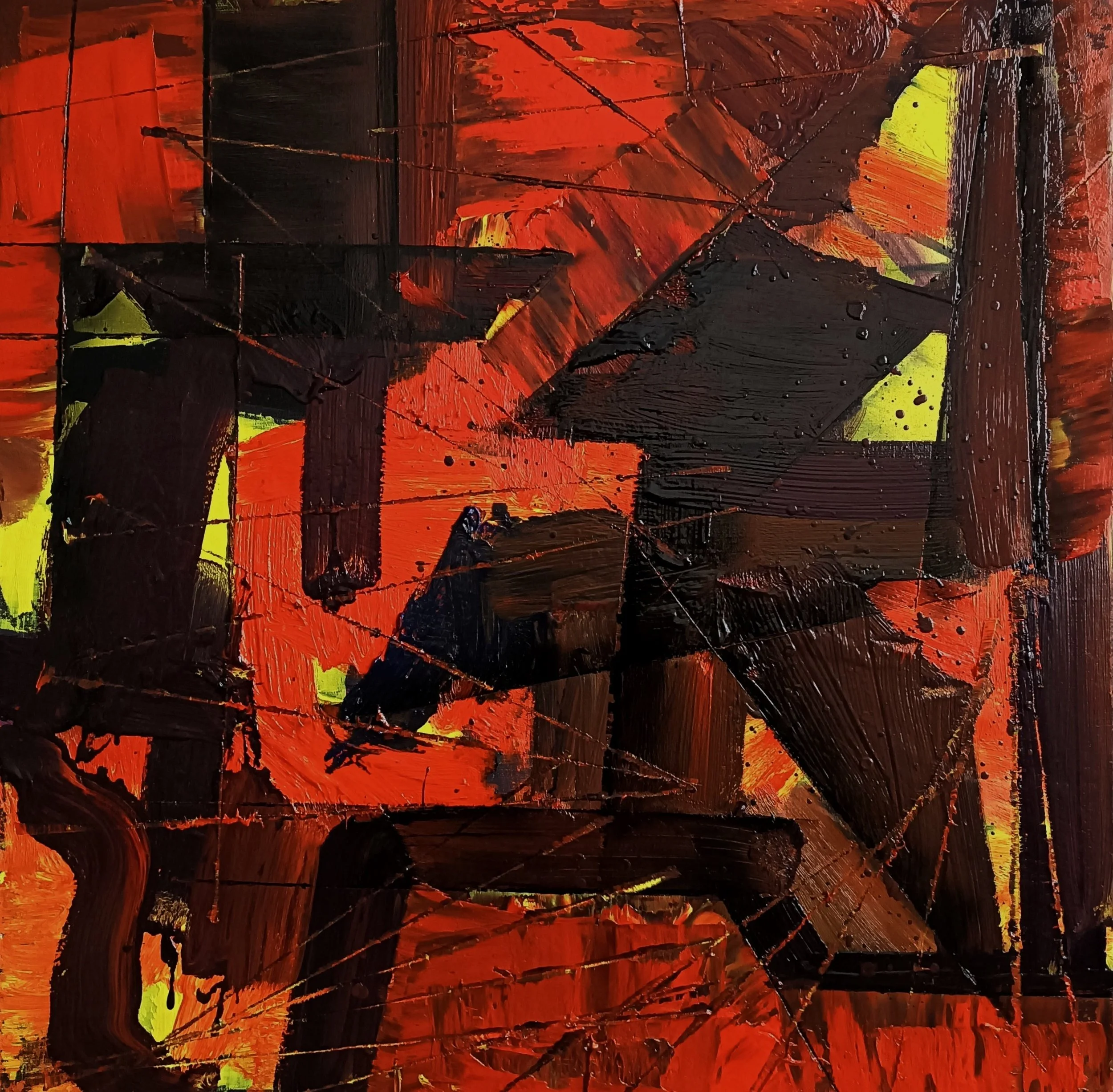
Confronteers, 2023. Oil on canvas, 100x100cm
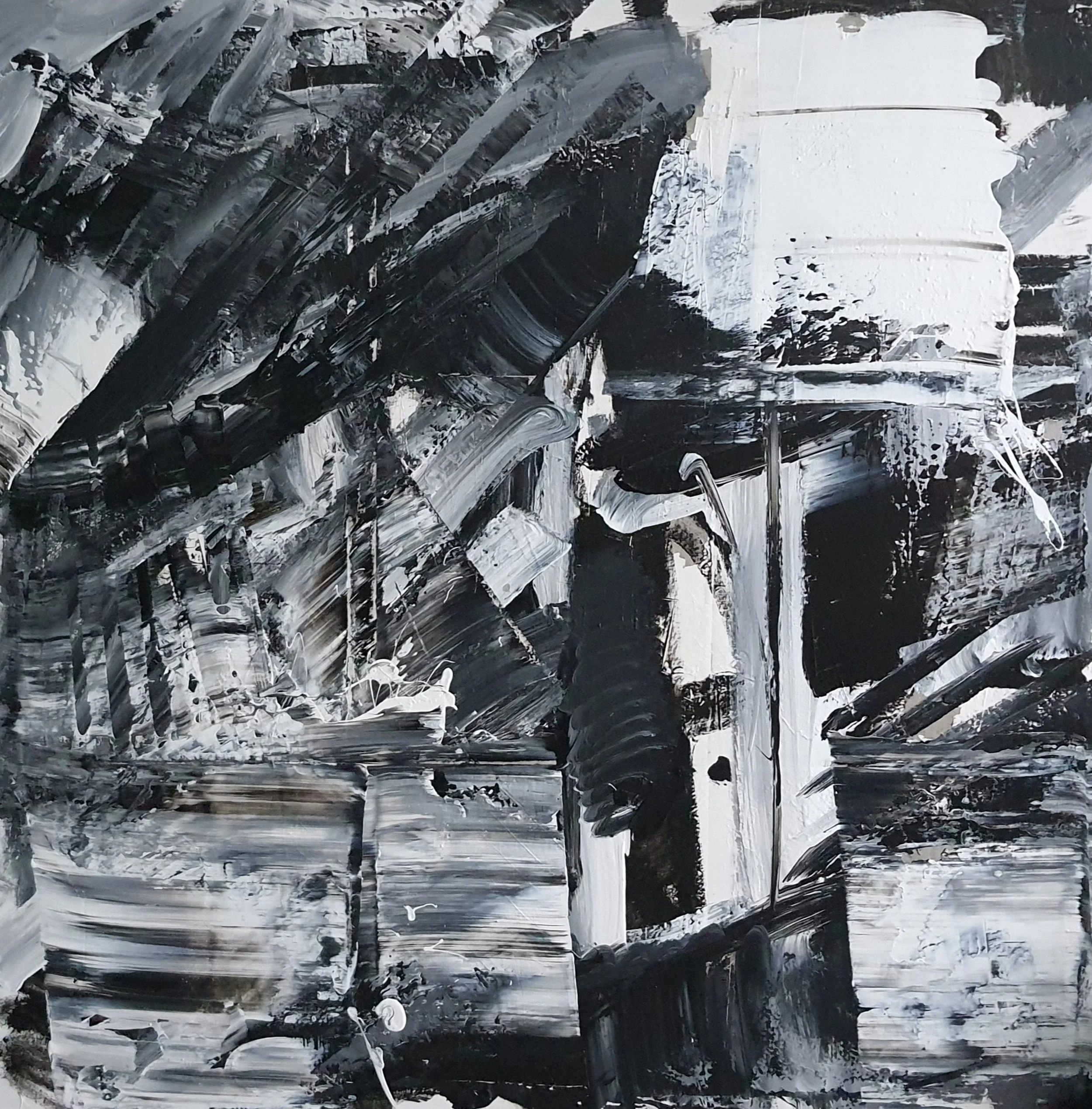
Envy, 2021. Acrylic on canvas, 160x160cm
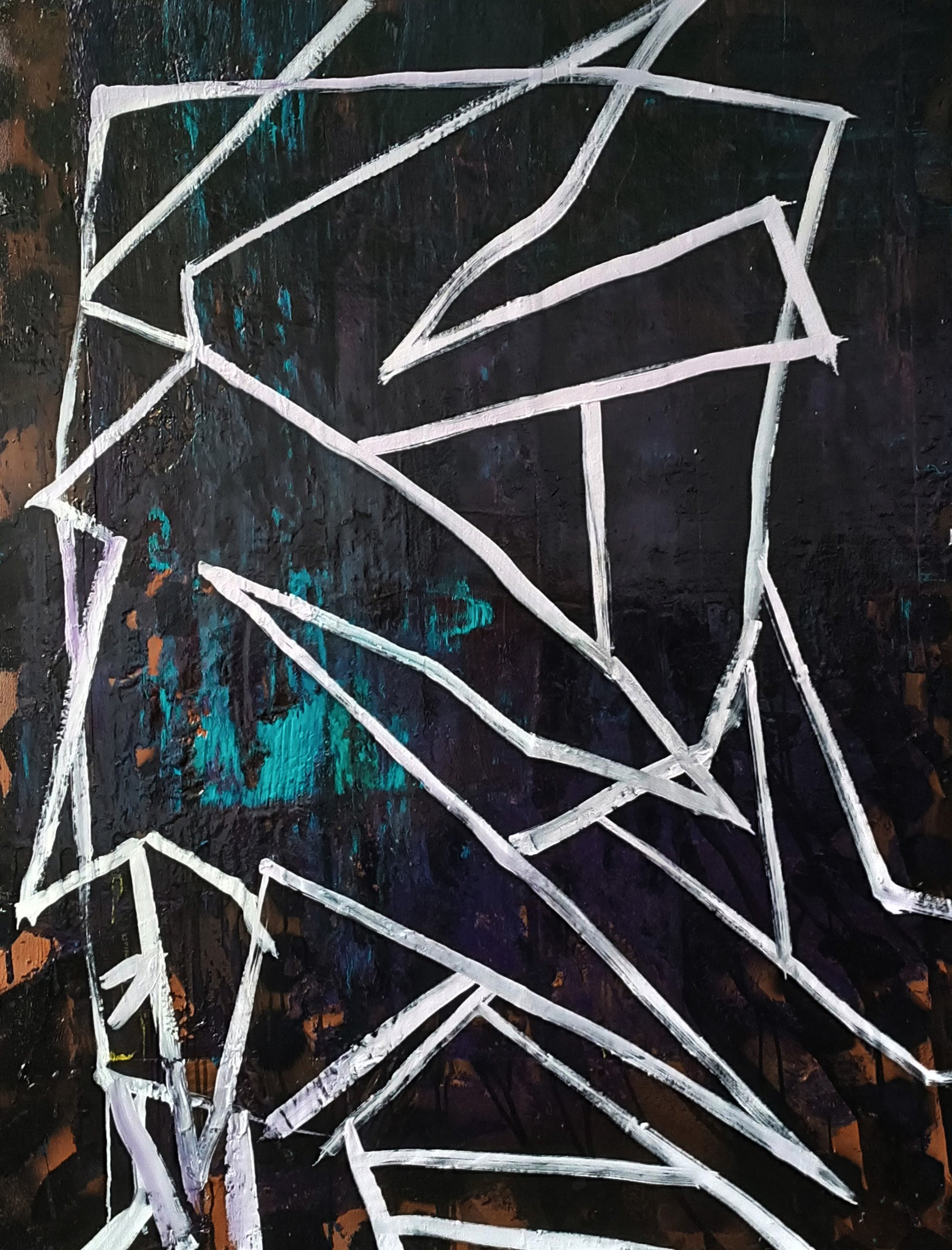
Ghost, 2025. Oil, acrylic on canvas,150 x120cm
Hideout, 2024. Oil, acrylic on canvas, 110x80cm.
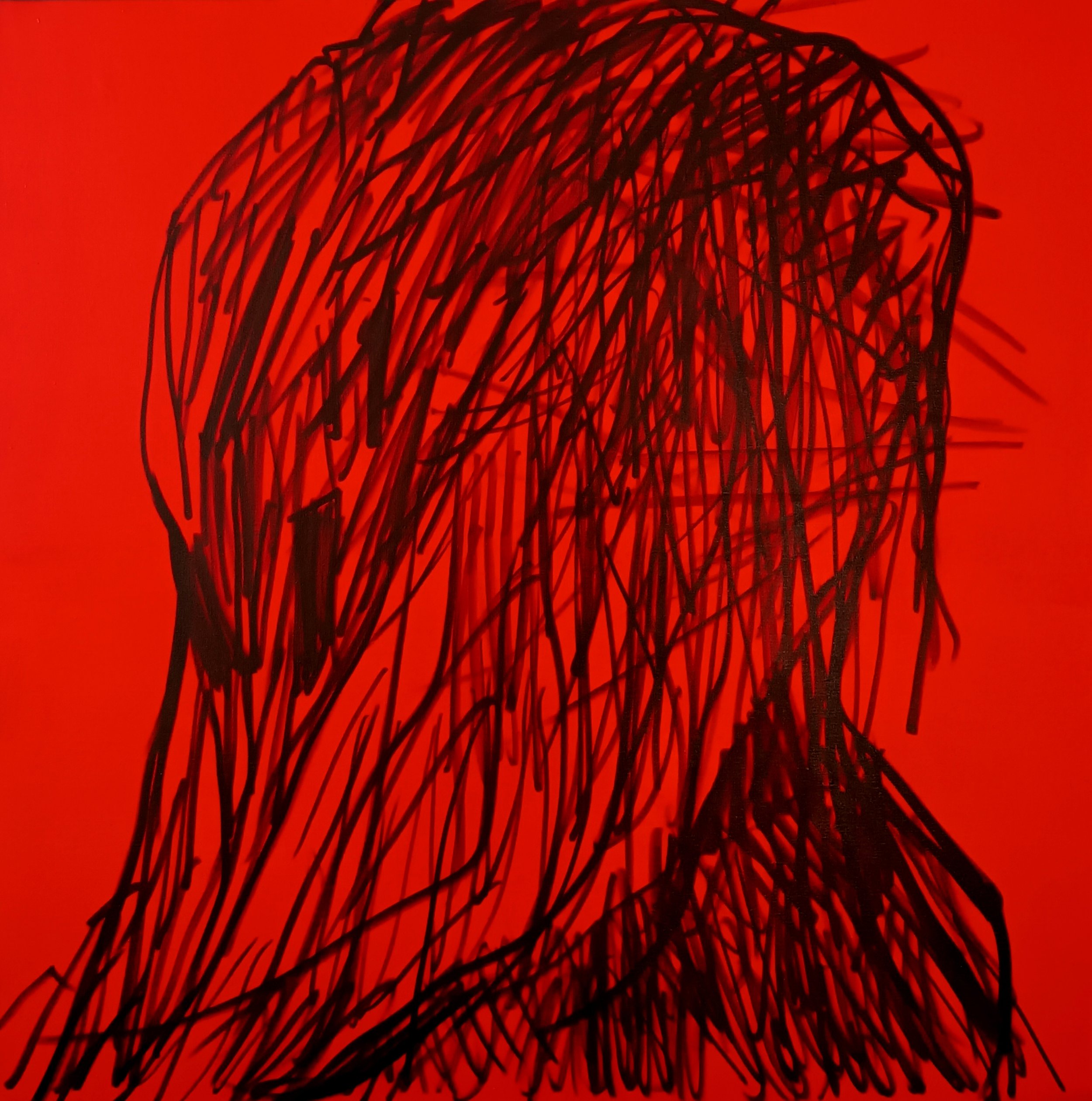
''In silence'',2025.Acrylic on canvas,100x100cm.
"Night Sky", 2023. Oil and acrylic on canvas, 100x100 cm
"Pyramid", 2025. Oil and acrylic on plywood, 80x50 cm
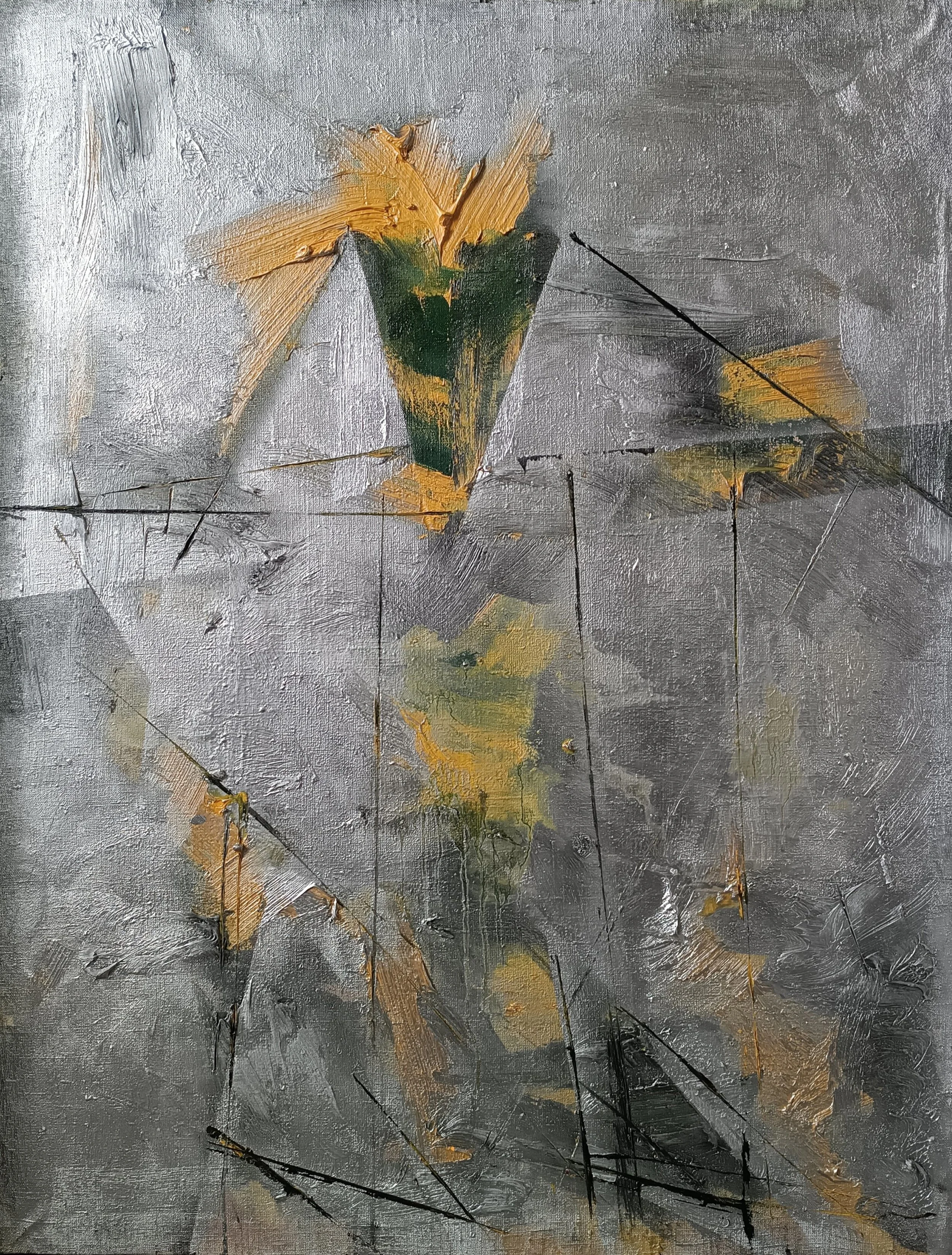
''Small town guy'', 2025.Oil, acrylic on canvas, 100x78cm.
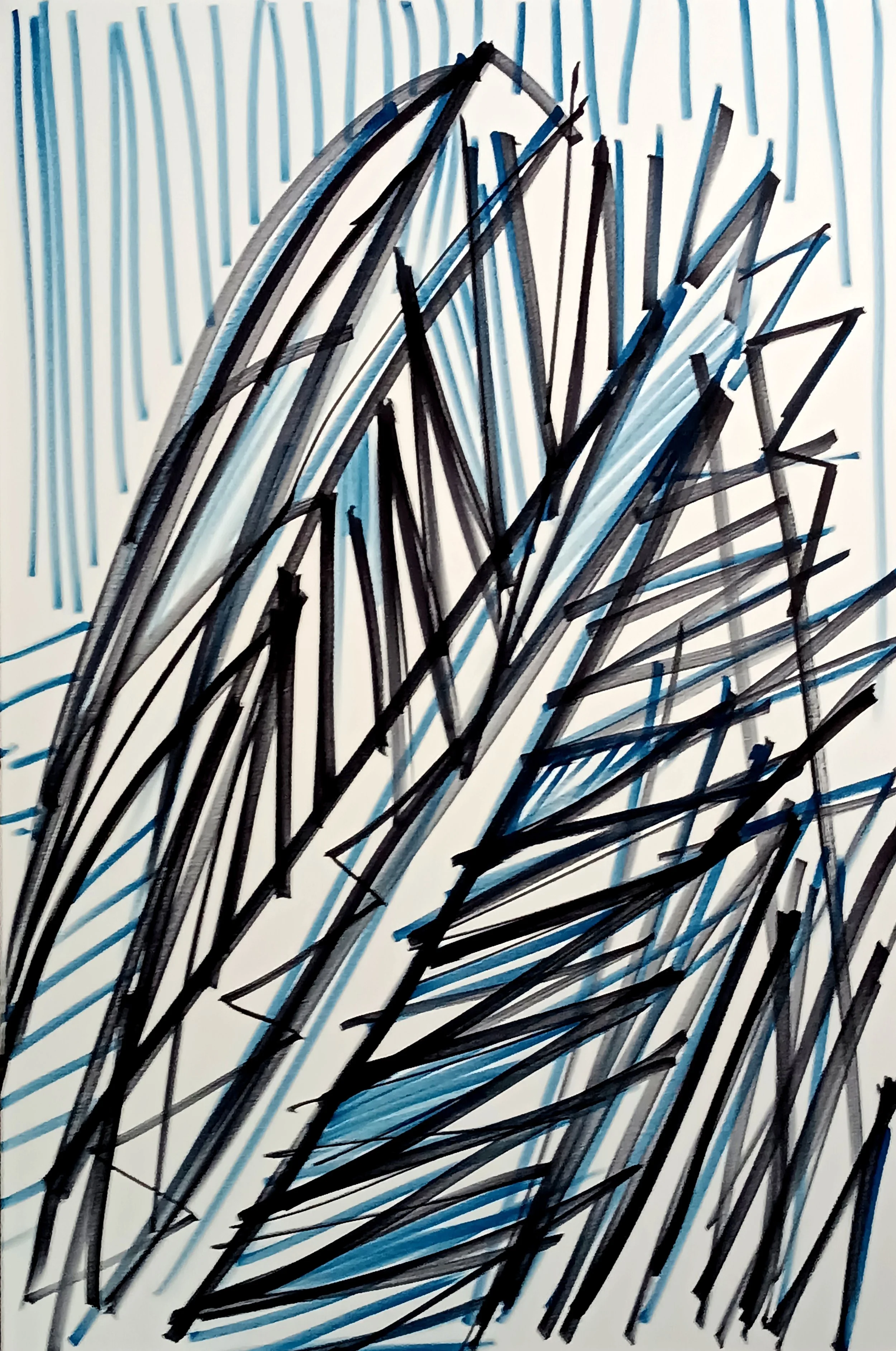
"Visitor'', 2025. Acrylic on canvas,120x80cm.