
Margaretha Gubernale
www.gubernale.com
www.margarethagubernale.org
There exists within the long arc of art history a persistent desire to reconcile two worlds: the tangible and the intangible, the visible and the metaphysical. From medieval icon painters to modern symbolists, artists have repeatedly attempted to create images capable of functioning as bridges between the earthly and the spiritual. Within this lineage, the Swiss artist Margaretha Gubernale occupies a distinctive position. Her paintings unfold not merely as images but as visual parables, quiet, contemplative narratives that attempt to bind human consciousness to the wider cosmic order.
Some artists seek novelty through rupture, and there are others who work toward continuity, toward a deeper unfolding of traditions that stretch across centuries. Margaretha Gubernale belongs decisively to the latter category. Her work does not attempt to abandon the long history of figurative painting but instead returns to it with philosophical seriousness, attempting to rediscover its capacity to carry thought, ethics, and metaphysical reflection. The result is a body of work that is both meditative and quietly ambitious: paintings that unfold as symbolic narratives where nature, humanity, and the cosmos are intertwined within a single pictorial language.
For more than four decades, Gubernale has pursued a singular artistic inquiry. Born in 1941 in Zug, Switzerland, she developed an artistic language rooted in symbolism yet open to modern anxieties and contemporary themes. Her work does not retreat into nostalgia or decorative spirituality; rather, it seeks a philosophical clarity within a world increasingly defined by technological acceleration, ecological tension, and existential fragmentation.
Throughout her extensive international career, exhibiting from New York to Paris, Beijing to Zurich, Gubernale has constructed a body of work that is both introspective and universal. Her paintings draw from nature, philosophy, mythology, and contemporary life, weaving them into symbolic compositions in which human figures become protagonists of ethical reflection.
At the center of her visual language lies one persistent element: blue. The chromatic atmosphere of her paintings is almost always permeated by variations of luminous blue, sometimes serene and celestial, sometimes deep and nocturnal. In Gubernale’s philosophical vocabulary, blue is not merely a color but a conceptual field. It represents air, intellect, spiritual expansion, and the infinite horizon of thought. The viewer does not simply observe blue in her paintings; one enters into it, as if stepping into an intellectual sky.
Her works thus exist in a delicate balance between narrative clarity and metaphysical speculation. Figures wander through forests, contemplate cosmic diagrams, or sit quietly beside water. Yet these scenes are never purely anecdotal. Each element, trees, animals, flames, satellites, books, or rivers, acts as a symbol within a wider philosophical structure.
In this sense, Gubernale’s art participates in a long symbolic tradition. One might draw parallels with the spiritual intensity of William Blake, the English visionary painter and poet of the late eighteenth century. Like Blake, Gubernale constructs pictorial universes where allegory and philosophy merge. Both artists seek to visualize the invisible architecture of thought, transforming metaphysical speculation into tangible imagery. Yet where Blake’s visions often erupt in apocalyptic intensity, Gubernale’s imagery unfolds with quiet clarity, offering contemplative spaces rather than prophetic storms.
Her work, therefore, occupies a rare position within contemporary art. In an era dominated by conceptual abstraction or digital experimentation, Gubernale insists on the enduring power of figurative symbolism. She demonstrates that painting, one of the oldest artistic media, still possesses the capacity to engage with the most pressing philosophical questions of our time.
Gubernale has described her artistic method as a synthesis of figurative representation and metaphysical symbolism. She sought a way to communicate ideas without limiting the viewer’s imagination. Pure abstraction, she felt, risked dissolving meaning entirely; strict realism, on the other hand, could imprison thought within literal depiction.
Her solution was symbolism, yet not symbolism in the narrow historical sense, but a living symbolic language capable of absorbing elements from surrealism, abstraction, and narrative painting. Through this approach, she constructs what she calls parareality: a visual realm where physical reality and metaphysical speculation coexist.
This concept becomes visible across her oeuvre. Trees are not merely botanical forms; they become pillars connecting earth and sky. Water is not simply a landscape element but a metaphor for emotion and life’s fluidity. Fire represents will and transformation. Air symbolizes intellect and thought. These four elements, earth, water, air, and fire, form the structural basis of her symbolic universe.
Yet Gubernale does not treat symbolism dogmatically. Instead, she employs it with narrative flexibility, allowing each painting to develop its own philosophical argument. Her compositions therefore function as visual essays, where the viewer gradually discovers layers of meaning through observation.
One of the most intimate works in Gubernale’s recent production is Priska’s Extended Arm 2022. The painting depicts a woman stepping lightly across a forest clearing beside a reflective pool of water. Her gesture, an arm reaching outward, creates the central axis of the composition.
At first glance, the scene appears serene, almost idyllic. Trees stretch vertically across the canvas, their slender trunks dissolving into a soft atmospheric haze. The forest is bathed in delicate tonal transitions of blue, green, and pale gold. Yet within this calm environment, subtle symbolic elements emerge.
The extended arm itself becomes a metaphor for human aspiration. It suggests an attempt to reach beyond immediate reality toward something unseen. The gesture evokes curiosity, discovery, perhaps even spiritual longing. Nearby, delicate birds flutter between branches, functioning as traditional symbols of transcendence.
Water occupies the lower part of the painting, reflecting both the surrounding trees and the woman’s movement. In Gubernale’s symbolic vocabulary, water represents emotional depth and the unconscious. The act of stepping across the pool, therefore, becomes a passage between inner reflection and outward action.
The painting ultimately explores a simple but profound philosophical question: how does the individual relate to nature’s silent intelligence? In Priska’s gesture, the viewer recognizes the human impulse to communicate with the world around us, a gesture both humble and hopeful.
In The Spiral of Backward- and Forwardspeed 2016, Gubernale turns her attention toward the cosmos. The painting depicts a woman seated upon a rocklike formation beneath a vast celestial sky filled with stars. Around her, luminous spirals of light trace invisible trajectories through space.
The figure raises her hands upward as if receiving something from the heavens. The gesture echoes ancient iconographic traditions where human beings become intermediaries between earthly existence and cosmic forces.
The spiral motif carries multiple symbolic meanings. Historically, the spiral represents both expansion and return, a form without beginning or end. Here it suggests the cyclical movement of time itself: humanity constantly moving forward while simultaneously circling back toward its origins.
The painting therefore operates as a meditation on temporal consciousness. In an age defined by rapid technological progress, Gubernale invites viewers to reconsider the relationship between progress and reflection. Advancement without wisdom risks becoming merely acceleration.
Yet the work remains hopeful. The luminous halo surrounding the figure suggests that knowledge, both intellectual and spiritual, remains accessible. The cosmos is not depicted as distant but as intimately connected to human awareness.
In Declaration Day of Angular Moon 2025, Gubernale introduces a more overtly allegorical narrative. A female figure stands precariously atop geometric structures, painting upon a luminous celestial sphere. Around her float planets and astronomical symbols, while a small industrial machine appears inside the moon itself.
The juxtaposition of artistic creation and mechanical technology forms the conceptual heart of the painting. The woman appears simultaneously as painter, explorer, and philosopher. Her act of painting the moon becomes a metaphor for humanity’s attempt to reshape reality through knowledge.
Yet the small machine within the lunar sphere hints at another dimension: technological intervention in nature. The painting does not condemn technology outright, but it asks whether humanity fully understands the consequences of its inventions.
The angular structures beneath the figure emphasize instability. Progress is precarious; the path toward knowledge is never entirely secure. Nevertheless, the figure continues her work with determination.
Here Gubernale articulates one of the central themes of her oeuvre: the ethical responsibility of human creativity.
Few works in Gubernale’s oeuvre demonstrate her ecological concerns as clearly as Maintain the Forest 2025. The painting depicts a quiet nocturnal forest scene illuminated by moonlight. At the center stands a sculptural structure resembling a water fountain integrated into a treelike form.
Three human figures gather around the fountain performing ritualistic actions involving water. The surrounding forest appears almost sacred, its tall trunks forming a natural cathedral.
Water again becomes a central symbol, this time representing the fragile balance of ecological systems. The figures appear engaged in acts of preservation rather than exploitation. Their gestures are humble, almost reverential.
At a time when environmental degradation threatens ecosystems worldwide, Gubernale’s painting offers a symbolic vision of stewardship. The forest is not portrayed as a resource to be consumed but as a living entity requiring care.
Rather than delivering an overt political message, the painting cultivates ethical awareness through contemplation.
The painting Now 2023 expands Gubernale’s ecological vision into a broader meditation on the present moment. Two women kneel beside a river illuminated by moonlight, placing small floating lights upon the water’s surface.
The surrounding forest glows with soft chromatic transitions, creating a dreamlike atmosphere. Yet subtle contemporary elements appear within the landscape, such as a technological device partially submerged in water.
These details remind viewers that modern technology is inseparable from natural environments. The ritual of placing lights on the river evokes ancient traditions of reflection and remembrance. The act transforms the present moment into a site of awareness.
In a world constantly oriented toward future progress or nostalgic pasts, Gubernale’s painting invites us to inhabit the ethical urgency of the present.
Priska ponders over the Meaning of Life, 2022,in this contemplative work, a solitary woman sits upon rocks beside a flowing stream under the pale light of the moon. Her posture, head resting gently upon her hand, signals deep reflection.
The composition emphasizes stillness. Trees stand quietly in the background, while water flows gently through the foreground. The painting evokes the ancient philosophical tradition of contemplation in nature.
Here Gubernale returns to a theme central to her artistic philosophy: the relationship between human consciousness and the natural world. The forest becomes a site where philosophical inquiry unfolds without distraction.
The painting does not offer answers. Instead, it dignifies the act of questioning itself.
Among Gubernale’s most socially critical works is The Dance of Subscription 2024. The composition depicts a central female figure surrounded by men offering various subscription contracts, papers labeled with terms such as “trial subscription” and “annual subscription.”
The scene unfolds almost like a theatrical performance. The surrounding figures appear engaged in a strange ritual of persuasion, while the central figure raises her hands defensively.
The painting comments on the contemporary economy of digital platforms and subscription based services. Human attention has become a commodity. The central figure represents the individual attempting to maintain autonomy within a system designed to capture and monetize engagement.
Despite its satirical tone, the painting retains Gubernale’s characteristic restraint. Rather than condemning modern society outright, it invites viewers to reflect upon their own participation in these systems.
Inspired by Goethe’s famous literary work, The Sorcerer’s Apprentice 2024 explores the dangers of uncontrolled power. In the painting, a woman rides atop a massive animal-like form while flames erupt nearby and a piano glows with mysterious symbols.
The imagery is layered with references: magic, technology, music, and human ambition. The figure appears both exhilarated and overwhelmed by the forces she has unleashed.
Gubernale’s interpretation emphasizes the timeless relevance of Goethe’s narrative. Humanity possesses extraordinary creative abilities, yet these abilities require ethical wisdom.
Without humility, knowledge becomes dangerous.
The Widening 2021 presents a tranquil forest scene in which a woman dressed in white appears to interact with strands of DNA like forms suspended among the trees.
The imagery suggests scientific discovery integrated with spiritual awareness. Rather than portraying science as antagonistic to nature, Gubernale presents it as another pathway toward understanding the universe.
The title itself, “The Widening,” suggests intellectual expansion. Knowledge enlarges human perception, allowing individuals to perceive deeper connections between life, nature, and cosmic order.
In Three Graces on the Lake Zug 2023, Gubernale revisits classical mythology within a contemporary context. Three women sit beside water holding mobile phones, each absorbed in her own digital interaction.
The painting subtly reinterprets the ancient motif of the Three Graces, traditionally representing beauty, creativity, and harmony. Here these virtues appear entangled with modern technology.
The serene landscape contrasts with the introspective posture of the figures. The work asks whether contemporary digital culture enhances or diminishes human connection.
Once again, Gubernale avoids moralistic conclusions. Instead, she creates a space where viewers may consider the complexities of technological life.
Across these paintings, Gubernale demonstrates a rare ability to address contemporary issues through symbolic language. Her work engages with themes such as ecological responsibility, technological change, and philosophical inquiry without abandoning the poetic capacity of painting.
In this sense, her art represents an important counterpoint within the contemporary art landscape. Much of today’s art world is driven by conceptual provocation or market spectacle. Gubernale’s paintings instead cultivate contemplation.
They ask viewers to slow down, to observe carefully, to consider the ethical dimensions of human existence.
Nature occupies a central place in Gubernale’s visual universe. Forests, rivers, and celestial skies appear repeatedly across her canvases. Yet these landscapes are not passive backgrounds. They function as philosophical environments where human actions acquire symbolic significance.
Her love of forests, particularly those surrounding her home in Zug, transforms natural space into a sanctuary of reflection. The forest becomes both a physical and spiritual habitat.
In this sense, her work resonates with ecological thought emerging in contemporary philosophy. Humanity is not separate from nature but embedded within its complex networks.
Within the broader trajectory of contemporary art, Gubernale occupies a distinctive position. Her work does not conform neatly to dominant trends such as conceptual minimalism or digital media experimentation. Instead, she maintains a commitment to figurative symbolic painting, a tradition that remains deeply relevant despite shifting aesthetic fashions.
Her career demonstrates that painting still possesses the capacity to engage with philosophical thought. Indeed, her works remind us that visual art can function as a form of philosophical inquiry.
By merging symbolism with contemporary concerns, Gubernale contributes to a renewed understanding of painting’s intellectual possibilities.
Margaretha Gubernale’s paintings invite viewers into a realm where the visible and invisible converge. Through symbolic narratives and luminous color, she constructs a visual language capable of addressing the deepest questions of human existence.
Her art does not shout; it speaks quietly yet persistently. Within forests bathed in blue light, beneath celestial spirals, beside reflective waters, human figures contemplate their place within the universe.
In an era often characterized by fragmentation and distraction, Gubernale’s work reminds us of something essential: that art remains one of humanity’s most powerful tools for reflection, connection, and ethical imagination.
Her paintings stand not only as aesthetic achievements but as philosophical invitations, open doors through which viewers may rediscover the profound dialogue between earth and sky, matter and spirit, human consciousness and the infinite cosmos.
By Marta Puig
Editor Contemporary Art Curator Magazine
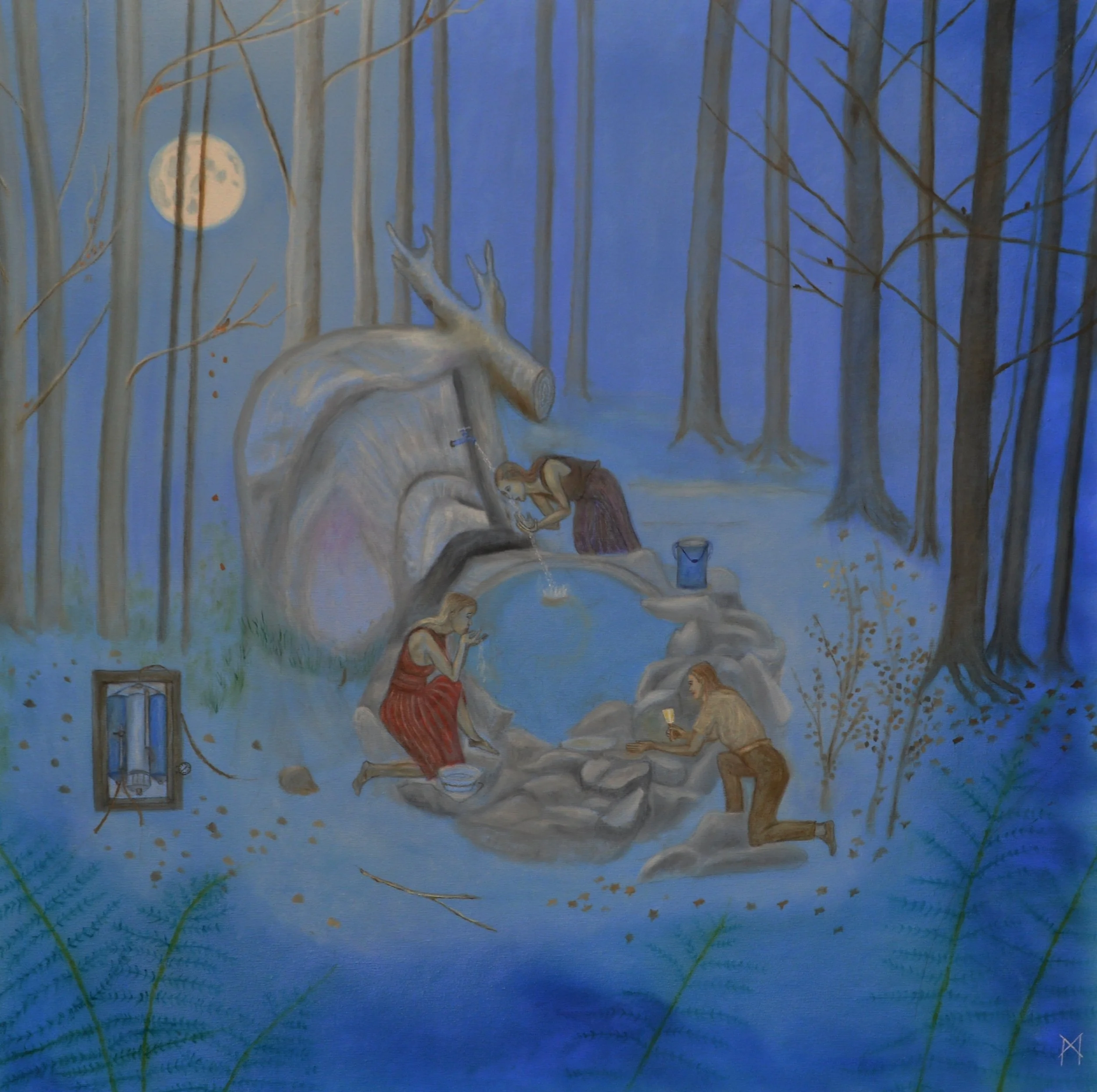
Maintain the Forest, 2025, Oil on Canvas, 100 cm x 100 cm
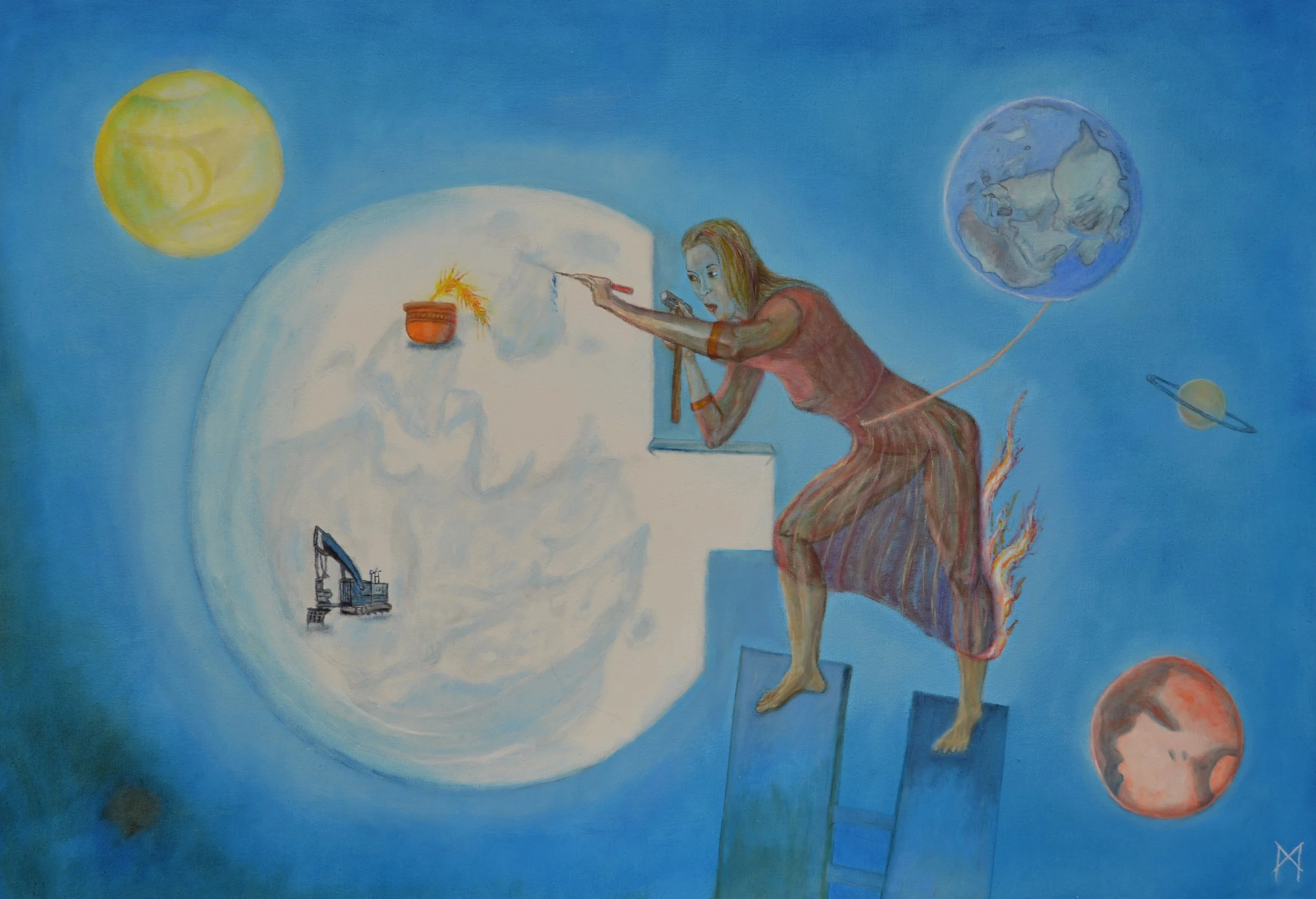
Declaration Day of Angular Moon, 2025, Oil on Canvas, 70 cm x 100 cm
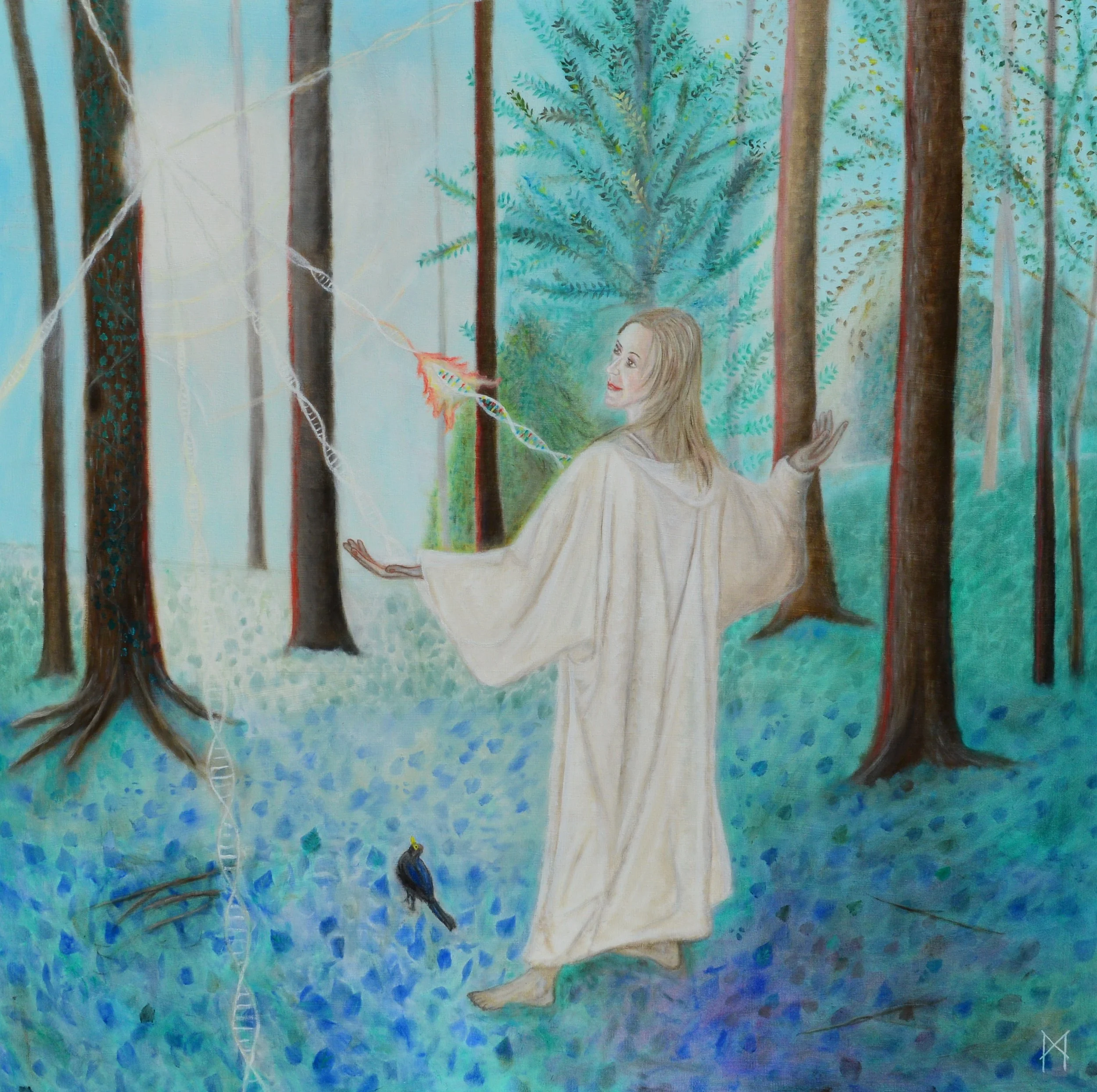
The Widening, 2021, Oil on Canvas, 100 cm x 100 cm
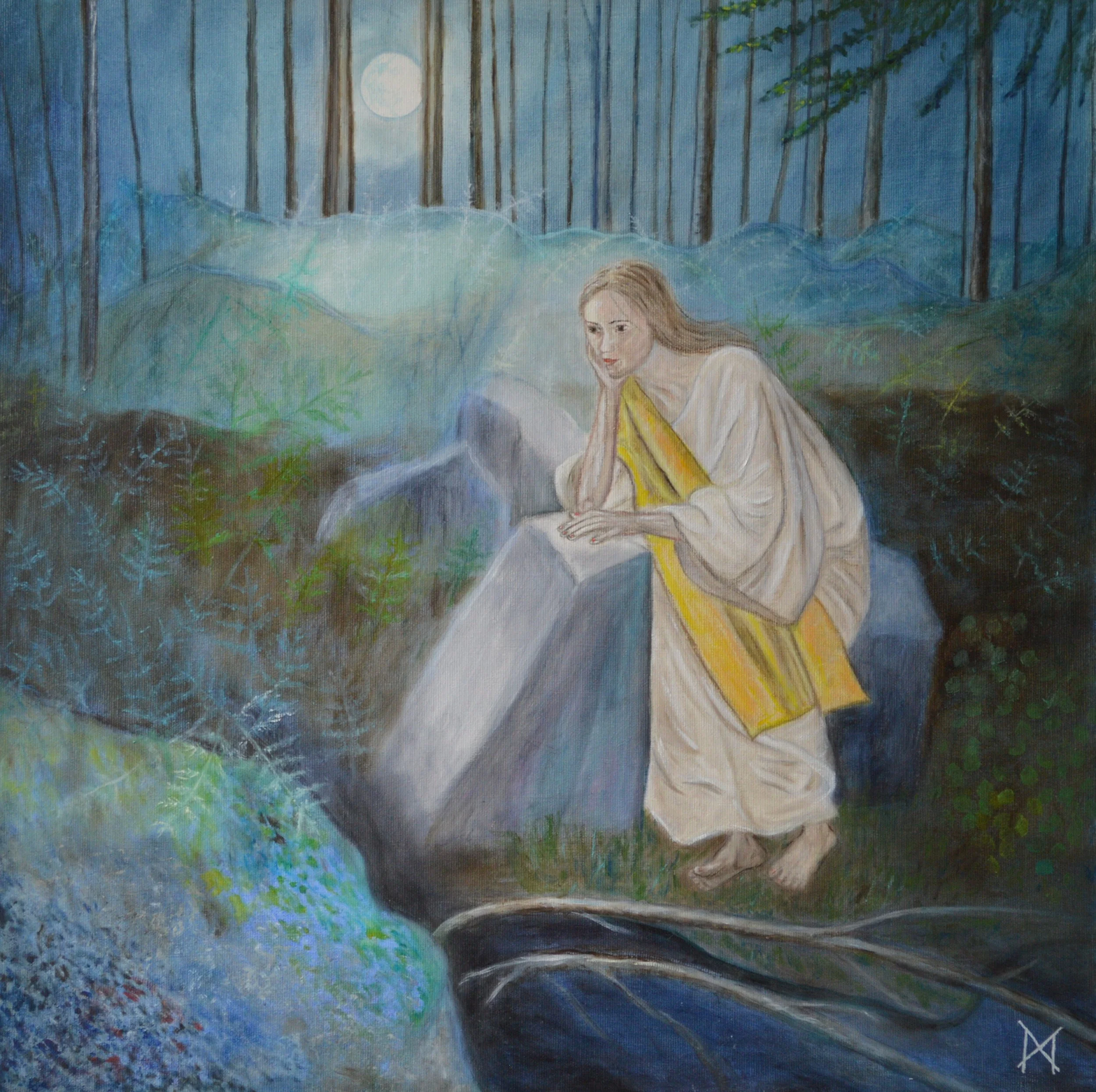
Priska ponders over the Meaning of Life, 2022, Oil on Canvas. 60 cm x 60 cm
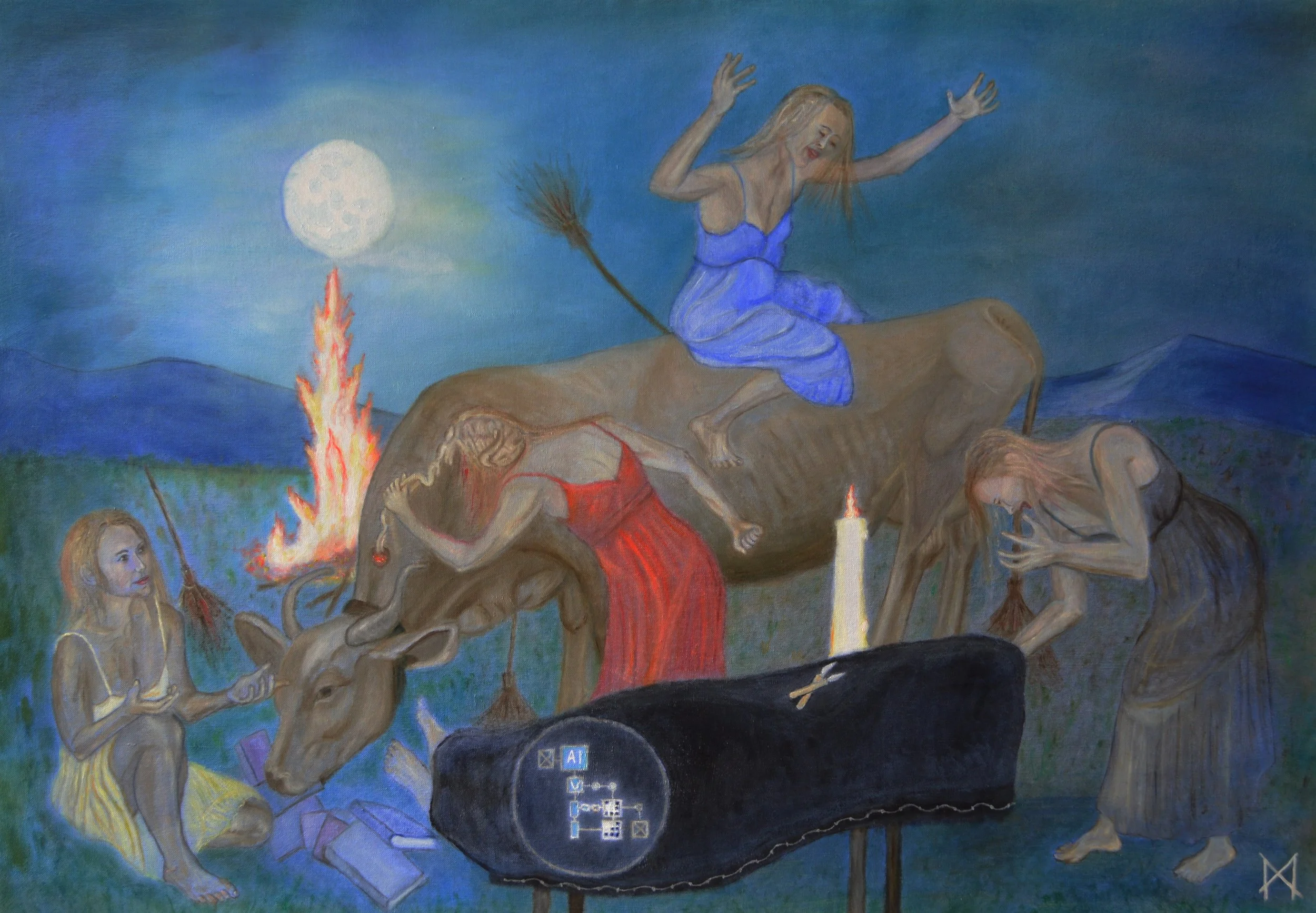
The Sorcerer's Apprentice (with Goethe), 2024, Oil on Canvas, 70 cm x 100 cm
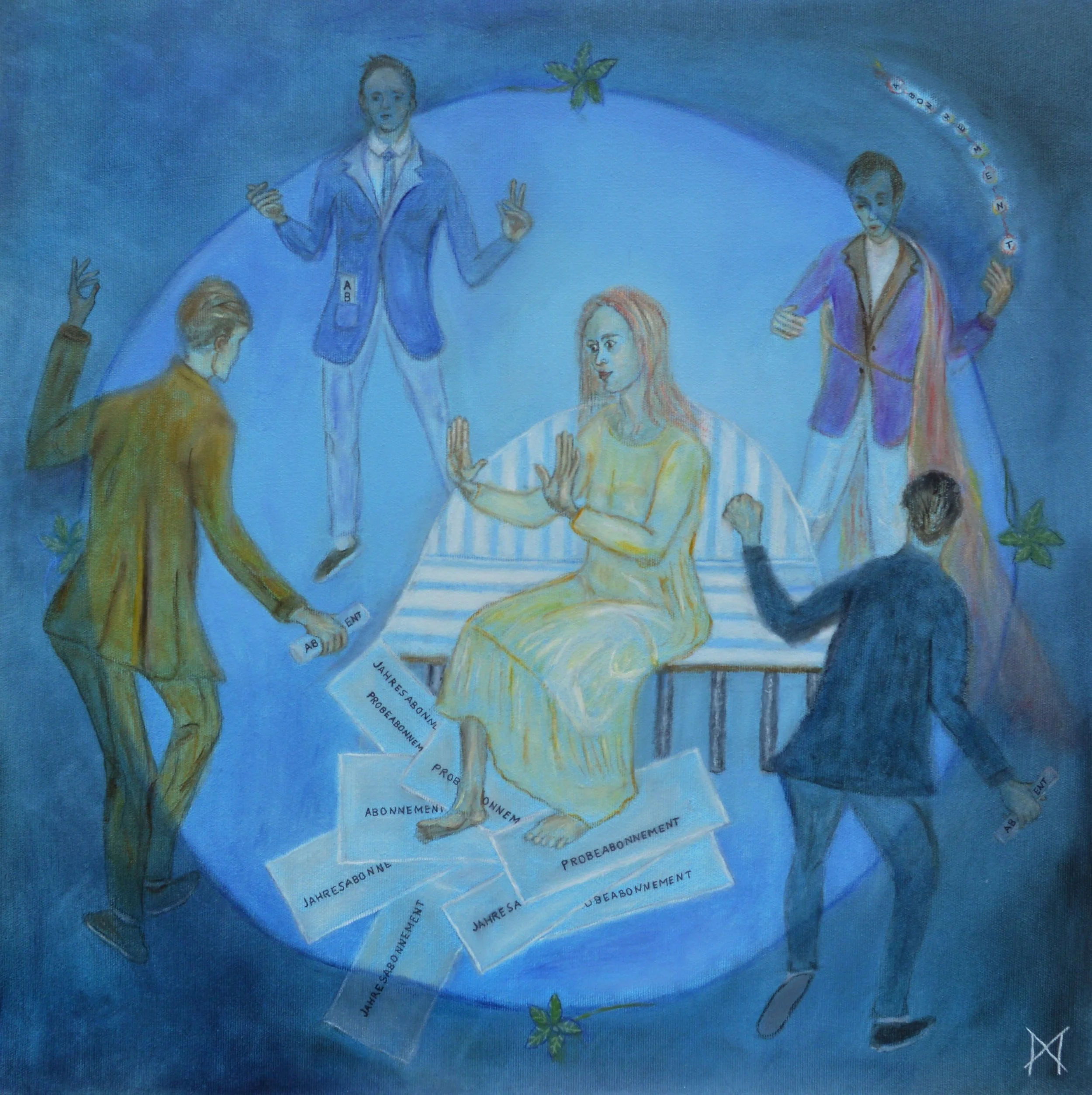
The Dance of Subscription, 2024, Oil on Canvas, 60 cm x 60 cm
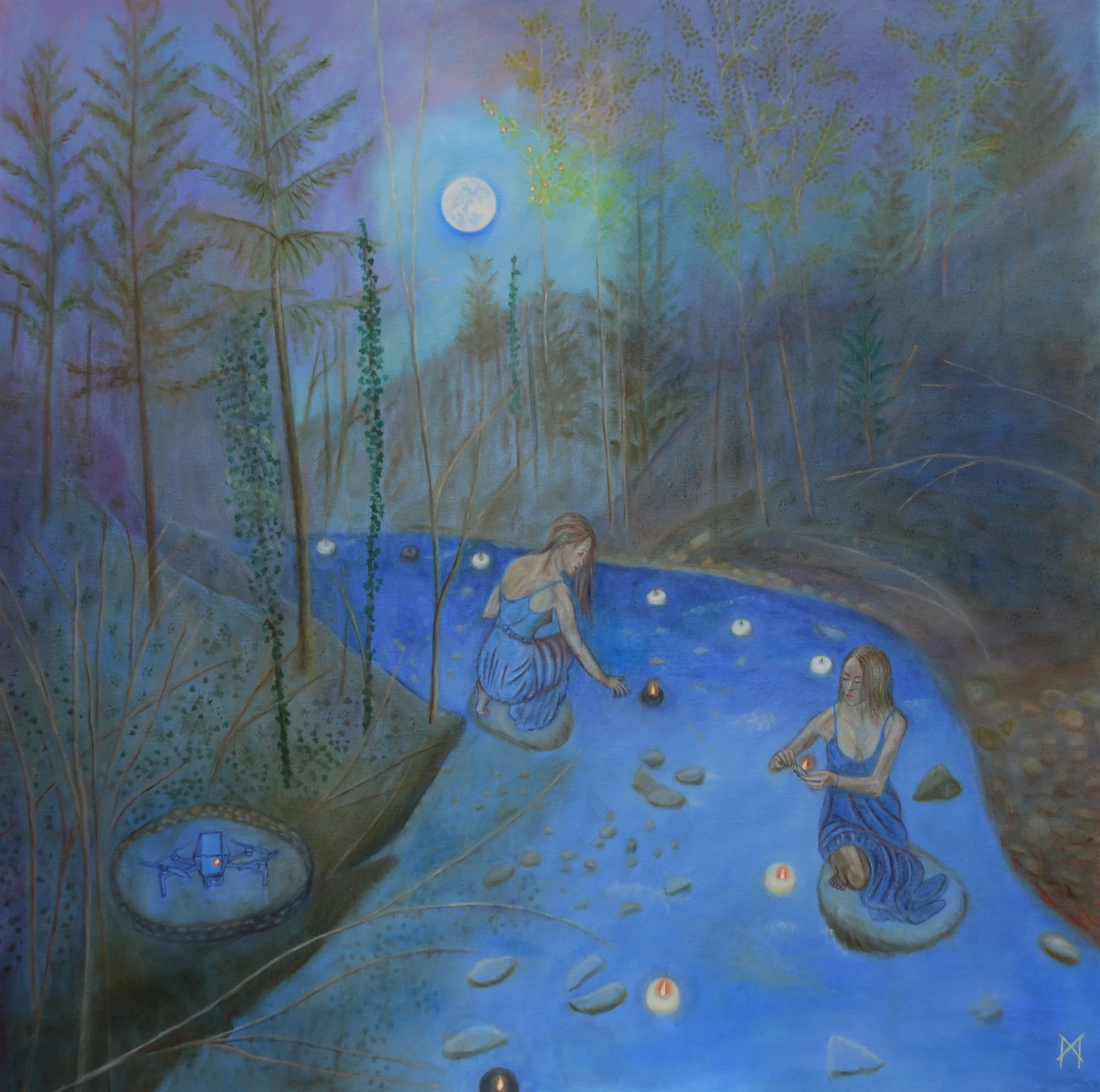
Now, 2023, Oil on Canvas, 100 cm x 100 cm
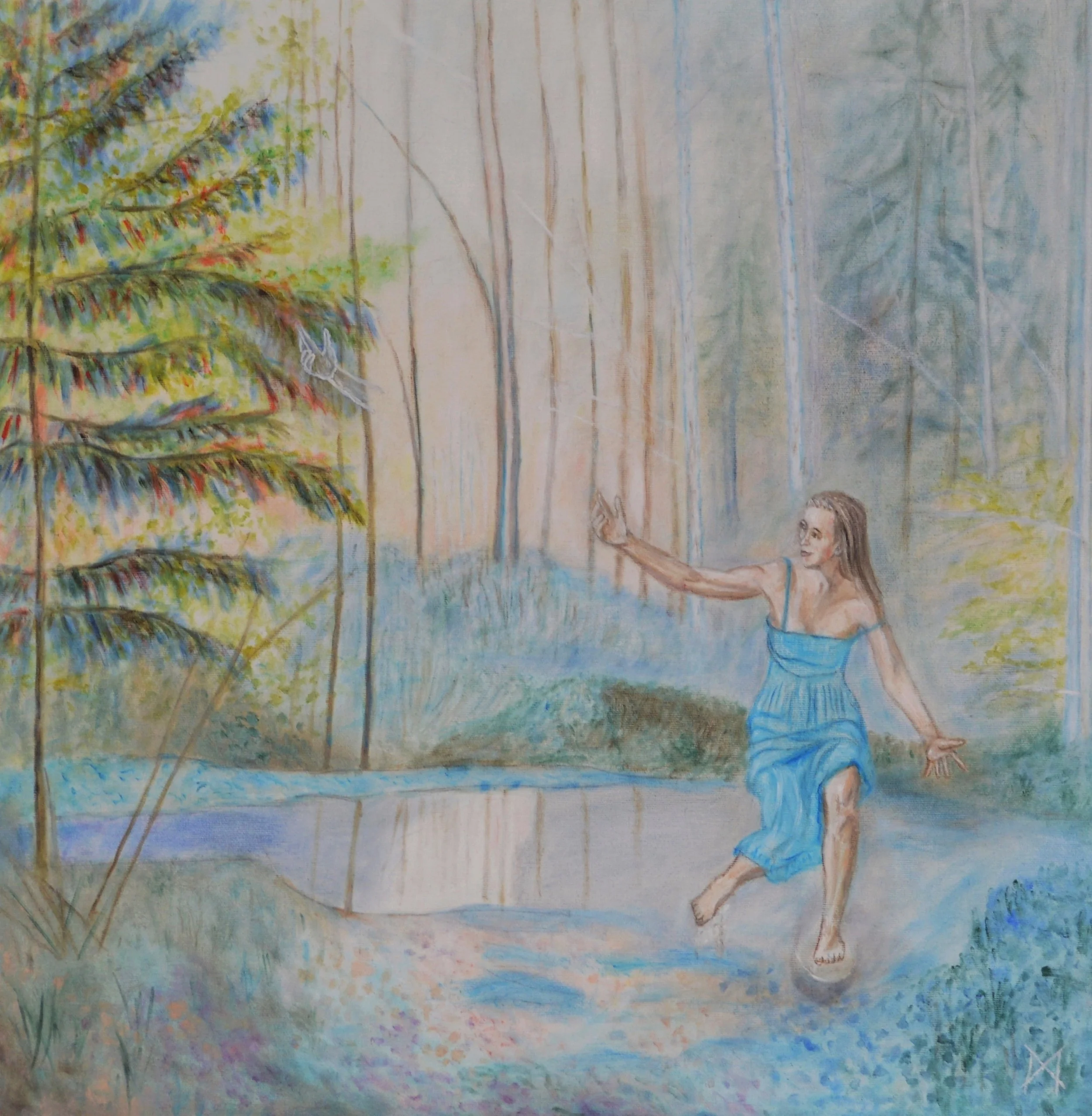
Priskas extended Arm, 2022, Oil on Canvas, 60 cm x 60 cm
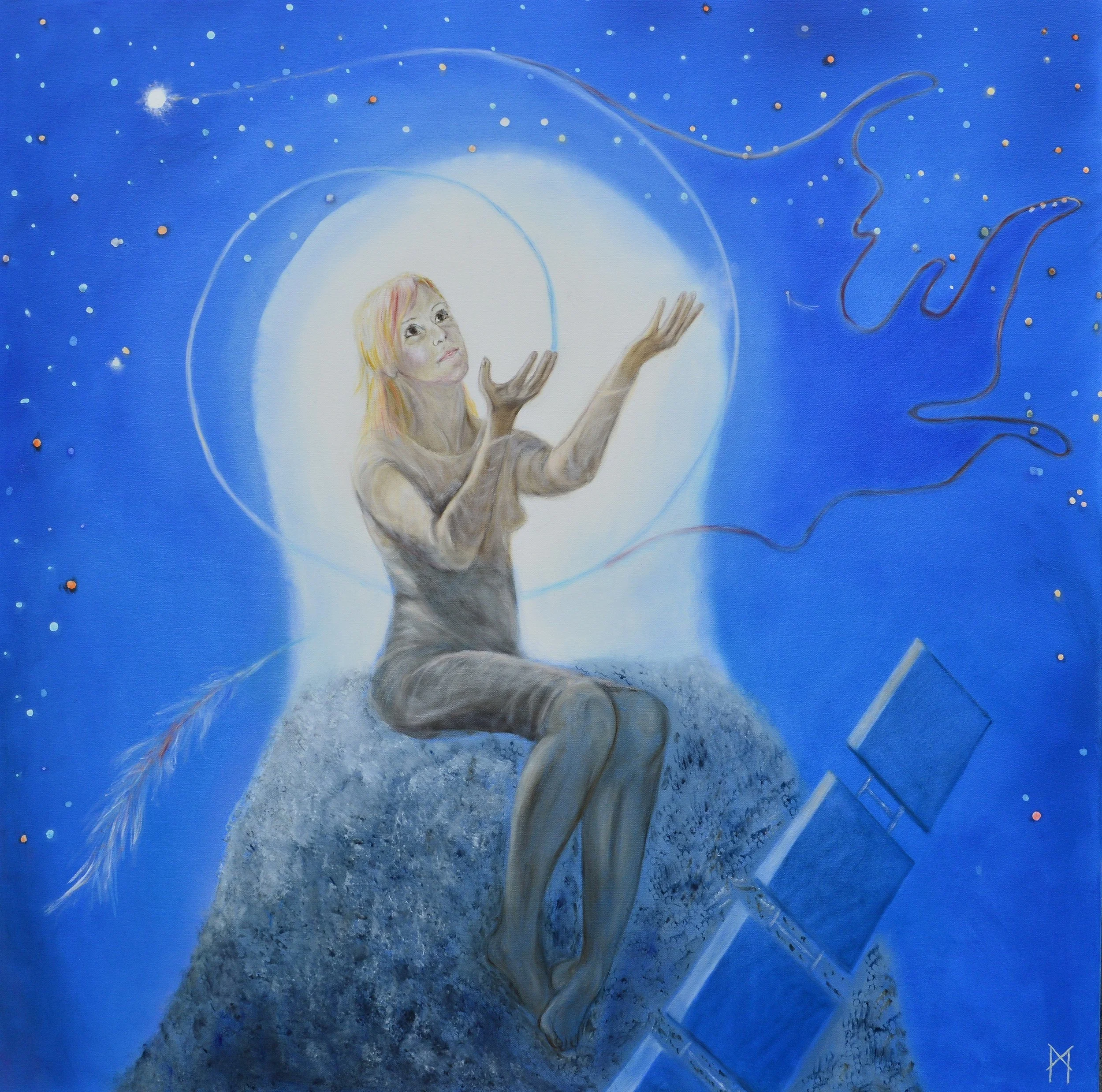
The Spiral of Backward- and Forwardspeed, 2016, Oil on Canvas, 100 cm x 100 cm
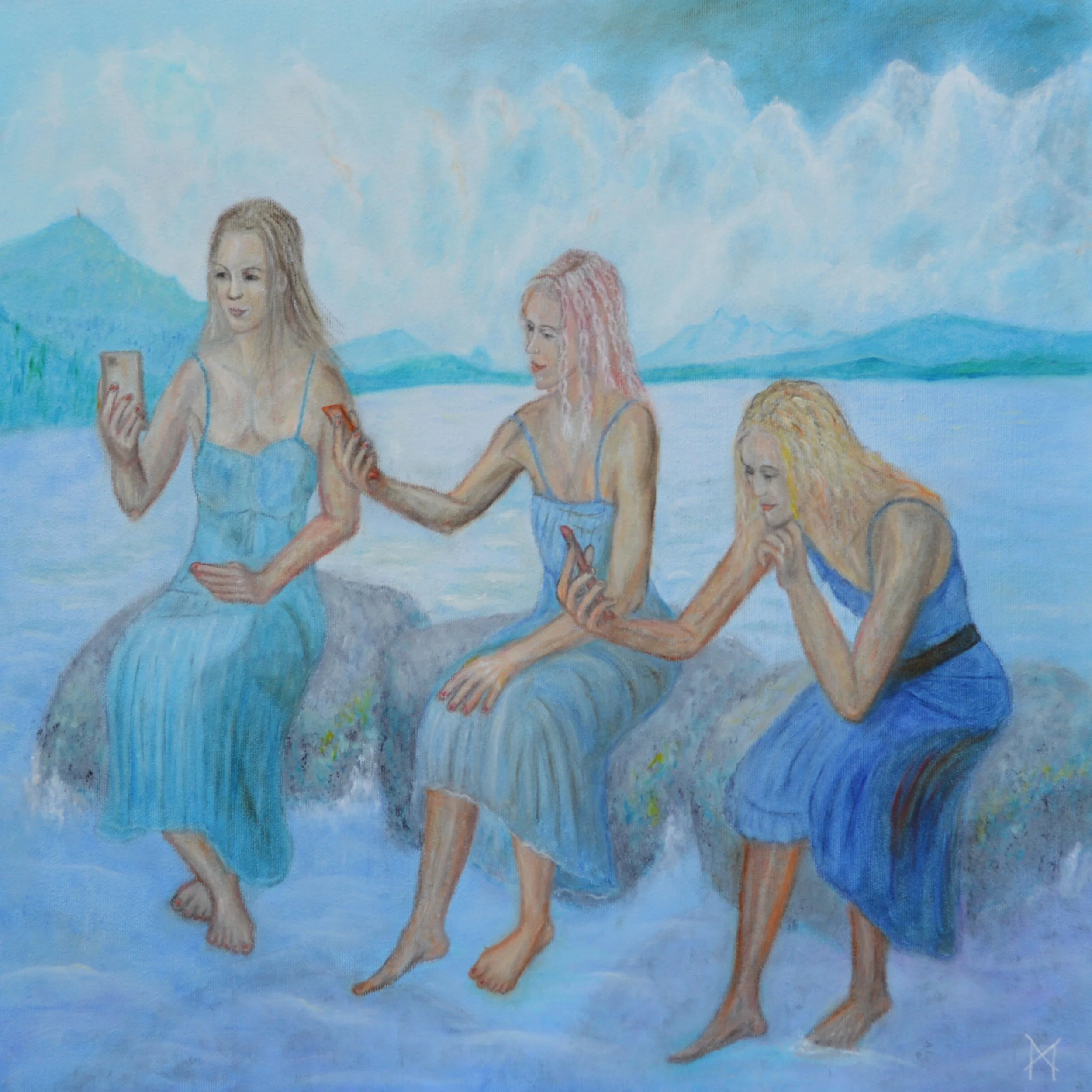
Three Graces on the Lake Zug, 2023, Oil on Canvas, 60 cm x 60 cm