David Poyant
For centuries, embroidery has inhabited a complex and frequently misunderstood position within art history, admired for its refinement yet persistently excluded from the dominant narrative of the fine arts. It has been revered as a vehicle of devotion, patience, and ornament, yet historically relegated to the margins of what institutions have traditionally recognized as “fine art.” Within contemporary practice, however, artists increasingly reclaim the expressive and conceptual power of fiber-based media. Among those voices, the work of David Poyant emerges with particular resonance. A self-taught embroidery artist from Acushnet, Massachusetts, Poyant transforms the humble language of thread into complex visual narratives that bridge craft and contemporary art.
Working entirely by hand, stitch by stitch, Poyant constructs images that operate simultaneously as paintings, meditations, and acts of remembrance. His embroidered surfaces function less like decorative textiles and more like fields of accumulated time. Each mark carries the evidence of labor. Each thread embodies the quiet persistence of attention. The resulting works unfold as landscapes of memory in which the tactile and the visual converge.
Remarkably, Poyant began this artistic journey only after retiring at the age of sixty-six. Such a beginning would already carry symbolic weight within contemporary art discourse, challenging the assumption that artistic careers must emerge early in life. Yet in Poyant’s case the late start becomes part of the conceptual fabric of the work itself. His practice is not simply a technical exploration of embroidery. It is also a reflection on time, aging, patience, and rediscovery.
The origins of this practice lie in something deeply personal. Poyant has often described how his work began as a tribute to his mother’s love of sewing. That gesture of remembrance gradually expanded into a larger creative language. The needle and thread became tools not merely for honoring familial memory but for exploring the broader terrain of human experience. From quiet landscapes and moments of childhood reflection to complex symbolic compositions referencing global cultures, his embroidered works invite viewers to slow down and contemplate the world through the rhythm of the handmade.
In a cultural moment dominated by rapid digital production, the insistence on manual craft becomes a philosophical position. Poyant’s work quietly resists the accelerated temporality of contemporary life. Each piece demands hours, often weeks or months, of careful labor. The viewer encountering the finished image senses this accumulation of time even without knowing the process behind it. The dense networks of stitches form a visual texture that feels alive with movement and energy.
Yet Poyant’s practice also reflects an intriguing dialogue between tradition and innovation. While the final works remain entirely handmade, he occasionally uses artificial intelligence as a conceptual tool to visualize initial compositions. In doing so he participates in a broader contemporary conversation about the relationship between human creativity and technological assistance. However, unlike purely digital artists, Poyant returns those conceptual sketches to the physical world through the tactile discipline of embroidery. The AI-generated image becomes merely a starting point. The final artwork emerges through human labor, interpretation, and intuition.
This hybrid methodology places his work at an interesting intersection within contemporary art. It acknowledges the presence of technological tools while affirming the irreplaceable value of the human hand. In Poyant’s practice, technology may inspire the image, but the meaning ultimately resides in the act of stitching.
The art world has taken notice. In only a few years his work has gained considerable recognition. Among the many distinctions he has received are the Massachusetts Cultural Council Grant, the Exhibizone Grand Prize for “A Celebration of Art Without Limits,” and international awards such as the International Prize Côte d’Azur in Nice, France, and the Protagonist of Contemporary Art Award in Saint Paul de Vence. His exhibitions have spanned institutions and venues including the New Bedford Art Museum, Gallery X, The Narrows Center, and international platforms such as the Venice International Art Fair. Publications ranging from Artsy Shark to the Boston Globe and Art Matters have featured his work, while digital presentations have projected his imagery onto public screens including Times Square.
Such recognition might suggest rapid success, yet the deeper significance of Poyant’s work lies not in accolades but in the quiet philosophical dimension embedded within each embroidered surface.
At a structural level, his compositions reveal an affinity with painters who explored the relationship between perception and mark-making. In this sense one might draw a comparison with the nineteenth century master Vincent van Gogh. Like van Gogh’s brushstrokes, Poyant’s stitches operate as expressive units that build the entire image through directional rhythm. The thread replaces the brush. The stitch becomes a painterly gesture. Light, shadow, and atmosphere emerge from the density and orientation of countless marks.
Yet Poyant’s work does not merely imitate painterly effects. Instead it reinterprets the logic of painting through the language of fiber. Where the painter’s stroke evaporates into the surface, the embroidered stitch retains its physical presence. It rises slightly above the ground of the fabric, casting subtle shadows that change with the angle of light. This tactile quality gives his images a sculptural dimension absent in traditional painting.
The result is a visual experience that oscillates between illusion and materiality. From a distance the works appear almost photographic in their detail. Up close they reveal a dense terrain of thread, color, and texture.
This duality becomes especially powerful in the individual works that form Poyant’s growing series, often referred to under the broader conceptual framework of Threading Stories. Each image functions as a narrative fragment, a moment suspended in embroidered time.
Child of the Sea Breeze, one of the most poetic works in the series depicts a child walking along a tidal shoreline. The figure stands with back turned to the viewer, feet touching shallow water, gazing toward a horizon where sailboats drift beneath expansive clouds. The entire image is composed of short directional stitches that mimic the fluid motion of water and sky.
The scene evokes the quiet introspection of childhood encounters with nature. The child’s posture suggests curiosity and openness, while the reflective water doubles the figure’s presence, reinforcing the theme of self-discovery. Poyant’s use of thread to render reflections in water demonstrates a remarkable sensitivity to the expressive potential of embroidery. The stitches shift direction to follow the ripples, producing a shimmering effect that recalls the broken brushwork of impressionist painters.
Philosophically, the work speaks to the formative relationship between human identity and the natural world. The sea becomes a metaphor for possibility. The child stands at the threshold of experience, facing an open horizon.
Boy in the Tree. In another composition a boy sits quietly upon the branch of a massive tree while two figures walk below along a sunlit path. The tree itself dominates the visual field, its network of branches rendered through interlocking threads of brown and green.
The work invites contemplation of solitude and imagination. Childhood often involves the creation of secret spaces where observation replaces participation. The boy perched above the ground occupies such a vantage point. He becomes both witness and dreamer.
The embroidered texture of the leaves produces an almost vibrational surface, suggesting the rustling of foliage in sunlight. The tree functions not merely as a setting but as a living structure of thought. Within its branches the boy finds a private world removed from the rhythms of adult life.
Here Poyant explores a universal psychological territory: the desire to step aside from the flow of society in order to observe it more clearly.
Fisherman at the Bar, a very different emotional register appears in the work, portraying a solitary fisherman seated at a bar. Warm interior light floods the wooden surfaces of the room while a glass of amber liquid sits before the figure. Through the windows behind him, the last light of sunset glows over distant water.
This piece reveals Poyant’s capacity to render complex atmospheric lighting through thread. The interior glows with hues of amber, copper, and deep brown, while the figure’s contemplative posture suggests quiet reflection after a day’s labor.
The image resonates with the maritime culture of coastal Massachusetts. Fishing communities often embody a rhythm of life defined by patience, risk, and endurance. By presenting the fisherman alone in a moment of stillness, Poyant humanizes this cultural identity.
The embroidered texture of the wood grain and reflections across the polished bar create a visual richness that reinforces the warmth of the scene.
Lady Worker is one of the most compelling works that depicts a woman laboring within what appears to be a workshop environment. She stands in profile, focused on her task ,while other workers appear in the background.
The piece functions almost as a meta-commentary on labor itself. Poyant, working patiently with needle and thread, portrays another individual engaged in repetitive manual work. The parallel is striking. Both forms of labor require concentration, skill, and resilience.
The composition subtly honors the dignity of everyday work. Rather than dramatizing the scene, the artist emphasizes the quiet determination of the central figure. The dense arrangement of stitches within the machinery and tables surrounding her enhances the sense of industrious complexity.
Through embroidery, a traditionally domestic craft, Poyant transforms the depiction of industrial labor into a meditation on human perseverance.
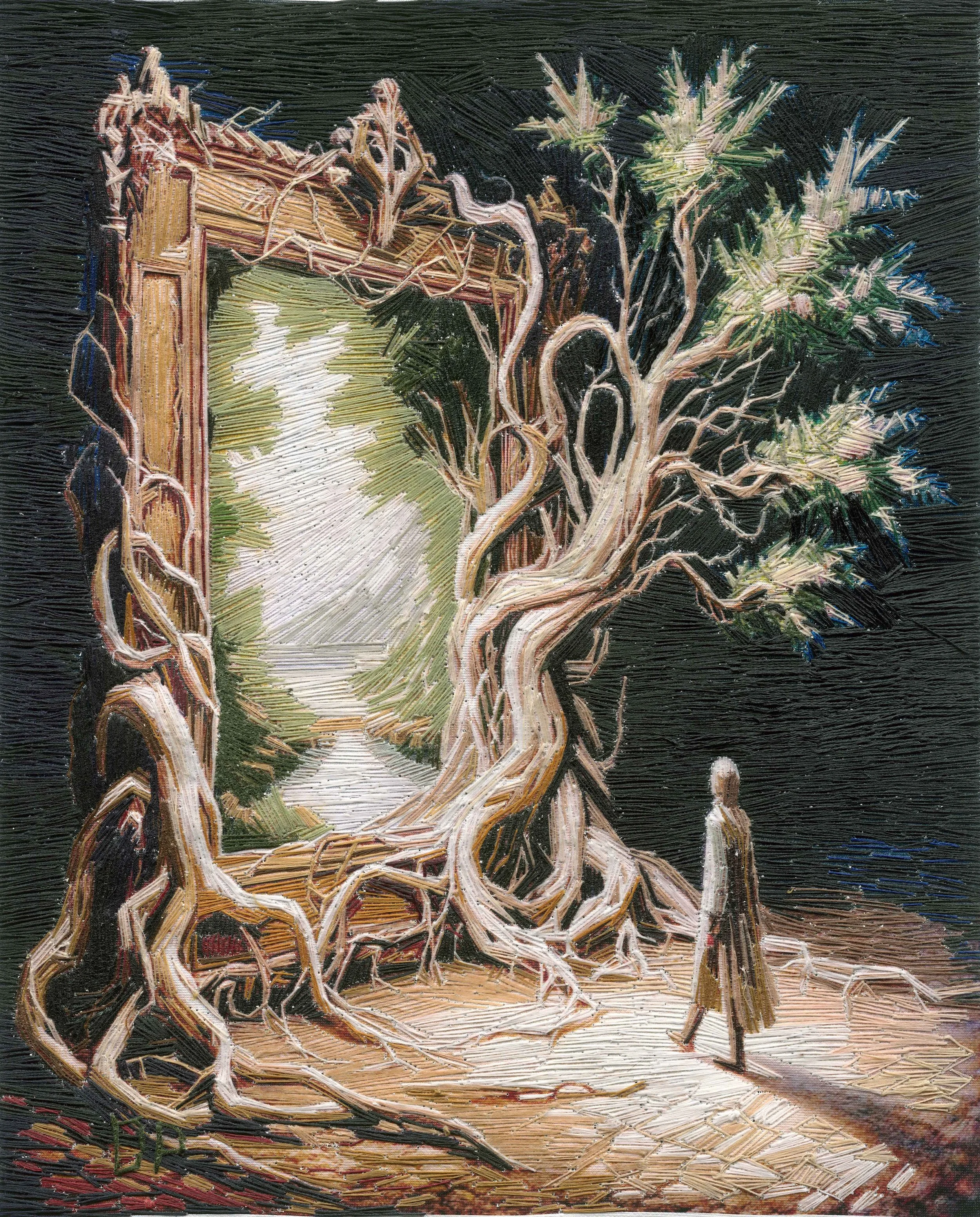
In the Listening Tree, a lone figure approaches an extraordinary tree whose roots and branches intertwine with a wooden frame resembling a doorway or portal. The surrounding darkness isolates the illuminated structure, creating a dreamlike atmosphere.
Here the embroidery becomes almost architectural. The twisting roots are rendered through elongated stitches that emphasize their organic movement. The tree appears both ancient and conscious, as though guarding a passage between worlds.
Symbolically, the image suggests the idea that nature retains memory. Trees witness human histories. They grow silently while generations pass. The figure approaching the tree could represent the human desire to reconnect with that deeper temporal scale.
Among Poyant’s works, this piece perhaps most clearly reveals the mythic dimension of his imagination.
Maasai Queen. Moving beyond American landscapes, Poyant also engages with global cultural imagery. In the work portraying a Maasai queen, the composition bursts with vibrant color and intricate ornamentation. The figure stands in regal profile surrounded by symbolic animals and patterns that evoke traditional African visual language.
The embroidery technique here becomes almost jewel-like. Bright reds, yellows, blues, and blacks interweave to create complex decorative structures. Each stitch contributes to a rhythmic pattern that mirrors the ceremonial beadwork associated with Maasai culture.
Importantly, the image does not attempt anthropological realism but rather celebrates the symbolic power of cultural identity. The queen appears as a figure of dignity and resilience, embodying the strength of heritage and tradition.
The Maasai Tribe expands this cultural exploration by presenting a dense assembly of figures and animals arranged within an intricate mosaic of forms. Faces, horns, masks, and ornaments overlap in a vibrant tapestry.
The piece demonstrates Poyant’s ability to orchestrate visual complexity. Despite the crowded arrangement, the image maintains clarity through careful color contrasts and directional stitching.
Philosophically, the work speaks to collective identity. Rather than focusing on a single figure, the composition celebrates community and the interconnectedness of human and animal life.
Returning to the artist’s coastal roots, Summer Cottage depicts a modest waterfront house surrounded by trees, docks, and small boats. The composition exudes a quiet sense of nostalgia.
The building itself appears almost woven into the landscape, its wooden surfaces echoed by the stitched textures of surrounding foliage. The water reflects subtle blues and greens while the dock leads the viewer’s eye toward the home.
In this work, Poyant explores the emotional resonance of place. Coastal architecture often carries memories of family gatherings, seasonal rhythms, and childhood summers. By rendering the scene through embroidery, the artist transforms it into a tactile memory object.
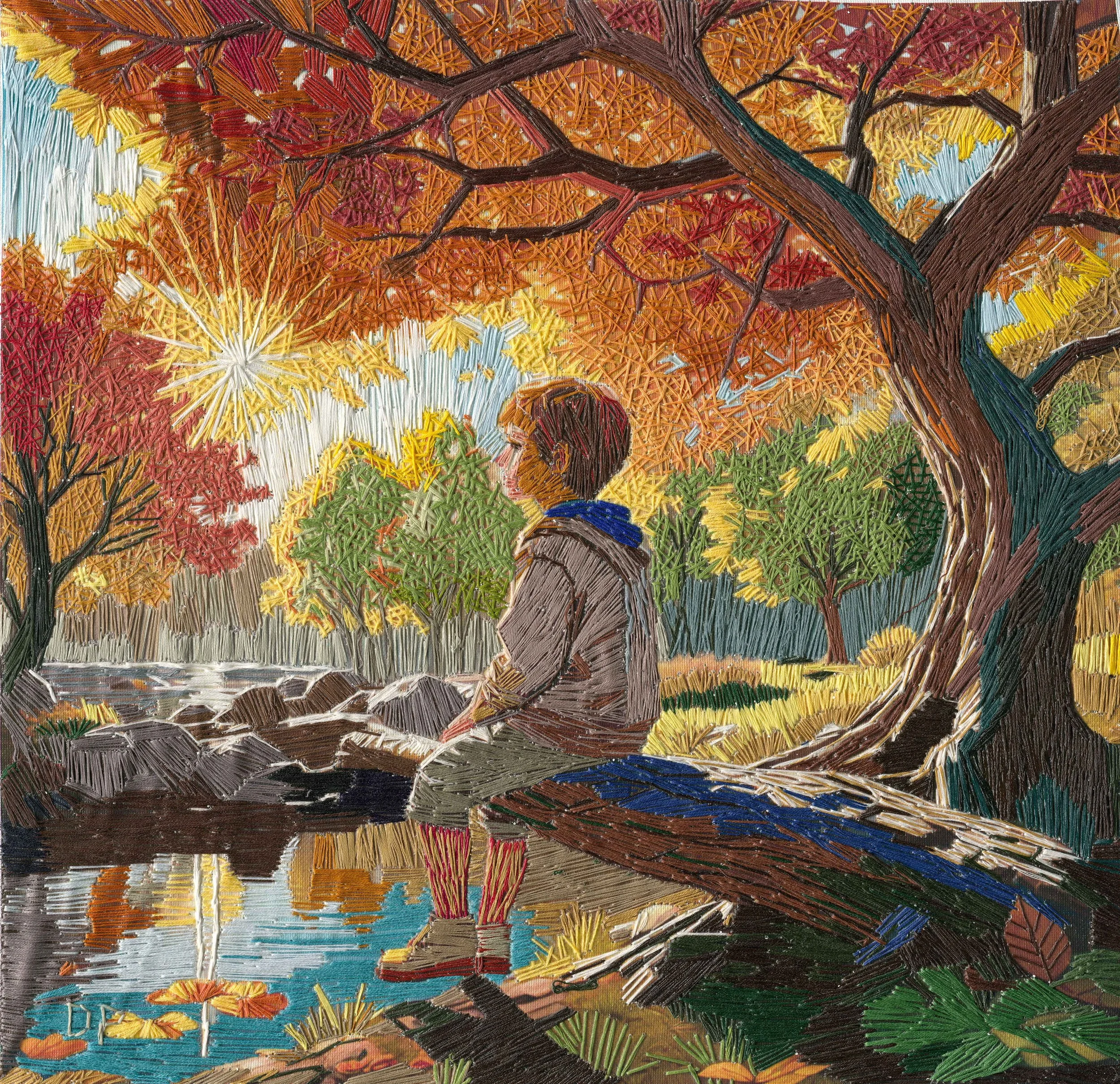
The Tree That Held His Secrets is perhaps one of the most poetic artworks in the series portrays a young figure sitting upon a fallen tree beside a calm body of water. Autumn leaves blaze above him in warm oranges and yellows while a brilliant star-like sun glows through the branches.
The composition conveys introspection and emotional refuge. The tree becomes a silent confidant, holding the thoughts and secrets of the solitary child.
The embroidered leaves create a luminous canopy that almost vibrates with light. Each cluster of stitches forms a small burst of color, collectively building a radiant autumn atmosphere. Here, Poyant reveals his profound sensitivity to the emotional landscape of childhood.
Walking into the Future presents a symbolic scene in which a lone figure walks toward a luminous path framed by twisting tree roots and branches that resemble both architecture and nature.
The composition evokes the archetypal motif of the threshold. The viewer witnesses a moment of transition between past and future, darkness and illumination.
The embroidered roots appear almost alive, guiding the figure toward the opening. The path beyond glows softly, suggesting possibility rather than certainty.
In many ways this work can be read as a metaphor for Poyant’s own artistic journey. Beginning a creative practice at sixty-six required stepping into the unknown. The embroidered path becomes an emblem of courage, transformation, and hope.
Beyond the individual images, the significance of David Poyant’s art lies in the philosophical position it occupies within contemporary culture. His practice reminds viewers that art does not always emerge from speed, spectacle, or conceptual provocation. Sometimes its deepest impact arises from patience.
Embroidery, historically associated with domestic craft, becomes in his hands a medium of contemplative storytelling. Each stitch marks a moment of attention. Each composition accumulates hundreds or thousands of such moments.
In a world increasingly mediated by digital images, this tactile accumulation carries profound meaning. It restores a sense of physical presence to the visual experience.
Furthermore, Poyant’s journey challenges conventional narratives of artistic development. By beginning his practice after retirement, he demonstrates that creativity remains available at any stage of life. His success affirms the value of lifelong curiosity and perseverance.
His growing list of awards and exhibitions across the United States and Europe suggests that institutions are recognizing the broader cultural importance of textile-based practices. Fiber art, once marginalized, now occupies an increasingly visible place within contemporary discourse.
Yet perhaps the most enduring contribution of David Poyant’s work lies in its emotional accessibility. Viewers encountering his embroidered scenes recognize fragments of their own lives within them: childhood wanderings, quiet moments by water, the warmth of a local bar, the dignity of daily work.
Through thread he reconstructs the textures of human experience.
Every stitch tells a story. And in the hands of David Poyant, those stories weave together into a larger meditation on memory, nature, and the quiet resilience of the human spirit.
In the broader landscape of contemporary art, David Poyant’s work occupies a quietly radical position. At a time when artistic production is often measured by speed, spectacle, and digital dissemination, Poyant reintroduces a value system rooted in slowness, patience, and the physical act of making. His embroidered works remind viewers that art can still emerge from the most fundamental human gesture, the movement of the hand guided by attention and care.
The philosophical depth of his practice lies precisely in this insistence on time. Every composition is built through thousands of individual decisions, each stitch placed deliberately, each thread contributing to the gradual emergence of an image. Unlike painting, where a brushstroke may be applied quickly, embroidery requires a rhythm of repetition that cannot be rushed. This temporal investment becomes embedded in the final work. The viewer does not simply observe an image but senses the duration that produced it. In this way, Poyant’s embroidery becomes a form of embodied time, a visible record of human dedication.
Such a methodology carries important implications for contemporary culture. In an era defined by rapid image consumption, the artist invites viewers to slow down and engage with the artwork at a different pace. The surfaces of his pieces reward prolonged looking. From a distance, the works appear painterly and cohesive, yet as one approaches them, the illusion dissolves into a landscape of threads. The eye begins to follow the paths of individual stitches, tracing the movements of the artist’s hand across the fabric. What initially appears as representation becomes, upon closer inspection, an intricate architecture of labor.
This relationship between illusion and materiality situates Poyant within a lineage of artists who have explored the structure of visual perception. Yet his contribution remains distinctive because it emerges from a medium historically associated with domestic craft rather than institutional fine art. By elevating embroidery to the level of painterly narrative, he participates in a broader cultural reassessment of fiber based practices. His work challenges outdated hierarchies that once separated craft from art, demonstrating that the conceptual and emotional power of a medium lies not in its historical categorization but in the imagination of the artist who employs it.
Equally significant is the thematic consistency that runs throughout Poyant’s imagery. Whether depicting coastal landscapes, solitary figures, working communities, or symbolic encounters with nature, his compositions revolve around the idea of reflection. The characters within his embroidered worlds often stand at moments of quiet contemplation. Children observe the horizon, workers focus on their tasks, travelers walk toward luminous pathways, and solitary figures sit beside trees or water. These scenes resonate with universal human experiences of introspection, memory, and personal transformation.
Nature plays a particularly central role within this visual language. Trees, rivers, sky, and sea appear repeatedly as environments in which human thought unfolds. In Poyant’s hands, nature becomes more than scenery. It functions as a partner in reflection, a silent presence that holds human stories within its larger temporal cycles. The embroidered tree that listens, the autumn branches glowing with sunlight, the coastal water reflecting a child’s footsteps, all these elements suggest that the natural world contains layers of meaning that extend beyond immediate perception.
This ecological sensitivity aligns his work with broader contemporary concerns about humanity’s relationship to the environment. Rather than addressing these themes through overt political statements, Poyant approaches them through quiet observation. His landscapes remind viewers that the natural world remains a source of emotional grounding and philosophical insight. The act of stitching these environments thread by thread becomes, in itself, a gesture of reverence toward the complexity of the living world.
Another important dimension of Poyant’s work lies in its intergenerational symbolism. His artistic journey began as a tribute to his mother’s love of sewing, transforming a familial memory into an expansive creative practice. In this sense, every piece carries an element of personal homage. The act of embroidery becomes a bridge between past and present, between inherited knowledge and contemporary innovation.
This bridge extends even further through his intriguing dialogue with modern technology. By occasionally using artificial intelligence as a tool for visualizing compositions before translating them into thread, Poyant demonstrates that tradition and innovation need not exist in opposition. Instead, his practice suggests that technological inspiration can coexist with deeply human forms of craftsmanship. The final works remain profoundly tactile objects that resist the immateriality of digital imagery.
In the context of contemporary art history, such a synthesis carries significant meaning. The future of art will likely involve increasingly complex relationships between digital processes and physical materials. Poyant’s work provides an early example of how such relationships can remain grounded in human creativity rather than dominated by technological automation.
His late entrance into the art world further amplifies the philosophical resonance of his practice. Beginning a new creative path at the age of sixty six challenges deeply ingrained assumptions about artistic timelines. In many ways, Poyant embodies the idea that creativity is not confined to youth or formal training. Instead, it emerges wherever curiosity, dedication, and emotional sincerity converge.
The remarkable list of awards and recognitions his work has received, from the Massachusetts Cultural Council Grant to international prizes in France, Italy, Switzerland, and beyond, reflects the growing recognition of this authenticity. Yet the true strength of his practice lies not in institutional validation but in the sincerity of its vision. Each embroidered image carries the quiet conviction that storytelling, craftsmanship, and patience still possess profound cultural value.
David Poyant’s embroidered worlds function as spaces of contemplation within an increasingly accelerated society. They remind viewers that meaning often resides in the smallest gestures, the placement of a stitch, the reflection of sunlight on water, the quiet posture of a figure gazing into the distance. Through these images, the artist invites us to reconsider the pace at which we experience both art and life.
In this sense, Poyant’s work does more than reinterpret embroidery as fine art. It proposes a broader philosophy of attention. Every thread becomes a reminder that beauty and understanding emerge gradually, through patience, observation, and care.
Perhaps this is the most enduring legacy of his practice. In an age defined by speed and distraction, David Poyant offers a different vision of artistic creation, one in which meaning is not downloaded instantly but patiently stitched into existence, one thread at a time.
By Marta Puig
Editor Contemporary Art Curator Magazine
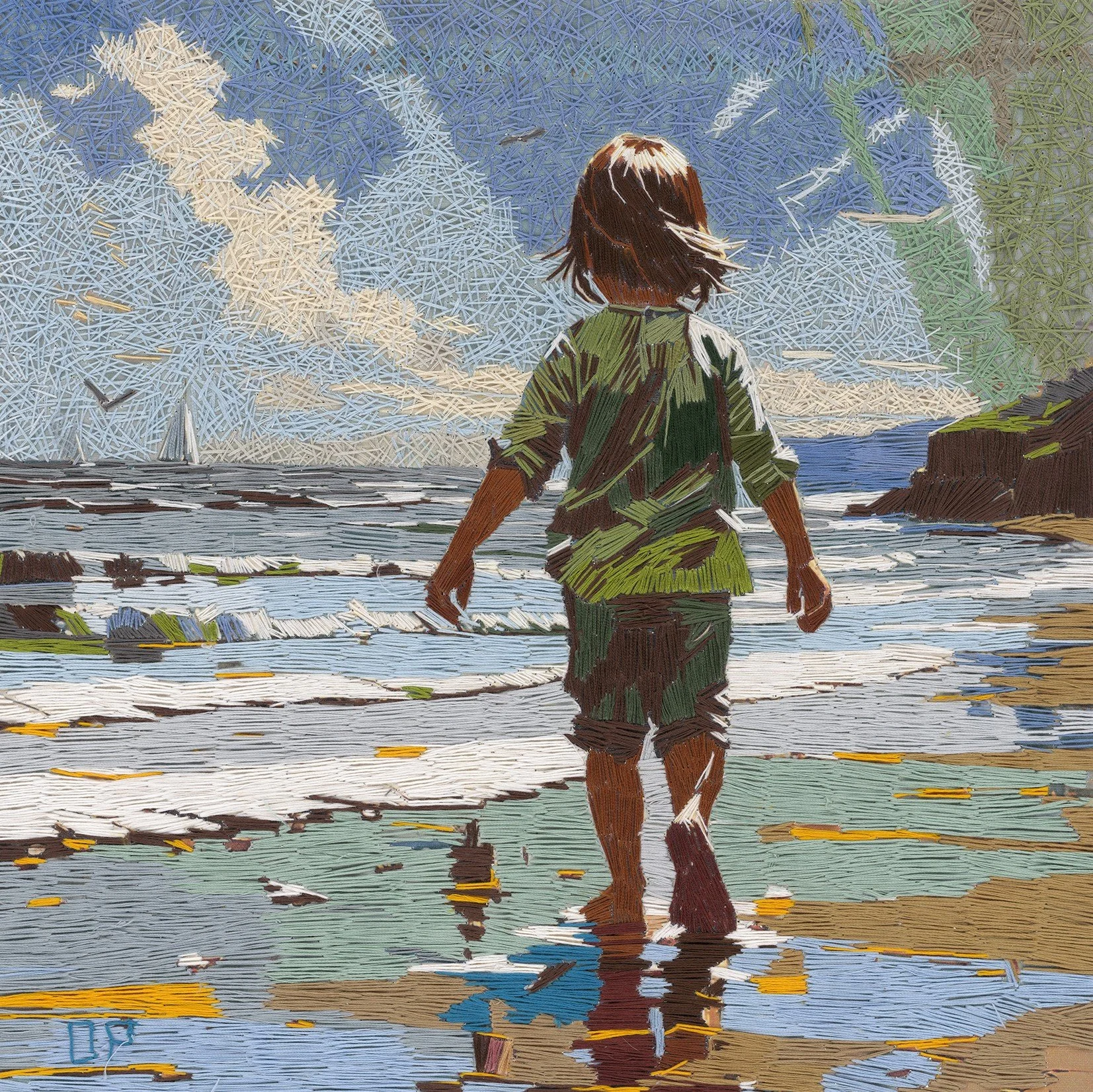
Embroidery 20/25 Child of the Sea Breeze Embroidery 43.18 x 43.18

Embroidery 20/25 Tree that Held His Secrets 40.64 x 40.64 Embroidery
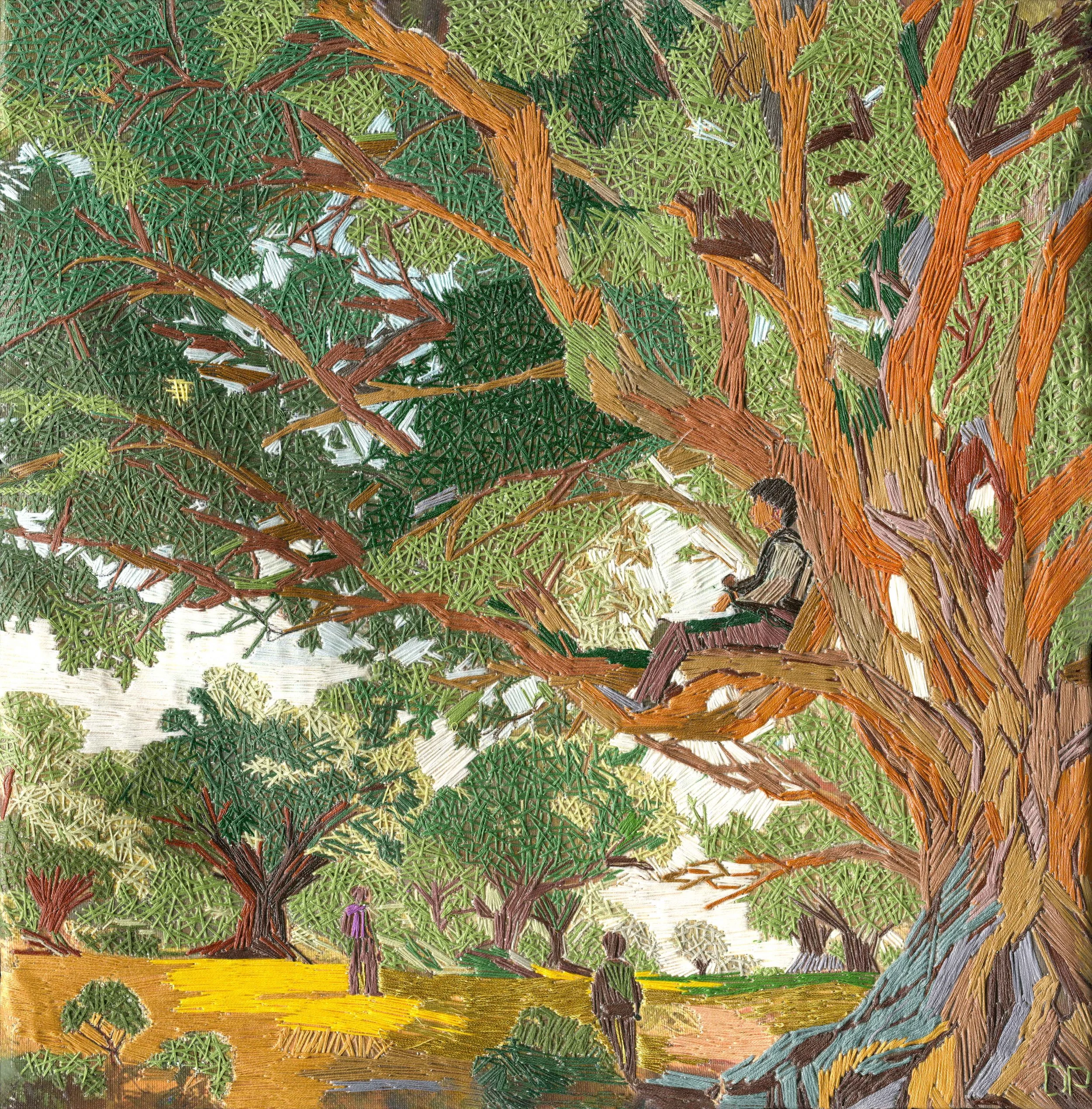
Embroidery 20/25 Boy in the Tree
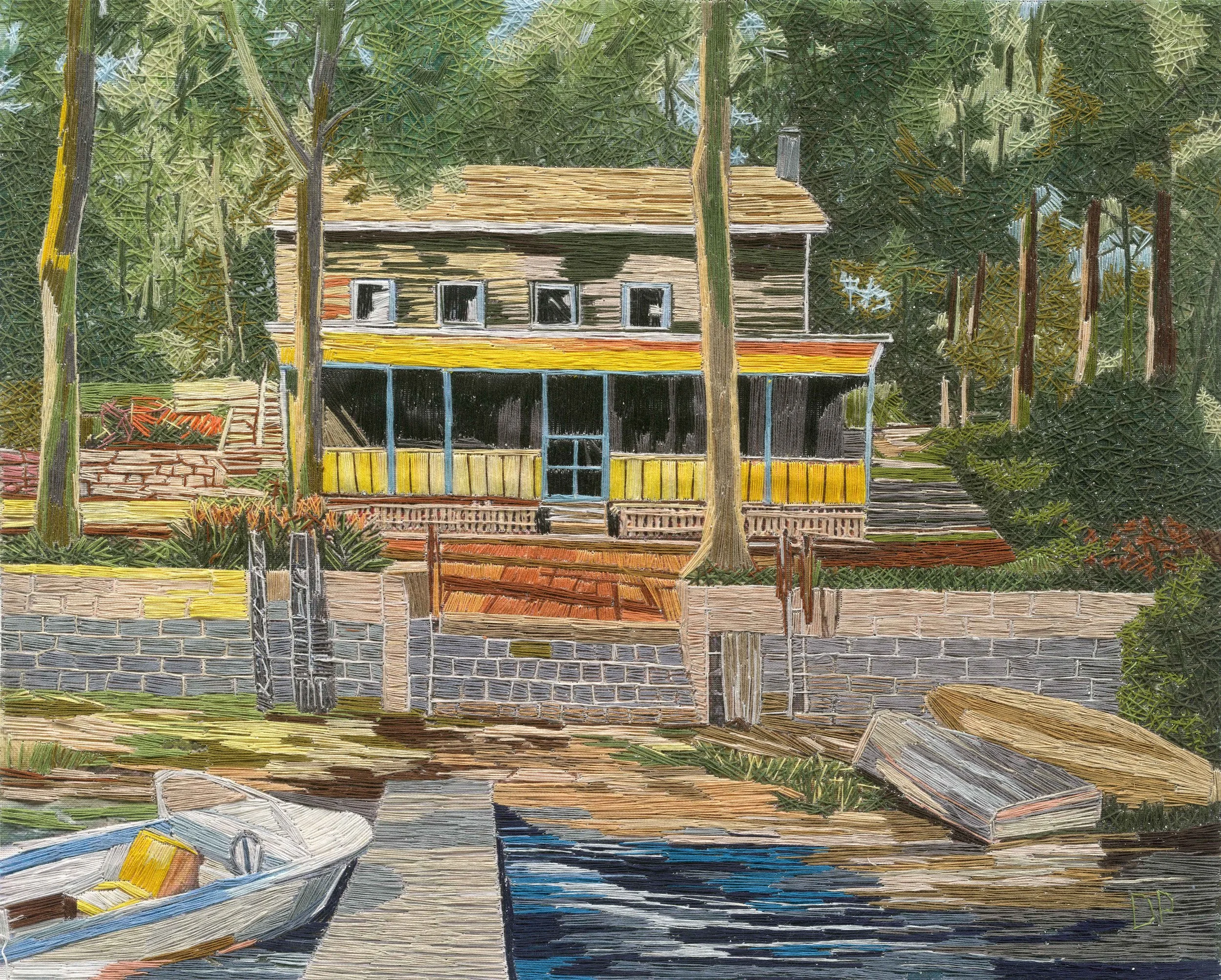
Embroidery 20/25 Summer Cottage
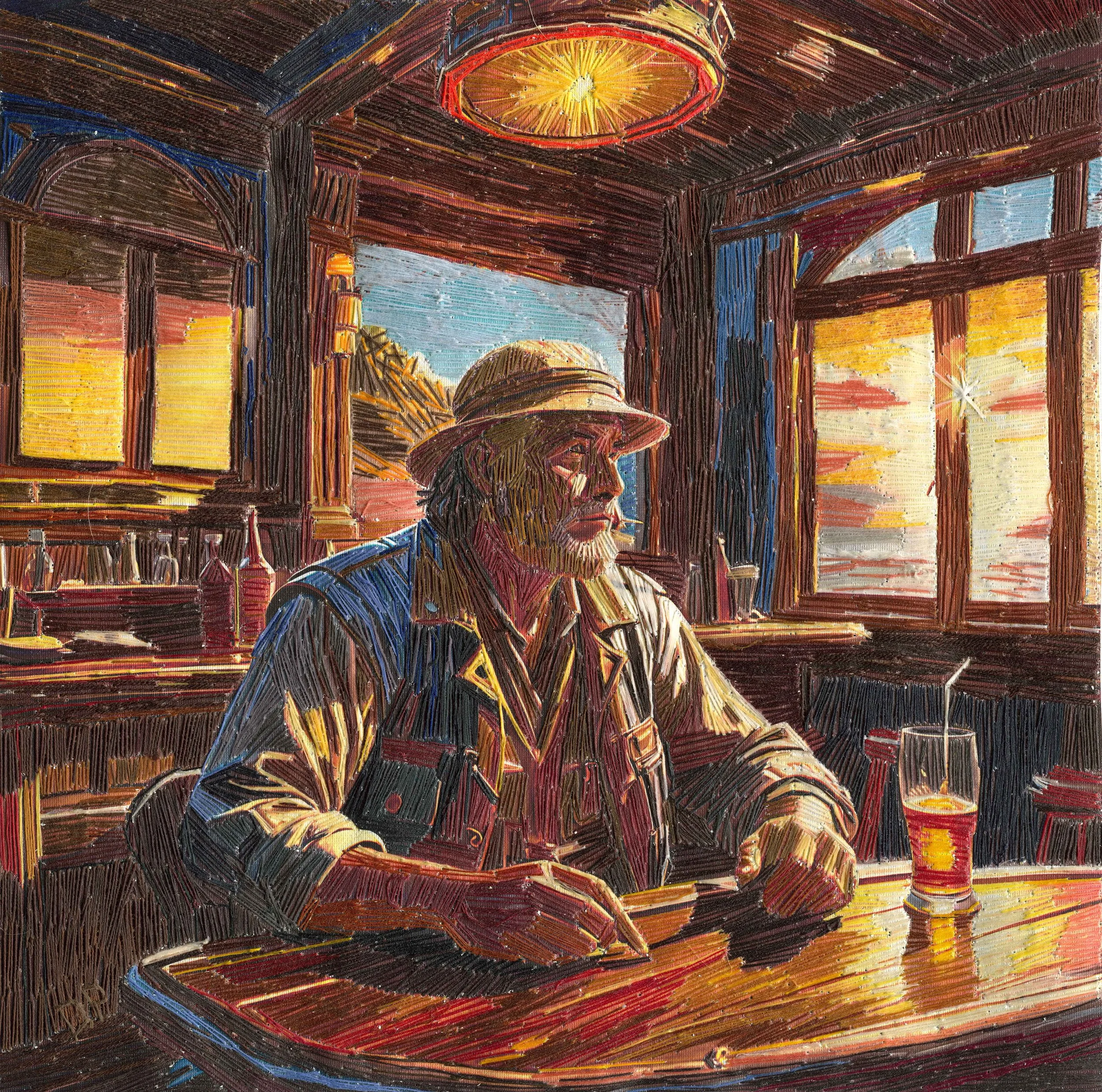
Embroidery 2025 Fisherman at the Bar
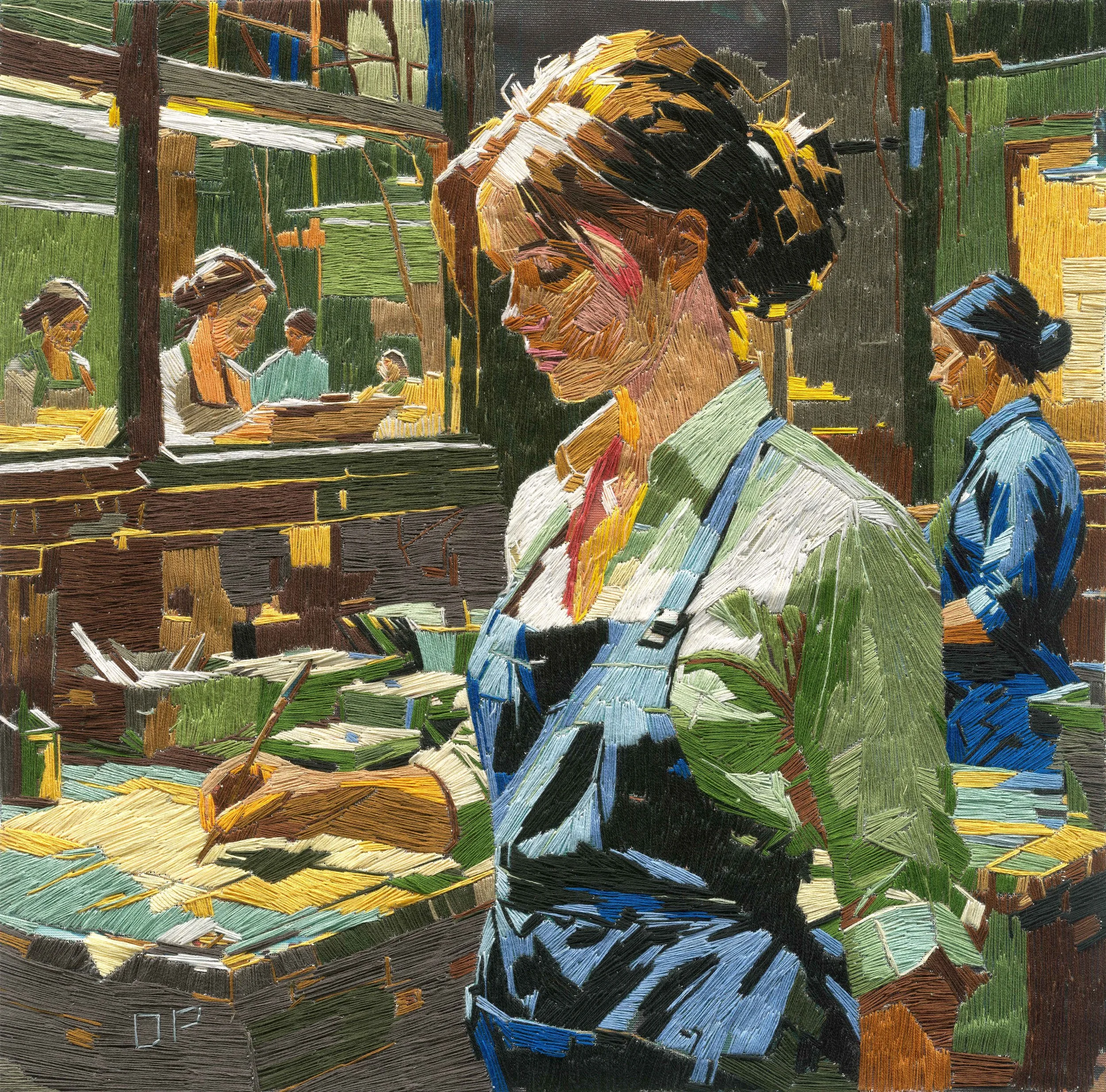
Embroidery 20/25 Lady Worker
Embroidery 20/25 Listening Tree
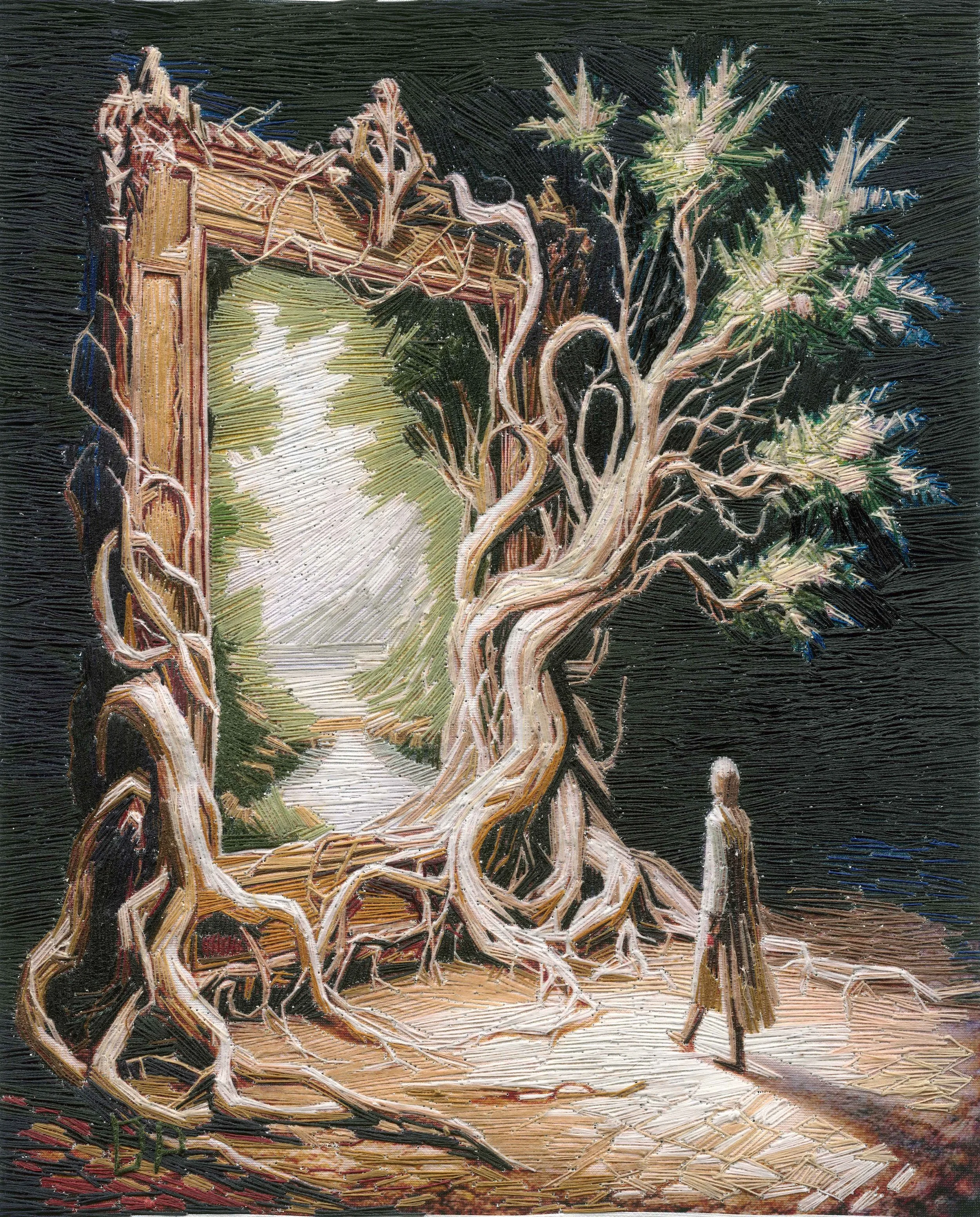
Embroidery 20/25 @alking into the Future
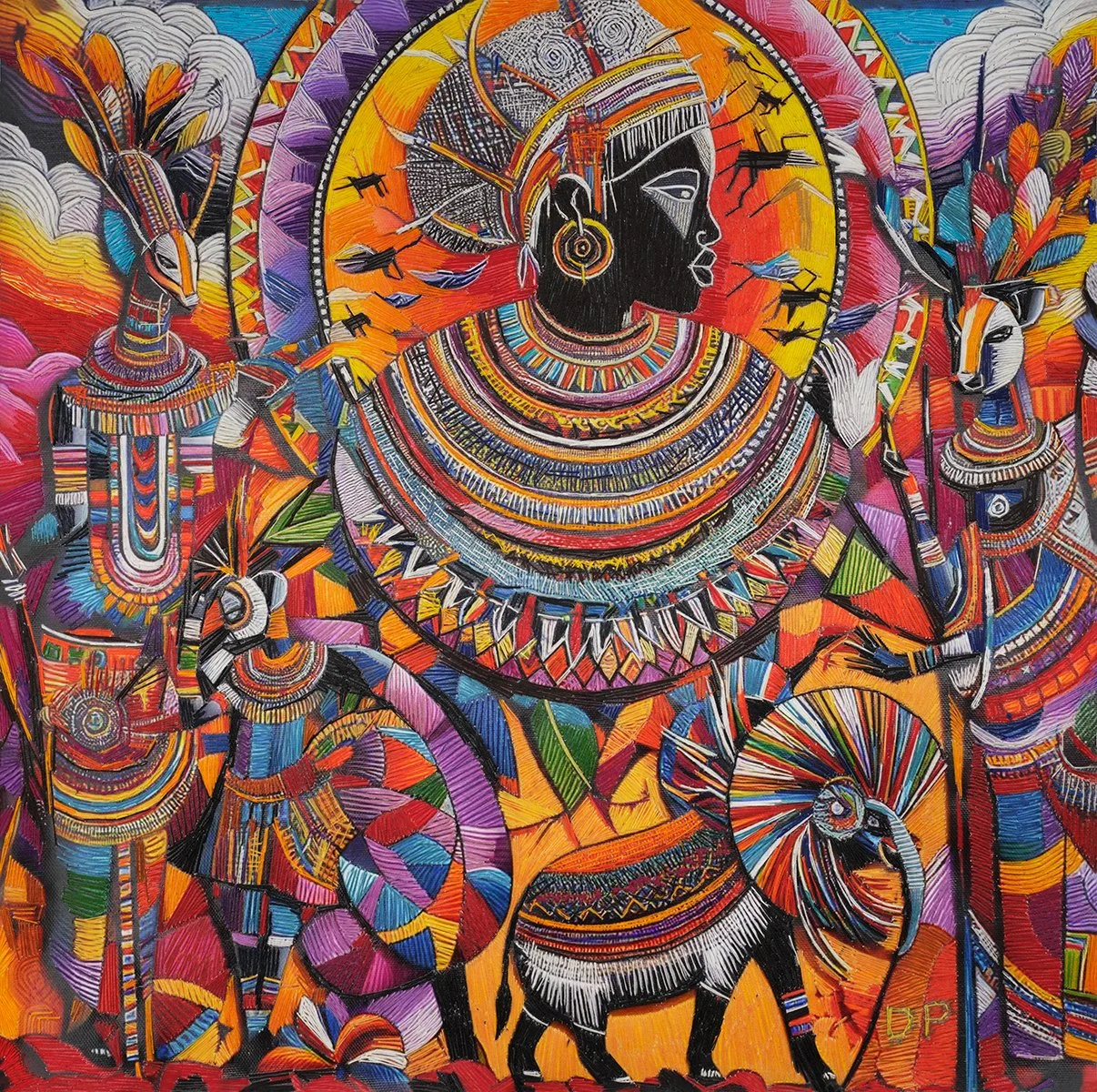
Embroidery 20/24 Massai Queen
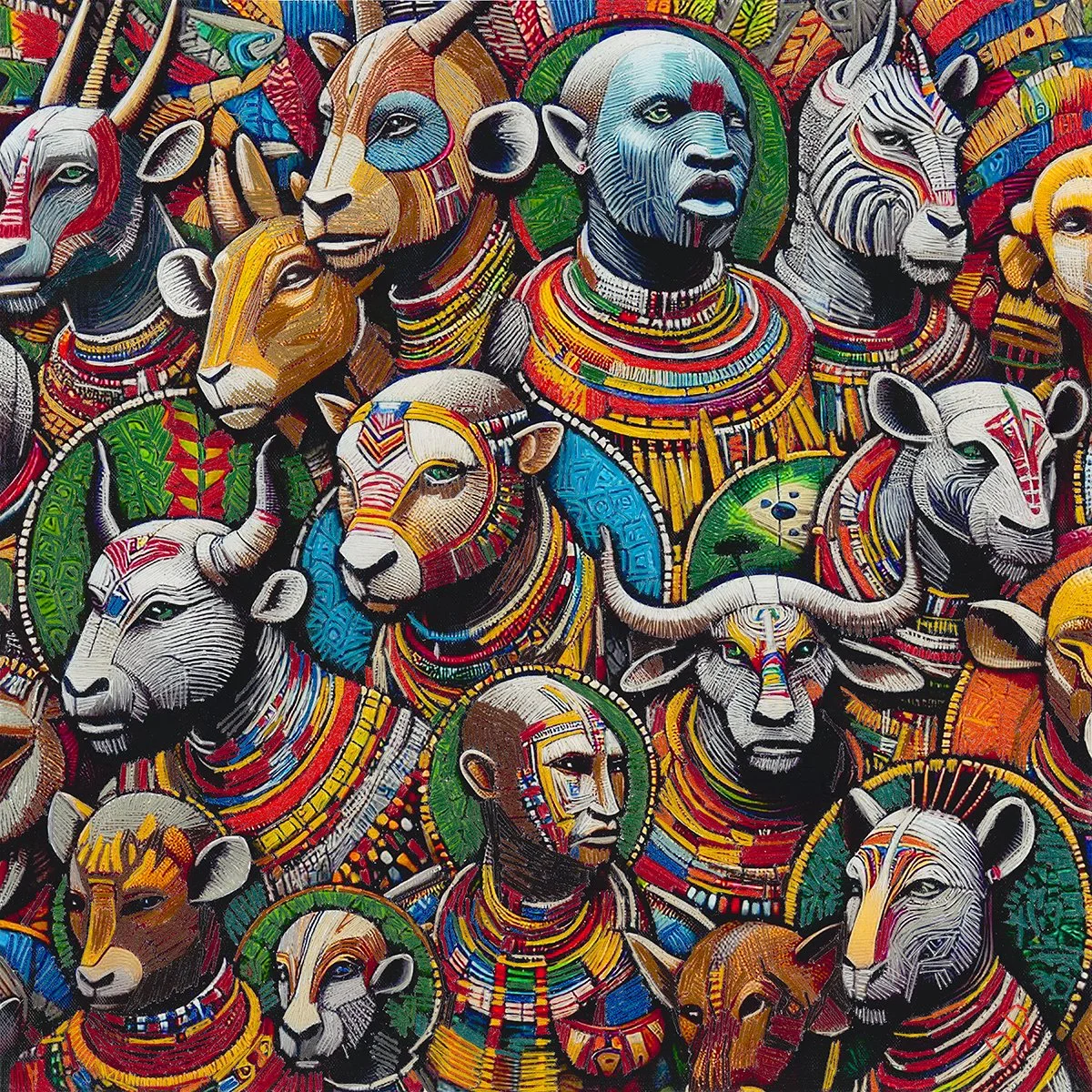
Embroidery 20/24 Massai Tribe