Interview with Cheraine Collette
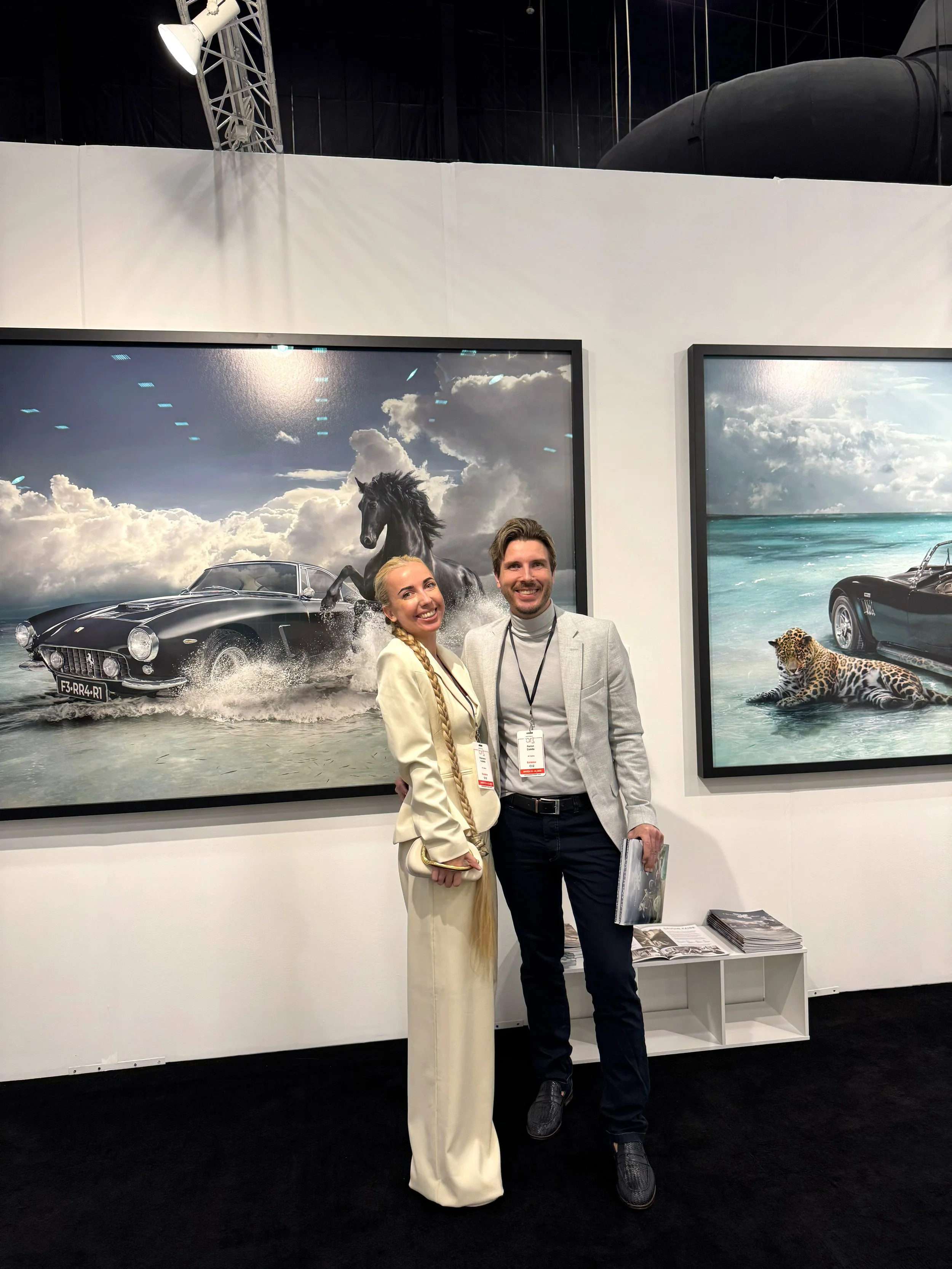
https://www.cherainecollette.com/
Cheraine Collette is an internationally recognized Dutch artist known for her ethereal photographic paintings that merge reality with imagination. Her work is held in museum collections, including the Museo d’Arte di Chianciano Terme in Italy, and has been exhibited at leading international art fairs such as CONTEXT Art Miami, Scottsdale Ferrari Art Week, and Palm Beach Modern + Contemporary, as well as at curated venues including Porsche Barcelona. With over 300 international awards, her practice explores the harmony between nature and humanity, creating immersive worlds that invite viewers to rediscover beauty as a powerful and transformative force.
Cheraine, how do you conceptualize the term “photographic painting” within your practice, particularly in relation to the historical tension between the mechanical index of photography and the expressive, interpretive gesture of painting? Your works appear to operate within a liminal territory where photographic fragments are not merely composited but re-authored into pictorial spaces that evoke the compositional logic of Old Master tableaux. In what ways do you see your process as extending or challenging the traditional ontology of photography?
The term photographic painting describes the territory where my work takes shape, a space where photography and painting no longer function as separate disciplines, but as complementary languages.
Historically, painting evolved through a long pursuit of visual truth. From the Renaissance onward, artists studied perspective, anatomy, and light to render the world with increasing precision. In many ways, photography continued that ambition by capturing reality with extraordinary fidelity. Yet within my practice, photography is not an end point, but a point of departure.
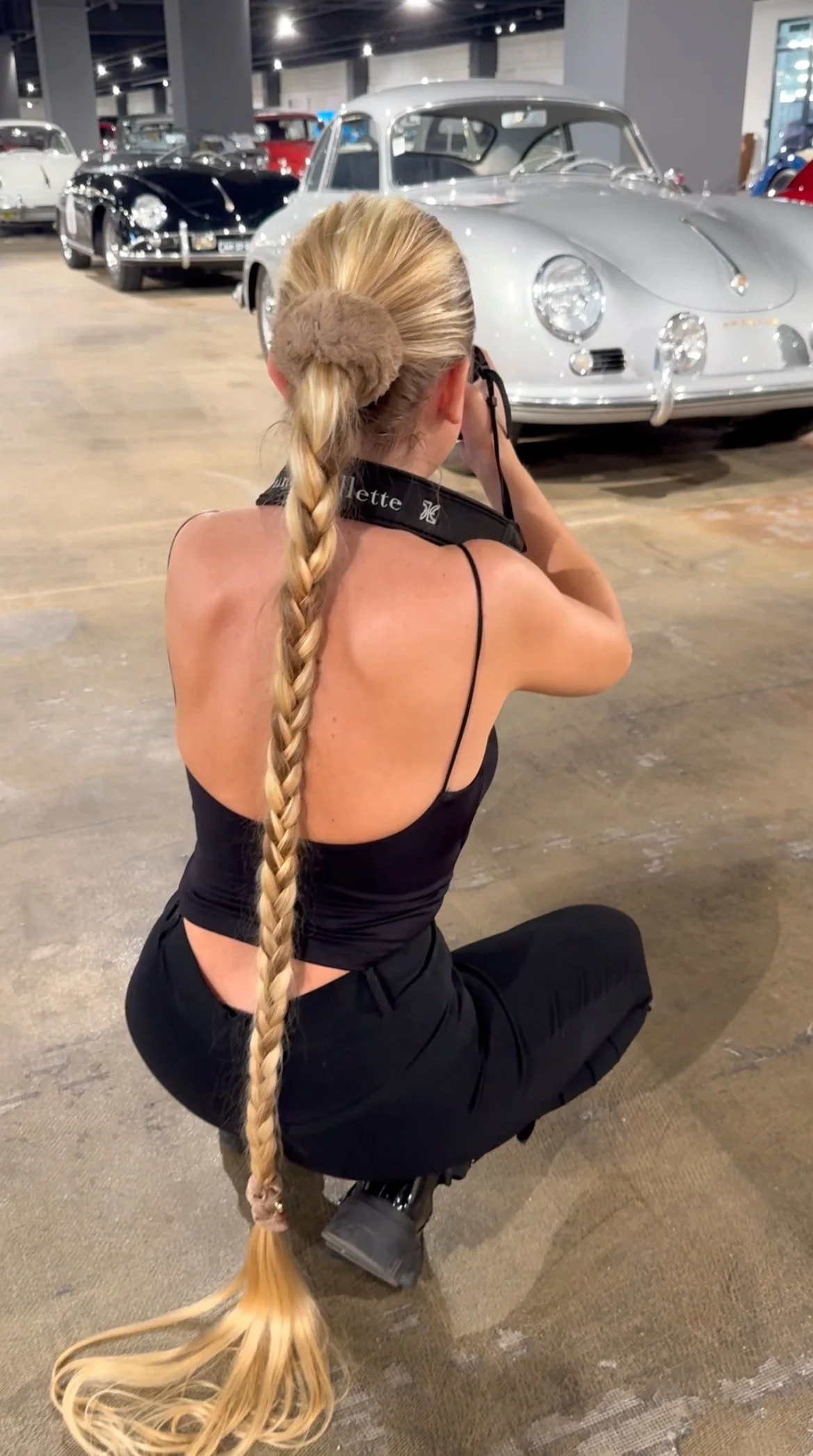
The process often begins with sketches, either digitally or on paper, where I develop the composition and study the direction of light, spatial relationships, and the elements required to construct the image. Once the concept is clear, I travel to different locations to photograph these elements, landscapes, animals, architectural spaces, always observing light and waiting patiently for the right moment or gesture.
These photographs then become fragments on a digital canvas, much like pigments on a painter’s palette. Gathered from different places and moments, they are slowly recomposed into a unified image. Every element within the work once existed in reality, yet the scene itself never existed as such.
It is precisely in this tension that the work finds its meaning. Rather than reinforcing photography’s traditional role as an index of reality, my process re-authors it into a constructed pictorial space. In this way, the work occupies a liminal territory between observation and imagination, where photographic material is transformed into something closer to a painted tableau, guided not only by what was seen, but by what can be envisioned.
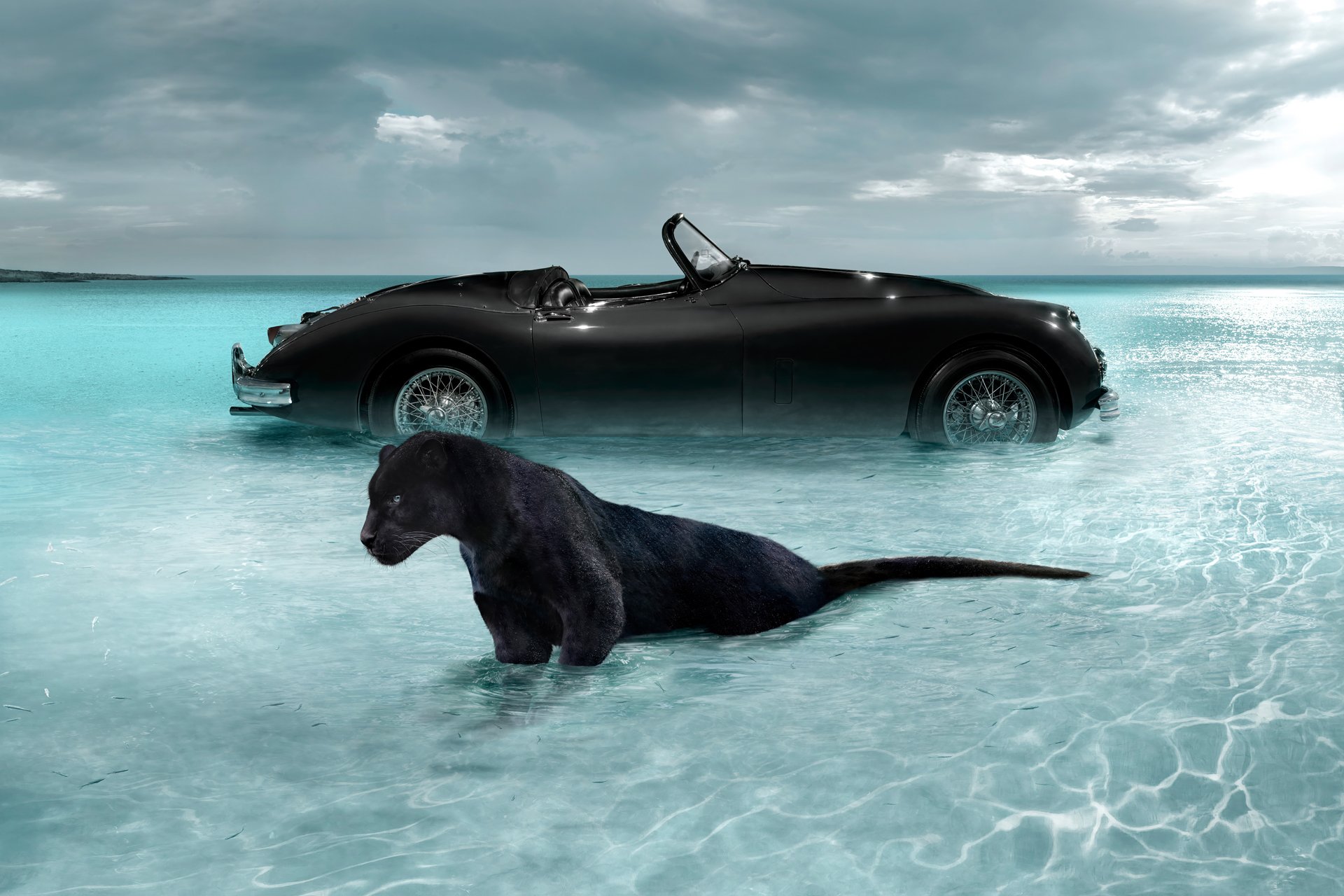
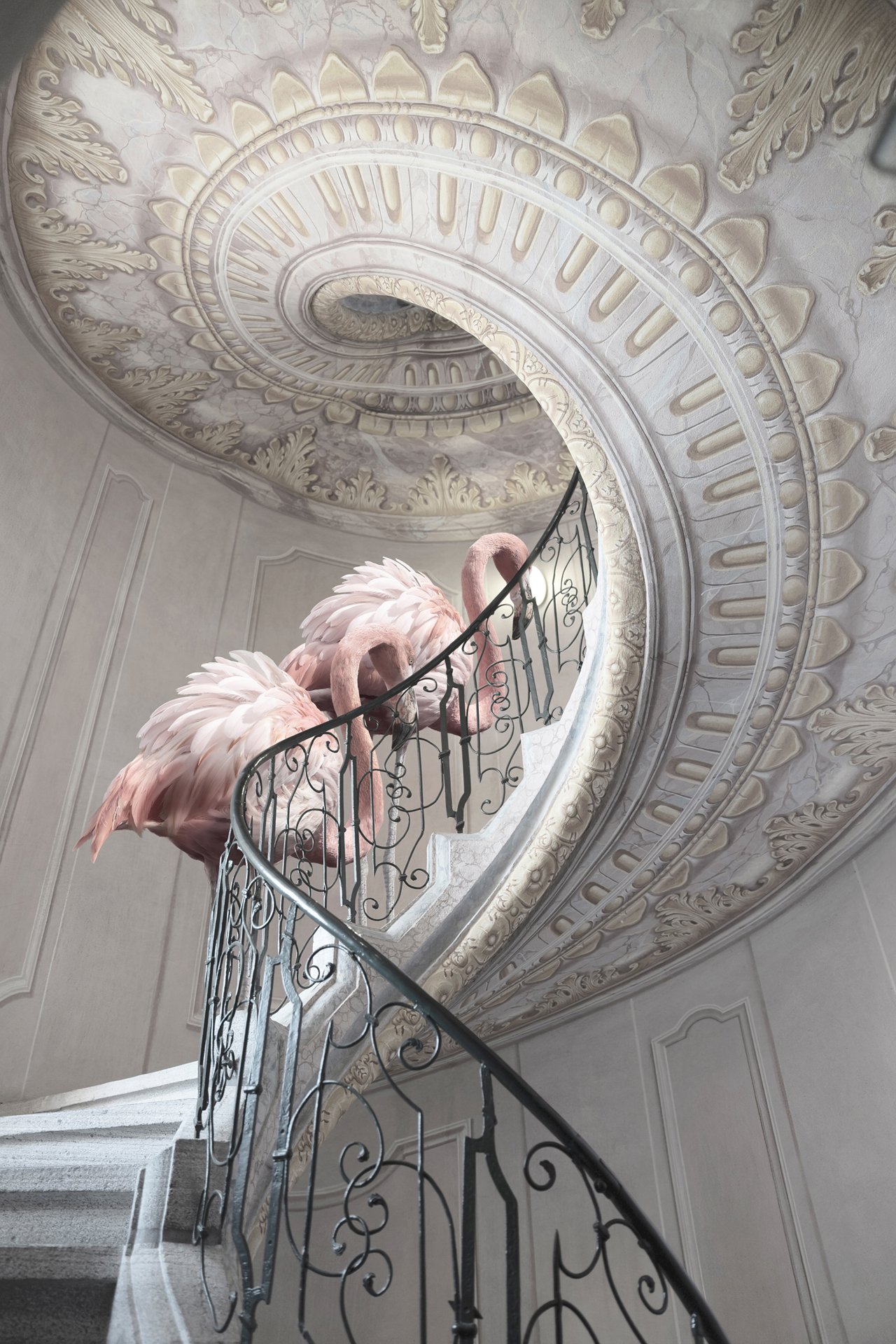
In many of your compositions, majestic animals inhabit palatial European interiors, environments historically coded with power, wealth, and human authority. By situating wildlife within these spaces of aristocratic architecture, do you intend to stage a symbolic reversal of hierarchies between nature and culture, or are these scenes better understood as speculative allegories about coexistence, vulnerability, and the fragile equilibrium between the natural world and human civilization?
I am less interested in reversing hierarchies than in revealing a deeper unity.
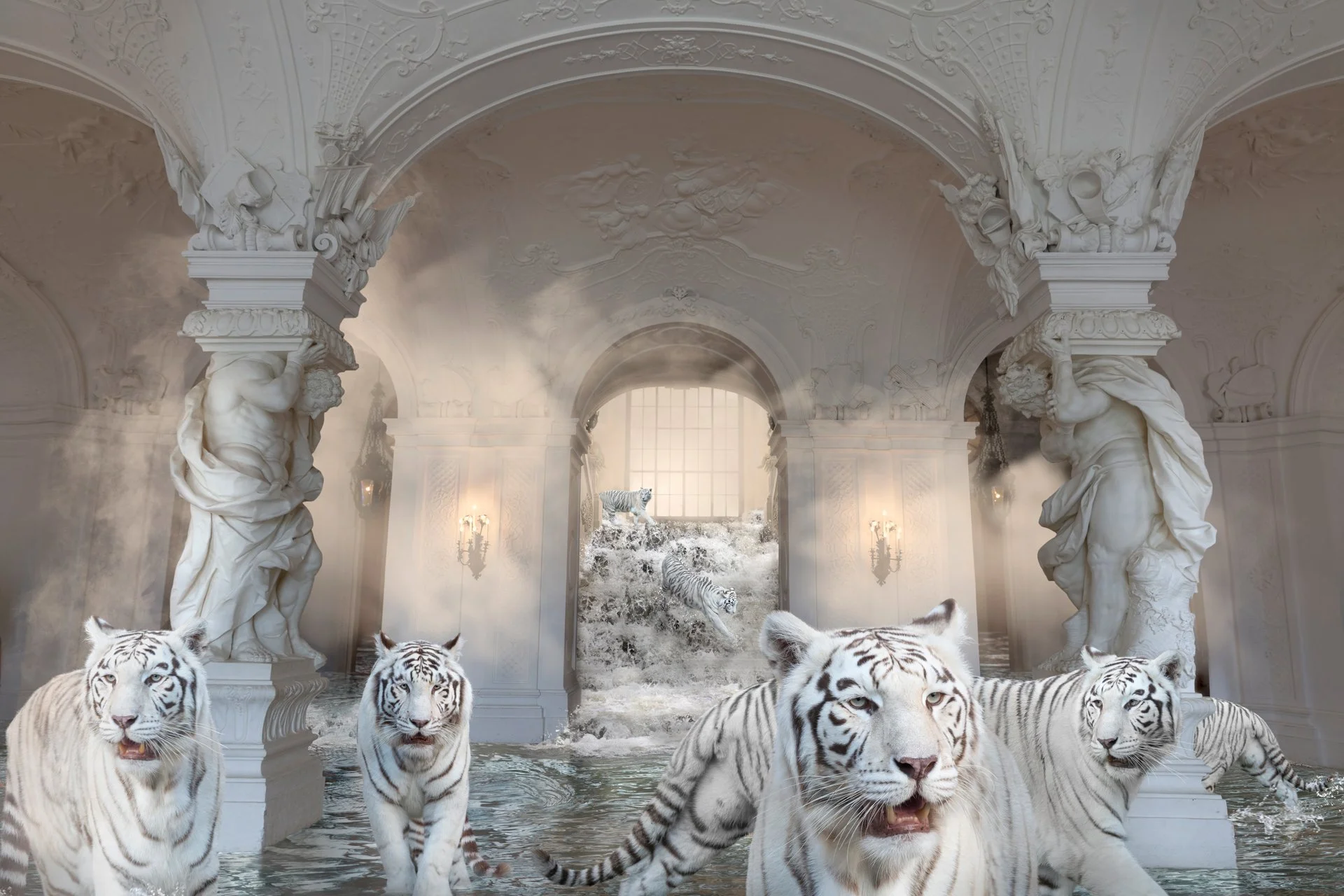
Palaces and historic interiors represent one form of architecture, shaped by human culture and often associated with power and authority. The animals that inhabit my images represent another form of architecture, the architecture of nature itself, shaped by evolution over millions of years.
When these two worlds meet within the same image, they no longer appear as opposites. Instead, they reveal themselves as parallel expressions of creation. To me, they are both extraordinary and fragile treasures of our world, and we, as human beings, are part of that same treasure.
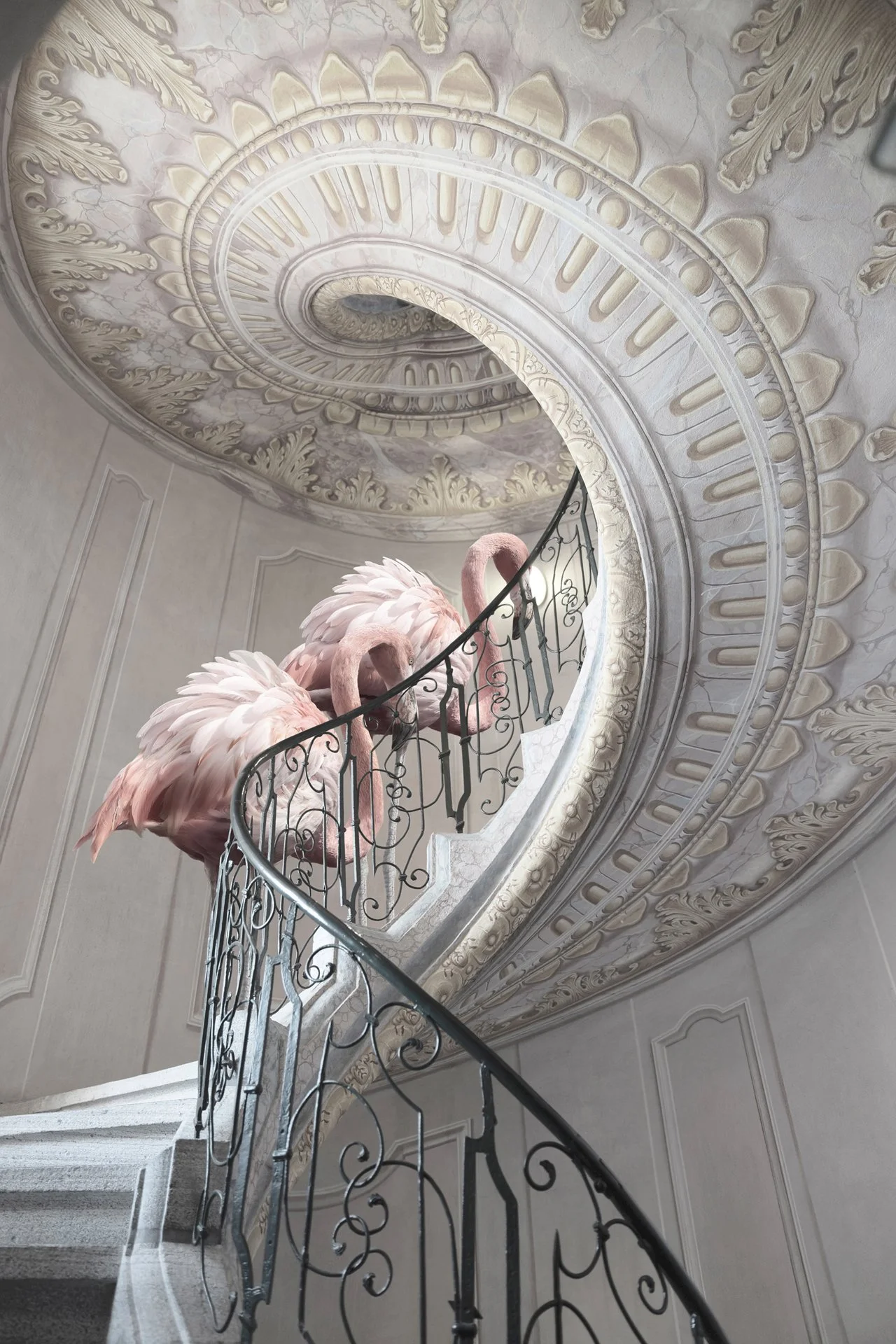
What fascinates me is that even within these architectural marvels, which may appear far removed from nature, there is an ongoing dialogue with the natural world. Their ornamentation, their forms, their details often draw directly from nature, as if we instinctively seek to remain connected to it.
Seen from this perspective, human architecture becomes a brief gesture within a much larger continuum. It reminds us that what we create, no matter how monumental, exists within the greater and more enduring architecture of the earth itself.
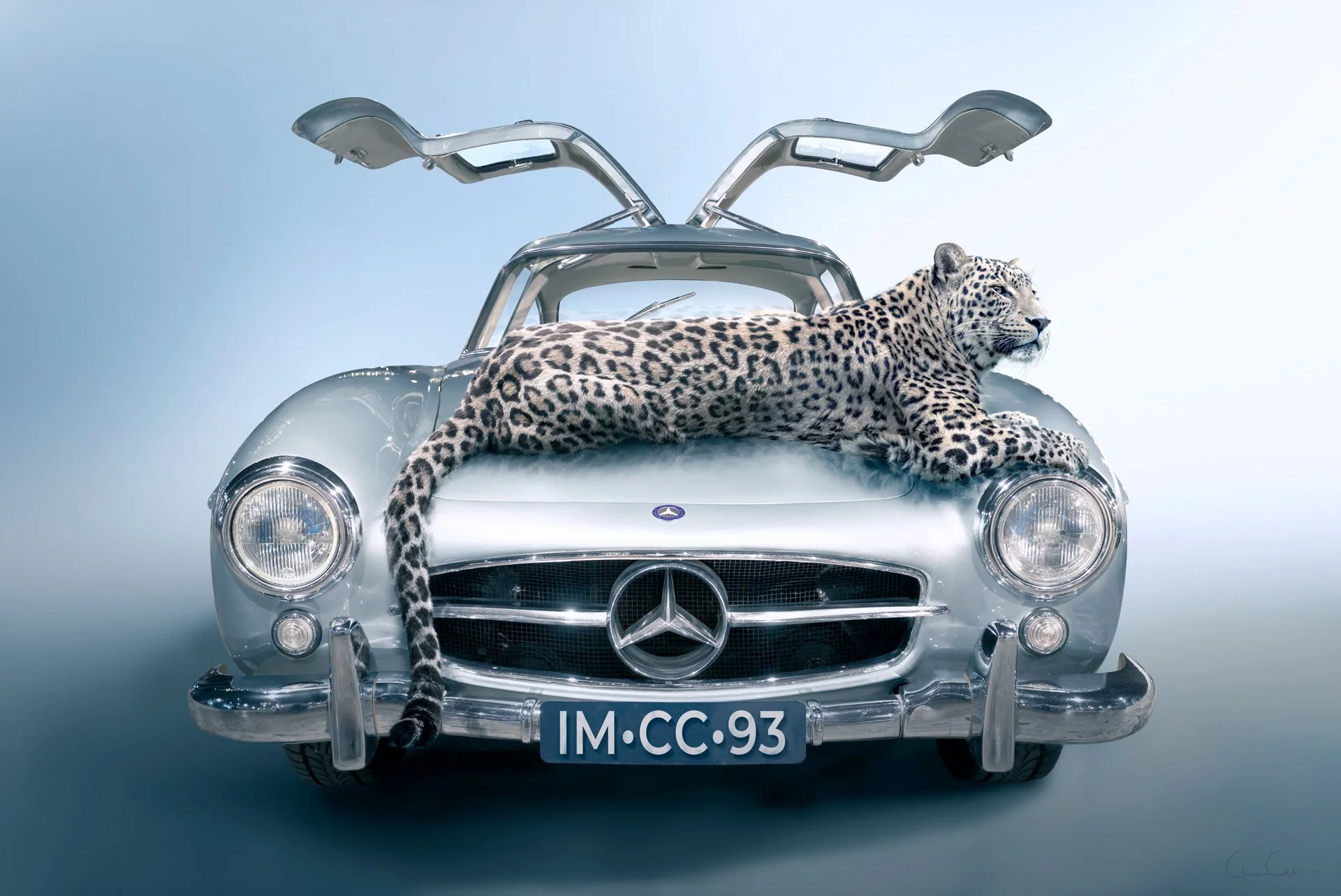
Your works are built from hundreds of photographic layers, each meticulously assembled through a process that resembles both digital montage and painterly construction. Could you elaborate on how this accumulation of layers functions conceptually within the work? Does this stratification of imagery mirror the layered narratives of mythology, history, and memory that seem to permeate your compositions?
The layered construction reflects both the technical and conceptual nature of the work.
Each photograph I take becomes a fragment of a larger visual vocabulary. When the composition is assembled on my digital canvas, these fragments gradually form a coherent world. Depending on the work, this process can involve hundreds or sometimes over eight hundred individual layers.
The number of layers, however, is not directly connected to the symbolic meaning of the image. Often it simply reflects the care required to make the different elements integrate convincingly. Light, perspective, texture, and small details must align so that the final scene feels believable.
In a way, the layers mirror the complexity of the world itself.
For example, I spend a great deal of time refining the fur of animals, restoring individual hairs that interact with light and with the surrounding environment. These subtle adjustments often require many layers, but they are essential for creating a sense of realism and depth.
Conceptually, the process is therefore less about montage and more about constructing a pictorial space in which different fragments of reality can come together to form a coherent and immersive world.
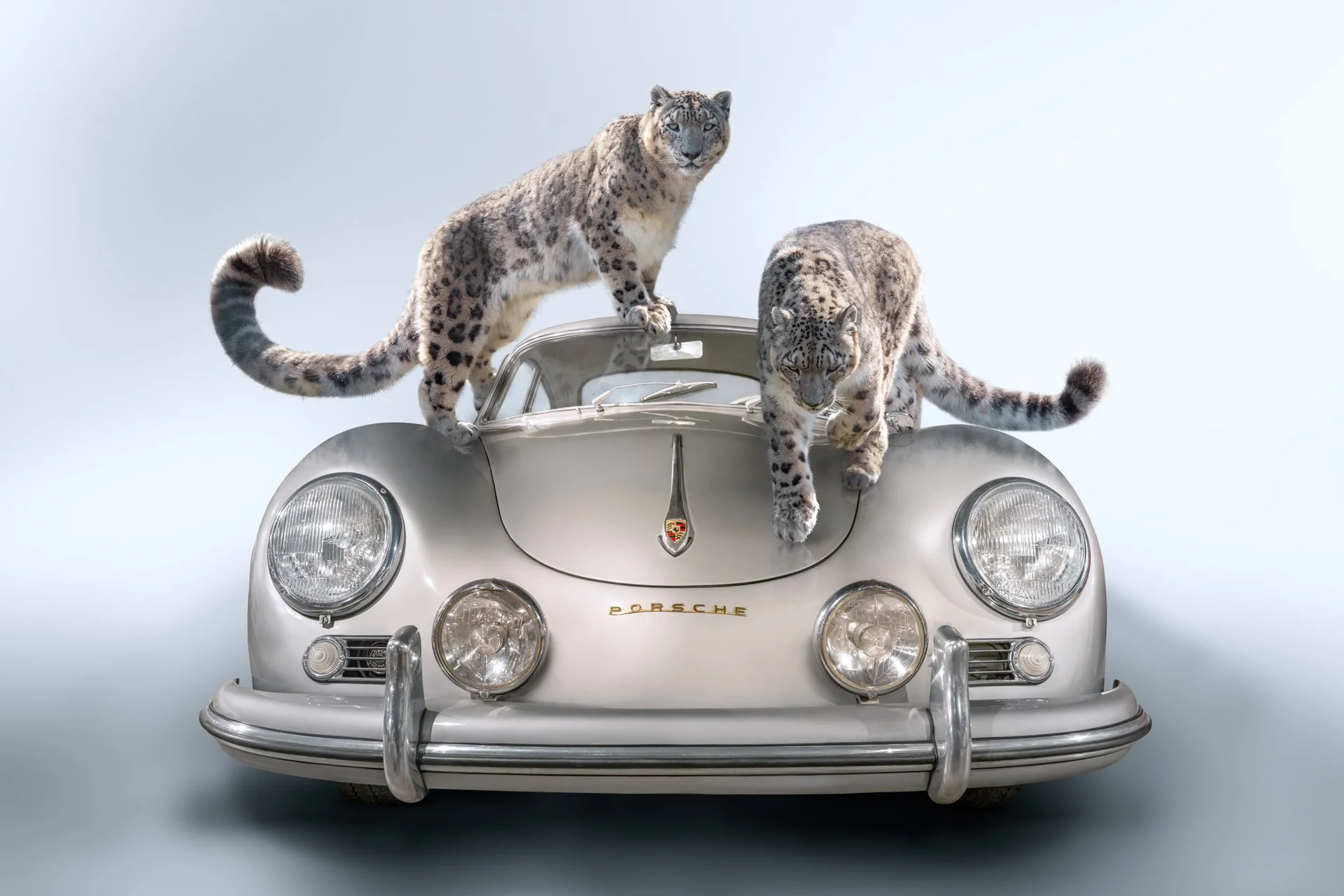
The interiors you depict often evoke the grandeur of Baroque and Neoclassical architecture, spaces historically designed to project permanence and cultural authority. When these monumental settings are inhabited by animals or your own self-portraits, the image begins to oscillate between spectacle and quiet introspection. What attracts you to these architectural environments as stages for your imagined realities?
Architecture has always fascinated me because it reflects humanity’s desire to create permanence.
Baroque and Neoclassical spaces, in particular, carry a strong sense of harmony, proportion, and intention. They are environments where every detail has been carefully considered, which creates a natural affinity with the way I construct my own compositions.
What attracts me to these spaces is the tension they hold. On one hand, they embody grandeur and cultural authority, yet at the same time they can feel remarkably still and contemplative.
These architectural marvels, while defining our cultural identity and connecting us to the past, are also inherently fragile, much like the natural environments that exist beyond them.
When animals or human figures enter these spaces, that stillness becomes more visible. The image shifts away from spectacle and opens into something quieter and more introspective.
In that sense, these environments become stages not for dominance, but for reflection, places where presence, scale, and silence can coexist, reminding us that even our greatest achievements remain part of the greater whole of the natural world.
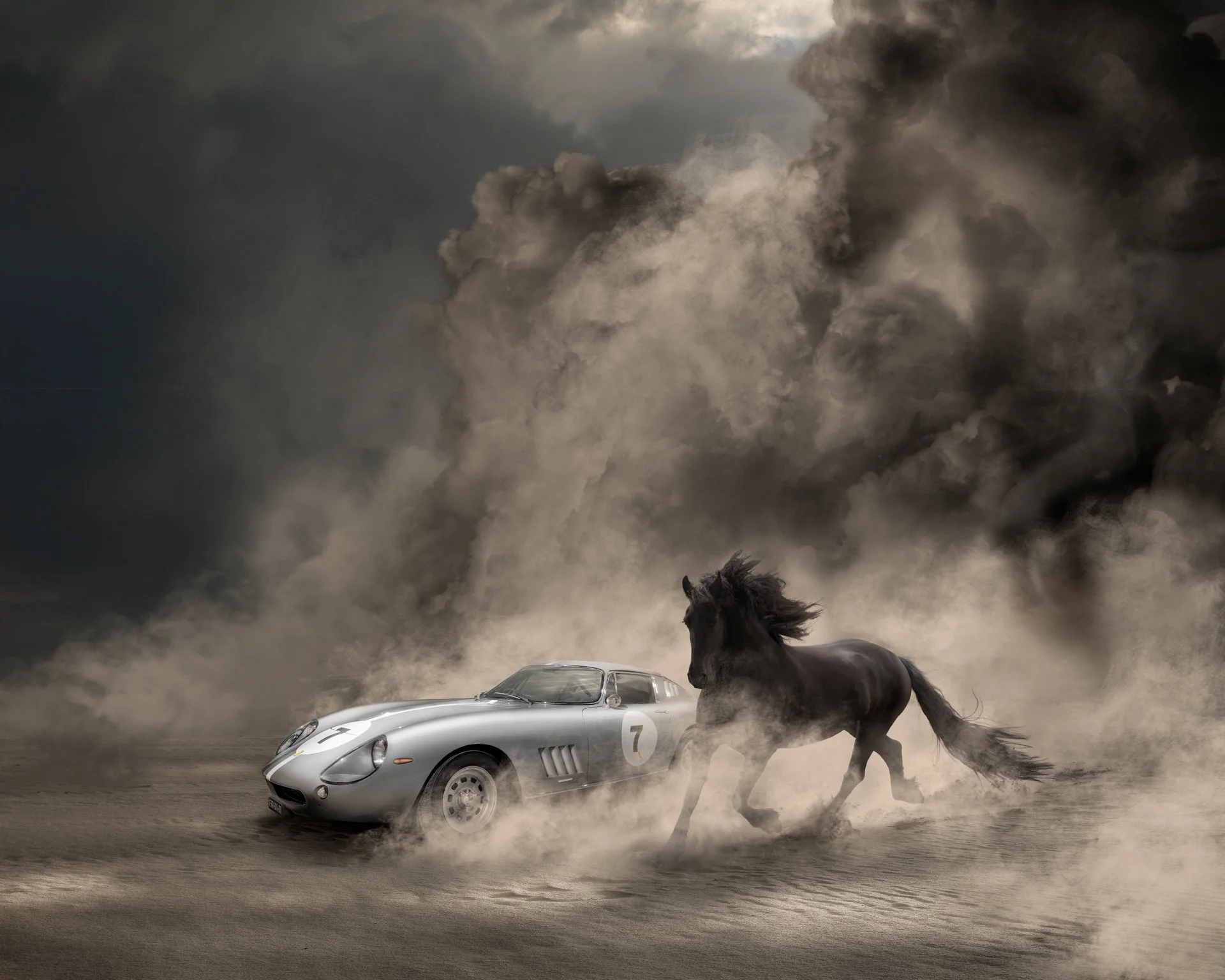
Your practice involves an extensive geographical journey to gather source material, from volcanic islands and national parks to European palaces. This method suggests a form of visual archaeology, collecting fragments of the world before reconstructing them into new symbolic constellations. How does the act of traveling and photographing these environments shape the conceptual architecture of your final compositions?
Once I have developed a concept through sketches, I begin searching for the locations where I can photograph the elements needed for the composition. When I arrive at a location, I take time to observe the landscape, study the direction of light, and wait for the right moment to emerge.
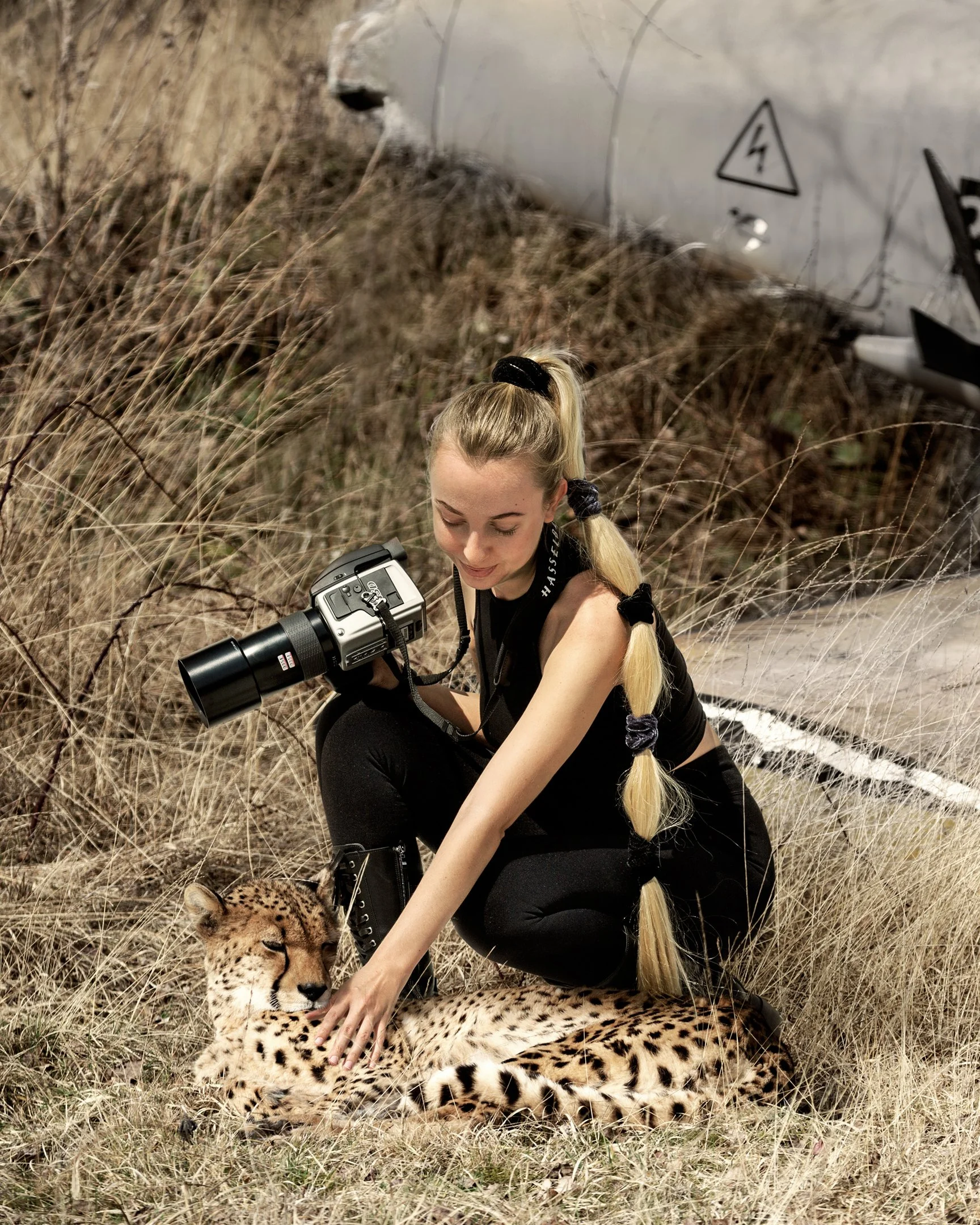
With animals, this often requires patience, sometimes waiting until they naturally move into a pose or gesture that aligns with the composition I have envisioned.
Over time, these journeys have created a large archive of photographic fragments that I can draw from. In that sense, the process does resemble a kind of visual archaeology, gathering pieces of reality from different places and moments, which later come together as a constellation within the image.
Travel therefore does not only provide material, it shapes the work conceptually. Each image becomes a meeting point of different environments, times, and experiences, forming a constructed world that remains rooted in reality.
Even when a composition begins with a clear sketch, I remain open to what I encounter. Sometimes a small, almost hidden detail, a gesture, a movement, or a quality of light, can reshape the image in subtle ways, offering something unexpected for the attentive viewer.
The presence of your own figure within many works introduces a curious dynamic between author and protagonist. When you insert yourself into these dreamlike environments alongside animals and mythic references, do you consider this a form of autobiographical gesture, or does the self-portrait function more as a symbolic mediator between the human viewer and the surrounding natural world?
I do not approach the figure as an autobiographical presence.
Although I often photograph myself as the figure within the work, I see it as a constructed role rather than a reflection of my personal identity. The figure becomes a character within the image, a presence that exists independently from myself.
In that sense, it functions as a symbolic mediator. It allows the viewer to enter the image, to recognize a human presence within a world that is otherwise composed of animals, architecture, and natural elements. The figure does not represent me as an individual, but rather a broader human perspective, a point of connection through which the relationship between humanity and the natural world can be experienced from within.
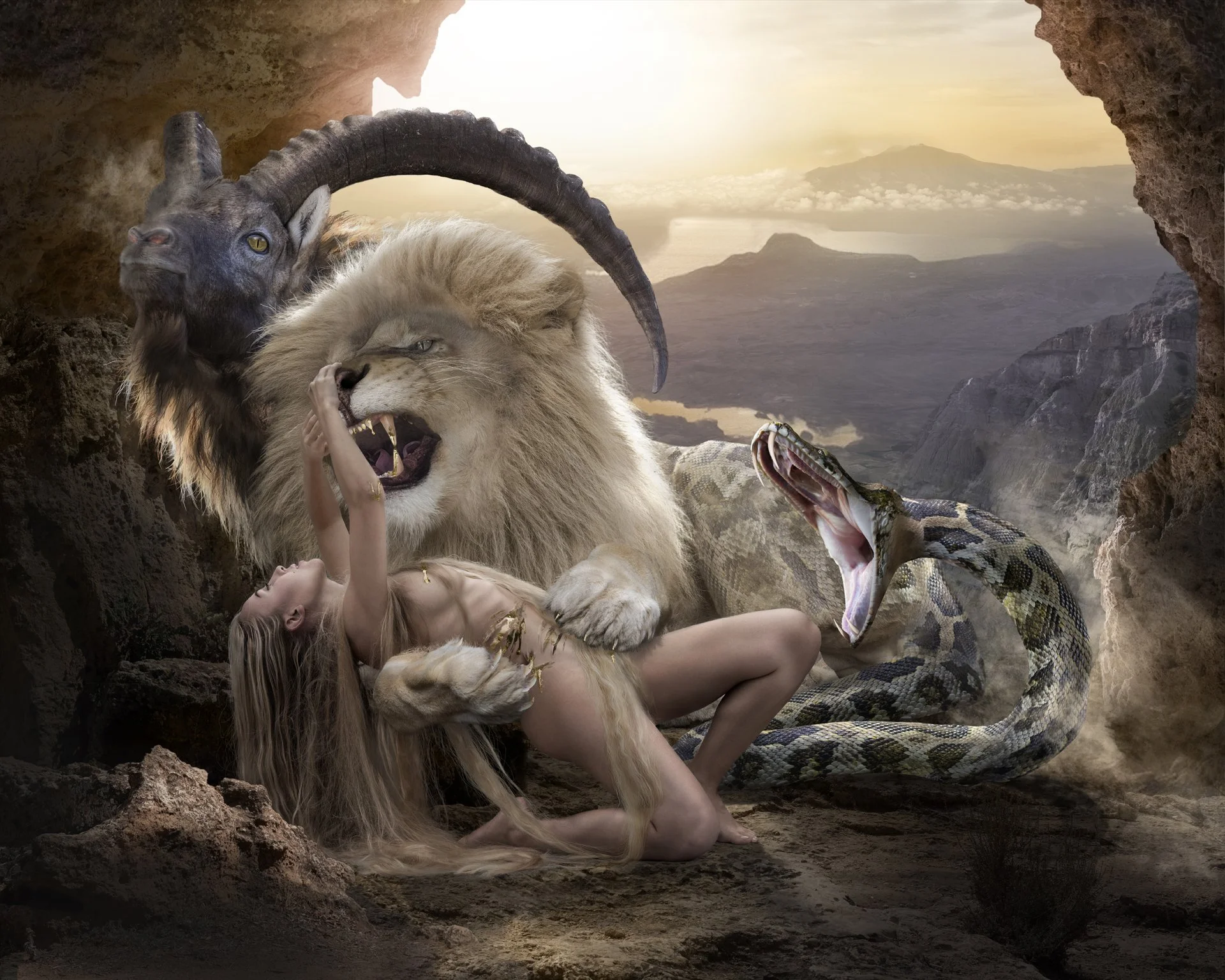
At the same time, there is a more internal dimension to this presence. In works such as the Where is Adam? series, where I embody the figure directly, often in a state of nudity, the act carries a quiet sense of exposure, not in a physical sense alone, but in a more enduring, inward way. The body becomes a vessel through which ideas of origin, innocence, and harmony are explored.
Inspired by the narrative of Genesis, these works are not intended as literal interpretations, but as reflections on a state of being, a world in which humanity and nature exist in complete balance. When I engage with this process, it feels less like constructing an image and more like entering a state of alignment, where intuition, creation, and something beyond the self seem to converge.
In that sense, the figure remains both present and absent, personal in its making, yet universal in its meaning, existing not as a portrait of the self, but as an invitation to reconnect with a more fundamental, shared origin.
In your statement, you suggest that celebrating beauty today can be understood as a form of resistance. Within contemporary art discourse, beauty has often been treated with suspicion, associated with seduction or aesthetic escapism. How do you negotiate this tension, and in what ways do you see beauty functioning as an ethical or philosophical strategy within your work?
For me, beauty is not superficial decoration but a gateway to deeper reflection.
In a world increasingly dominated by speed, noise, and distraction, beauty has the rare ability to slow us down. It invites us to pause and truly look. In that moment of attention, we reconnect with something fundamental, the quiet wonder that still exists within the natural world.
In this sense, beauty becomes a quiet form of resistance against indifference. What we find beautiful, we tend to remember. What we remember, we begin to value. And what we value, we are more inclined to protect.
My brother Ferron Collette often says, “It is effortless to create a monster; it takes practice and patience to create an angel.” He also asks a question that stayed with me: “If you strip away the story of the artwork, what value remains?”
For me, beauty is one of the most profound qualities an artwork can possess. It allows a work to transcend time, to remain meaningful beyond context, and to continue inspiring long after the moment of its creation.
That emotional connection is often the first step toward caring for what is fragile in our world.

Many of your compositions evoke the narrative structure of classical allegory, drawing upon references to Greek mythology, biblical symbolism, and fairytales. Yet these narratives are never illustrated literally; instead, they emerge through subtle symbolic arrangements of animals, architecture, and gesture. How consciously do you construct these allegorical frameworks, and how much space do you leave for ambiguity and viewer interpretation?
I do not approach these works as illustrations of specific narratives, but rather as explorations of certain moments, emotions, or possibilities within them.
When I draw from mythology, biblical stories, or fairytales, I am often interested in the space just before a turning point, a moment where the outcome is not yet fixed. I am often drawn to the possibility that a story could unfold differently.
In mythology, this might be an instant before fate unfolds. In biblical narratives, such as the story of Eden, many details remain open, the place, the animals, the nature of coexistence. This openness allows me to imagine alternative perspectives, often centered around harmony.
The allegorical structure is therefore constructed consciously, but not rigidly. I carefully compose the elements, animals, architecture, gestures, so that they suggest relationships and meanings without defining them completely.
Ambiguity is essential. It allows the image to remain open, inviting the viewer to bring their own interpretation, their own sense of narrative, into the work. In that sense, the image becomes less a fixed story and more a space for contemplation and possibility.
There is an intriguing dialogue in your work between the digital and the artisanal. While the compositions are assembled digitally through hundreds of layers, the final works are produced through the craftsmanship of master print ateliers. How important is this collaboration with traditional printing ateliers to the conceptual integrity of your photographic paintings?
The Artworks are fully conceived and created by me.
The role of the master print atelier is strictly related to the physical production of the work. They do not alter or interpret the image in any way. Their responsibility is to ensure that the final print faithfully reflects the original composition.
For each production, I personally select the atelier and oversee the process, particularly in terms of color accuracy and material quality. It is essential that the tones, depth, and details remain true to the original work as I have created it.
In that sense, the collaboration is not creative but precise and technical. The atelier functions as a highly skilled extension of the production process, ensuring that the work is realized physically with the same integrity with which it was conceived.
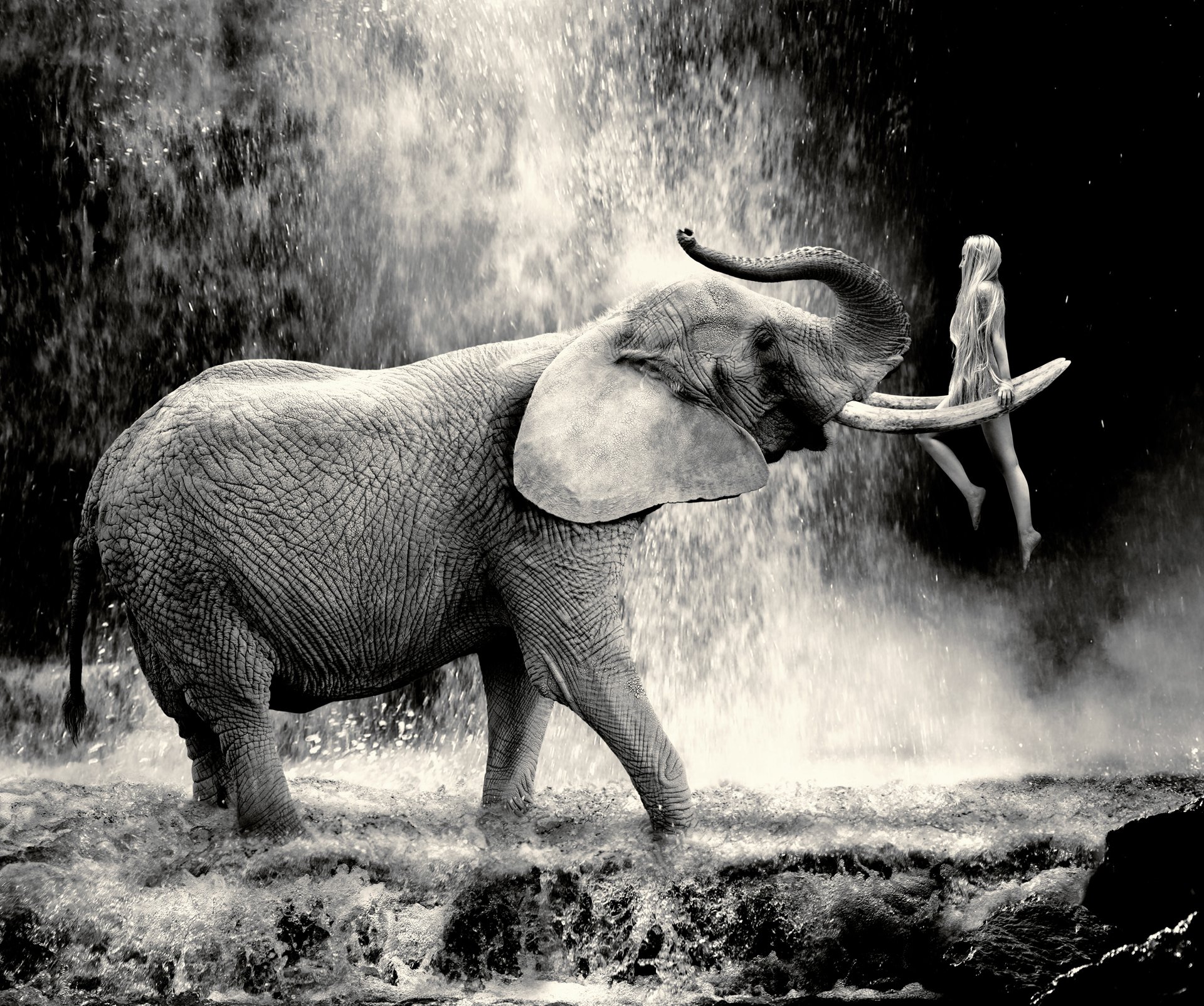
The animal kingdom in your work often appears calm, dignified, and almost sovereign within the pictorial space. Unlike documentary wildlife photography, these creatures seem to inhabit a symbolic rather than ecological reality. What role do animals play within your visual language?
Animals play a central role in my visual language because they embody a form of presence that feels both timeless and self-contained.
Unlike humans, they are not defined by constructed systems of power, culture, or ownership. In the images, they often appear calm and sovereign, not because they dominate the space, but because they exist in quiet alignment with their environment.
For me, the choice of each animal is very deliberate. There is often a strong sense that a particular animal belongs to a specific setting, as if it could not be replaced by another. Its form, movement, and color must resonate with the atmosphere of the space, creating a sense of harmony that feels almost inevitable.
In that sense, they move beyond an ecological context and take on a symbolic dimension. They represent continuity, adaptability, and a form of life that persists beyond human structures. They exist within time, but are not bound by the same sense of time as we are.
In works such as the Marvels series, where animals inhabit abandoned or decaying architecture, this relationship becomes more visible. The built environment, once a symbol of human presence, gradually recedes, while nature continues to evolve and reclaim its place.
The animals therefore become more than subjects. They act as quiet witnesses to time, reminding us of both the fragility of our creations and the enduring rhythm of the natural world.
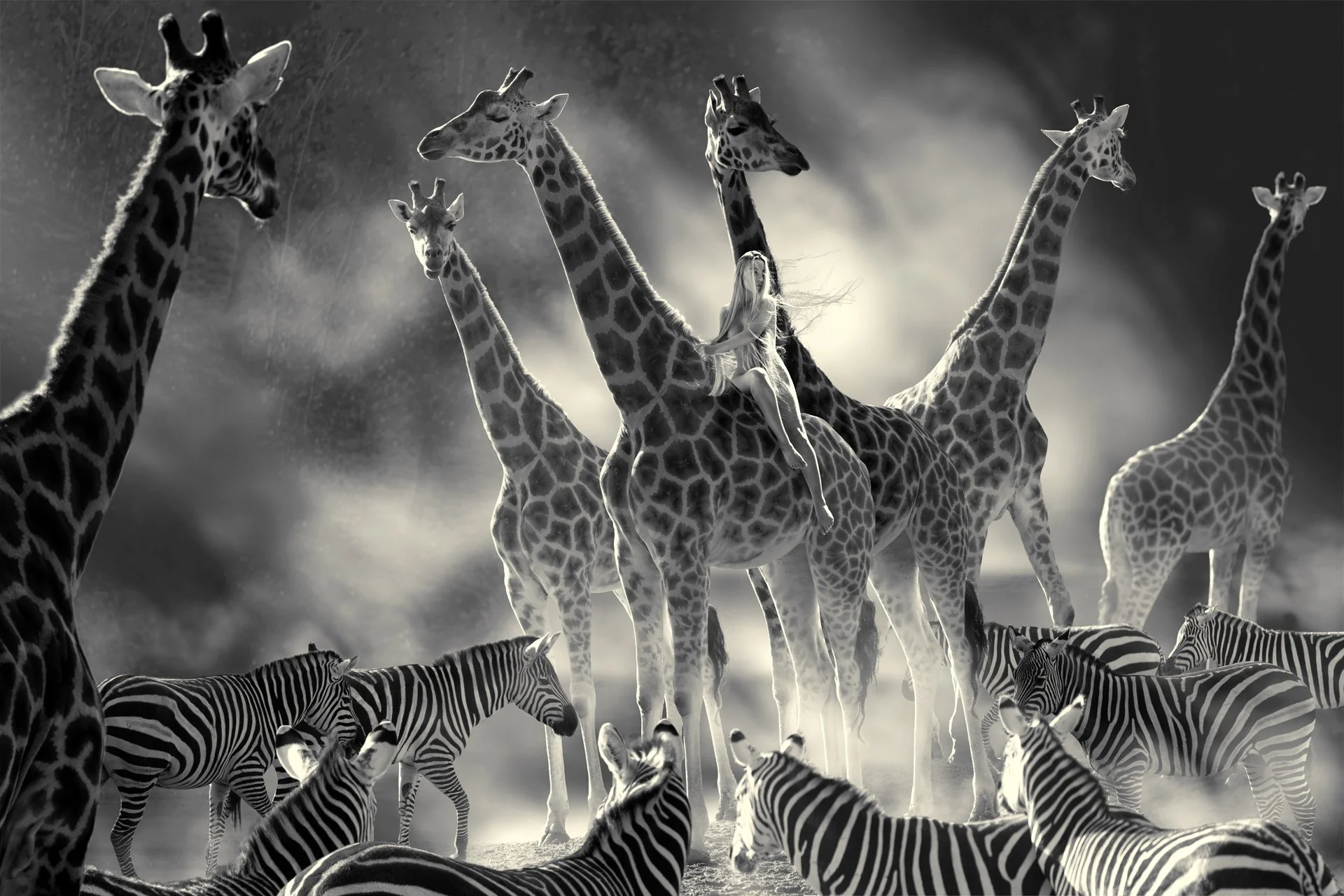
Your practice merges technological precision with a deep reverence for historical aesthetics. Do you see your work as participating in a broader rethinking of medium boundaries in contemporary art?
I think contemporary art is increasingly moving beyond strict medium boundaries, and in that sense my work naturally exists within that broader shift.
Historically, painting evolved through a continuous effort to render the visible world with greater precision. Over time, this pursuit of realism brought painting closer to what photography would later achieve, the ability to capture reality with remarkable fidelity, while still maintaining complete freedom in composition.
Photography, on the other hand, introduced a new level of accuracy in recording the world, but it is often bound to the moment it captures. In my practice, I work between these two traditions.
Photography allows me to gather fragments of reality as they exist, while the compositional process draws from the logic of painting, constructing scenes that go beyond a single moment. In that sense, the work can be seen as a continuation of a longer artistic trajectory, where realism and imagination are brought together within the same image.
The scale of your recognition, with hundreds of international awards within only a few years, is remarkable. Has this rapid global visibility influenced the evolution of your practice?
I am very grateful for the recognition, as it allows the work to reach a wider audience.
At the same time, I try to maintain a certain distance from external validation. The development of my work is guided primarily by an internal process, by curiosity, intuition, and the desire to explore new ideas.
Visibility can create opportunities and open doors, but it does not define the direction of the work itself.
In that sense, the evolution of my practice remains consistent. It continues to grow from the same foundation, while gradually expanding in depth and complexity.
The phrase you often invoke, “Beauty is the key that unlocks the doors to a better world.” In the context of global environmental fragility, do you see your imagined landscapes as a form of ecological meditation?
I would not describe the works as ecological statements in a direct sense, but they are certainly connected to a deeper awareness of our relationship with the natural world.
When I speak about beauty as a key, I see it as a way of opening perception. Beauty has the ability to slow us down and invite a more attentive way of looking. In that attention, a sense of connection often emerges.
At the same time, I believe beauty carries a more active potential. When people encounter something they perceive as truly beautiful, it can uplift them, it can inspire a sense of care, of kindness, of possibility. In subtle ways, it encourages us to act differently, to move with greater awareness, and perhaps with more intention toward the world around us.
The landscapes and environments in my work are not depictions of specific places, but constructed spaces in which nature, architecture, and human presence exist in a state of quiet harmony. They suggest a world that feels possible, rather than one that is lost.
In that sense, the images can be understood as a form of contemplation, not by pointing to what is wrong, but by reminding us of what is still worth valuing, and what we might continue to move toward. I am drawn to the idea that change does not always come through disruption, but through gradual refinement, a continuous movement toward something more balanced, more considered, more beautiful.
If that awareness creates even a small shift in how we see, think, or act, then it can carry outward, like a quiet ripple. And if enough of those moments accumulate, they begin to shape a different trajectory, one that moves, step by step, toward a more harmonious future.
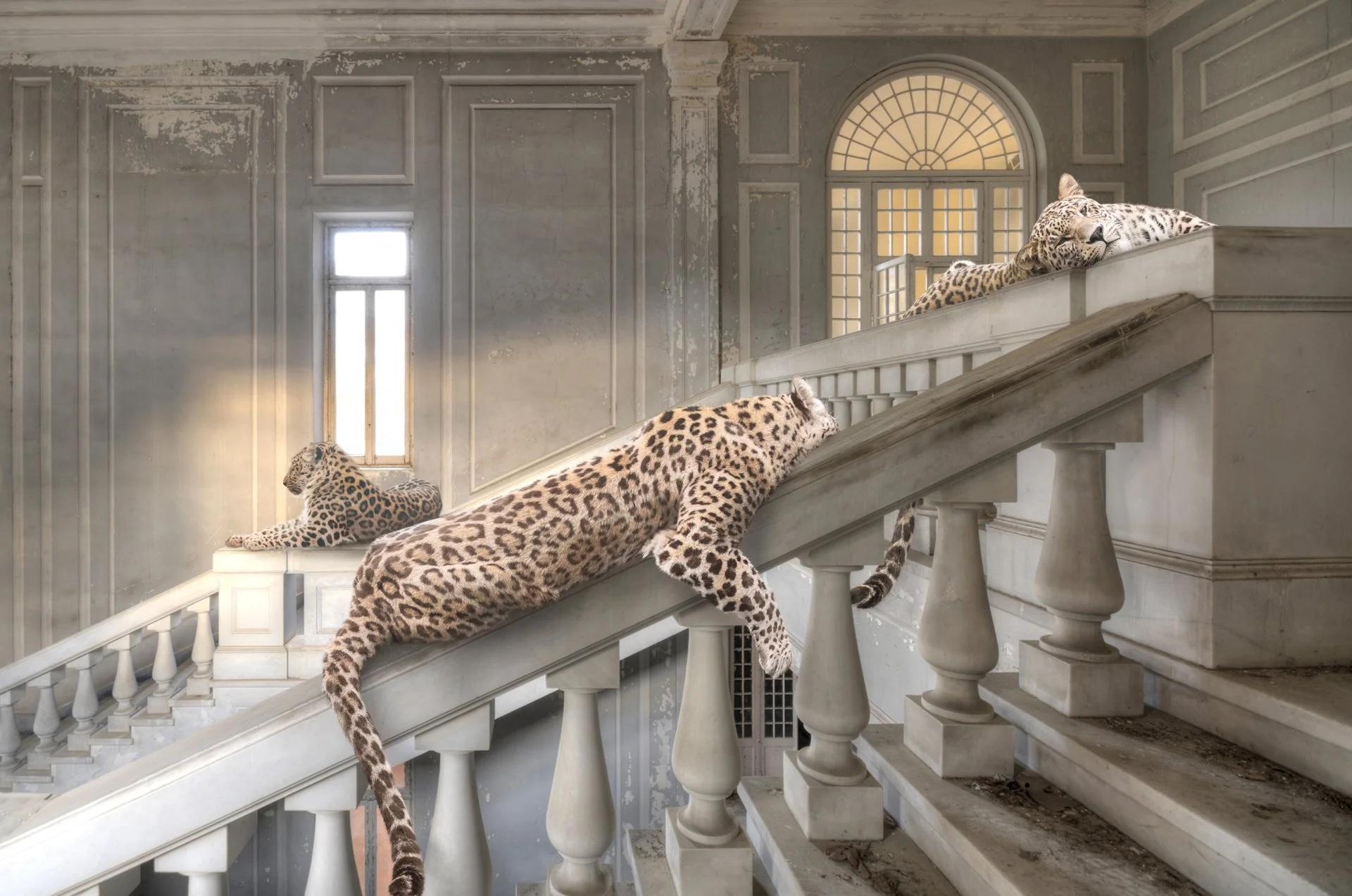
The merging of images from disparate locations suggests a form of visual world-building. Do you think of each artwork as an autonomous image, or as part of a larger evolving universe?
Each work is conceived as a complete and autonomous image, with its own internal balance and meaning.
At the same time, the works exist within series, where a certain harmony in color, atmosphere, and theme gradually emerges. Within a series, the images resonate with one another, creating a subtle sense of continuity without forming a fixed narrative.
I am interested in this balance between independence and connection. Each work invites the viewer into its own world, while still belonging to a larger shared language.
Across different series, there is also a deeper continuity. They often explore the relationship between humanity and the natural world, reflecting on both its fragility and its beauty, and suggesting a quiet search for harmony.
In that sense, the work is not constructed as a single continuous story, but as a constellation of images that share a common atmosphere and way of seeing.
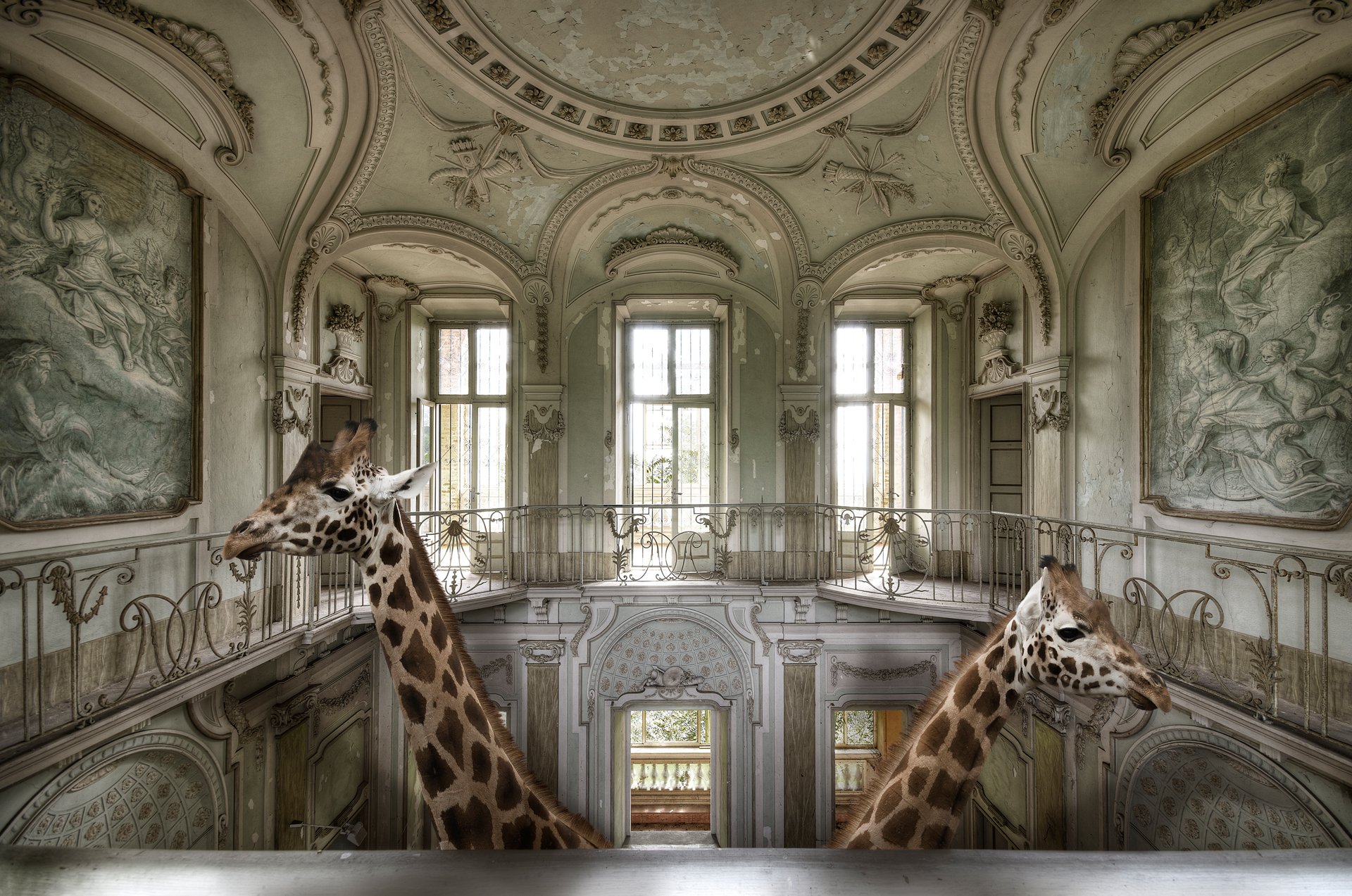
Your works often feel like portals into parallel realities where nature, architecture, myth, and the human figure coexist in improbable harmony. How do you hope viewers interpret these spaces?
I hope they are experienced as invitations rather than conclusions.
The worlds within the images are not meant to be read as fixed realities, but as spaces where different possibilities can exist side by side, places where nature, humanity, and imagination are not separated, but gently brought back into balance.
Perhaps they can be seen as moments that feel both familiar and unfamiliar at the same time, something that could exist, even if it does not.
I am less interested in defining how they should be interpreted, and more in allowing the viewer to enter the image and find their own sense of meaning within it.
At the same time, I do not see these spaces as an escape from reality, but rather as quiet propositions. They suggest that harmony, while it may appear distant, is not entirely beyond reach. That even within our current world, there are fragments of this balance, moments where things align more closely with what we intuitively feel to be right.
If the work can evoke a sense of wonder, stillness, or a renewed awareness of our connection to the world around us, then it has fulfilled its purpose. And perhaps, within that awareness, there is also a subtle shift, a reminder that while the future unfolds beyond our control, there remains a space within it where perception, intention, and action shape how we experience and move through what is given.
The worlds depicted may appear harmonious, yet they often hold a quiet tension within them, a balance between opposing forces, light and darkness, stillness and movement. In that sense, they are less about perfection, and more about the possibility of coexistence: what would it mean if humanity and the natural world could truly exist in balance, even within their differences?