Natalia Rose
Born in Stavropol, Russia, in 1953, Natalia Rose is a Danish abstract artist whose practice explores the expressive possibilities of color, gesture, language, and memory. Since settling in Denmark in 1981 and later becoming a Danish citizen, she has developed a body of work that investigates how painting can communicate experiences that lie beyond the descriptive capacities of words. Working primarily with acrylic and ink on linen and cotton canvas, Rose approaches abstraction as a visual language capable of conveying emotional, cultural, and intellectual complexities while remaining open to individual interpretation. Her paintings are characterized by richly layered surfaces, expressive brushwork, pictographic markings, and an enduring dialogue between spontaneity and structure, creating compositions that invite prolonged engagement rather than immediate resolution.
Although Rose established herself as a professional artist in 2010, the foundations of her artistic practice extend much further back. Throughout her life she maintained a deep commitment to creative expression, long before painting became her principal vocation. As she has often recalled, she cannot remember a period in which creativity was absent from her life. As a child she was continually occupied with making things, designing and sewing clothes, writing for newspapers, drawing, and painting. Creative activity was not understood as a separate discipline but as a natural mode of thinking and a way of engaging with the world. The pleasure of entering what she describes as a state of creative flow, where ideas could move freely between imagination and material form, remained a constant presence even when professional circumstances led her in other directions.
Growing up in the Soviet Union profoundly influenced her understanding of both creativity and artistic practice. At the time, pursuing a career as an artist appeared uncertain and impractical, encouraging her to seek a more conventional educational and professional path. Rather than abandoning creative ambitions, however, she carried them alongside her academic and professional life, allowing artistic ideas to mature gradually over many decades. She has described this period not as an interruption of creativity but as a time during which images, concepts, and visual possibilities continued to develop internally while awaiting an opportunity to find their appropriate form.
Rose's academic education reflected an equally strong interest in language, literature, and culture. She studied Philology and Literature at Lomonosov Moscow State University, graduating as a philologist before continuing her education after moving to Denmark. Between 1983 and 1986 she studied Film History and Danish Language at the University of Copenhagen, completing a Cand. Phil. degree. These studies established an intellectual foundation that would later become inseparable from her artistic practice. Although her eventual career shifted from language to painting, her enduring interest in communication, interpretation, translation, and cultural exchange continued to inform the conceptual framework of her work.
For more than three decades, from 1977 until 2010, Rose worked professionally in language teaching, journalism, and information technology. These occupations may appear distant from contemporary painting, yet they share concerns that would later emerge at the center of her artistic practice. Teaching languages requires sensitivity to the ways meaning shifts between linguistic systems. Journalism demands careful observation and the communication of complex ideas. Work within information technology introduces questions concerning structure, systems, and the organization of information. Throughout these years Rose remained immersed in different forms of communication, continually examining how ideas are transmitted, interpreted, and transformed.
Looking back, she has often described this extended professional period as essential rather than incidental to her artistic development. Rather than representing years lost to creativity, it broadened her understanding of culture, language, and human experience while confirming an increasing awareness that visual art offered possibilities unavailable through other forms of expression. Eventually, after exploring what she has called a conventional career, she recognized that something remained incomplete. The desire to return fully to creative work had never disappeared, and reconnecting with it became both a personal and artistic necessity.
When Rose decided to devote herself professionally to painting in 2010, the transition represented considerably more than a change of occupation. It marked the culmination of a lifelong search for the most appropriate medium through which to articulate ideas that had accompanied her for decades. She has described this decision as the moment when she finally became a whole person, suggesting that painting enabled different strands of her life, intellectual inquiry, cultural experience, memory, and imagination, to converge into a coherent artistic practice.
Her first exhibition in Copenhagen in 2014 established the public beginning of this new chapter. Although relatively late in comparison with many artists, Rose's emergence as a professional painter was distinguished by an unusual depth of lived experience and intellectual preparation. Rather than arriving at abstraction through formal experimentation alone, she approached painting after decades spent studying language, literature, culture, and communication. These experiences continue to shape both the conceptual concerns and the formal qualities of her work.
Since that first exhibition, Rose has developed an increasingly international exhibition profile. Her paintings have been presented in Denmark, New York, Paris, Amsterdam, London, Saint Petersburg, Barcelona, Zurich, Milan, Palermo, Venice, Dubai, Basel, Montreux, Niagara Falls, Nantes, Billiers, and numerous other cities through museums, biennials, galleries, art fairs, and curated exhibitions. At the same time, her works have entered private collections in the United States, Canada, Spain, Sweden, Denmark, and elsewhere, reflecting the broad geographical reach of her practice while remaining rooted in the intellectual concerns that have defined it from the beginning.
Despite this international presence, Rose's work has never been driven by geographical identity alone. Instead, her paintings emerge from a continual dialogue between different cultural experiences accumulated throughout her life. Born and educated in Russia, living in Denmark since 1981, and working within an increasingly international artistic context, she occupies a position between multiple cultural traditions rather than belonging exclusively to one. This condition of moving between languages, histories, and systems of thought has become one of the defining characteristics of her artistic outlook.
Rose has frequently described herself as a translator of culture and ideas. The phrase is particularly revealing because it connects her earlier academic and professional life directly with her painting. Translation is never a process of literal substitution. Every translation involves interpretation, adaptation, and transformation. Meanings shift as they pass from one language into another, preserving certain qualities while acquiring new ones. Rose approaches painting in much the same way. Her works do not illustrate concepts directly but translate experiences into color, gesture, rhythm, and symbolic form, allowing meanings to remain fluid rather than fixed.
This conception of painting as translation explains her continuing fascination with communication itself. Throughout her practice she asks how ideas can be transmitted without relying upon descriptive representation or literal language. What happens when words become insufficient? How can invisible experiences, emotions, memories, states of mind, and fleeting sensations, be communicated visually? Rather than attempting to answer these questions through theory, Rose explores them through the material language of painting.
At the heart of her work lies a sustained investigation into the relationship between image, word, and sound. These three systems of communication occupy different positions within human experience, yet each possesses expressive capacities unavailable to the others. Words define, analyze, and describe. Images evoke and suggest. Music communicates through rhythm, harmony, and emotional resonance without requiring verbal explanation. Rose's paintings occupy the fertile territory where these forms intersect, borrowing qualities from each while remaining fundamentally painterly.
Her choice of abstraction emerges directly from this investigation. Instead of depicting observable reality, she seeks to visualize emotional and intellectual experiences that cannot easily be represented through figurative imagery. She has often remarked that her paintings are concerned not with what she sees but with what she remembers, what she imagines, and ultimately what she wishes to see. This distinction is central to understanding her practice. Memory becomes more significant than observation, and imagination becomes a means of extending reality rather than escaping it.
Consequently, Rose's paintings avoid functioning as illustrations of specific narratives or places. They create environments in which color, gesture, symbolic forms, and layered surfaces communicate emotional states that remain deliberately open. Rather than directing viewers toward predetermined conclusions, the paintings invite them to participate in constructing meaning through their own memories, associations, and experiences.
This openness reflects one of the most consistent principles guiding Rose's work. She has repeatedly emphasized that every viewer brings a different personal history to a painting. Dreams, fears, desires, cultural background, and lived experience inevitably shape interpretation. Rather than attempting to control this process, she embraces it. For Rose, the richness of art lies precisely in its ability to generate multiple readings simultaneously. A successful painting continues to evolve through every encounter, acquiring new meanings without ever becoming exhausted by a single interpretation.
Her admiration for artists and thinkers who understood art as a language further illuminates this position. Rose has frequently referred to Eugène Delacroix's observation that a work of art can communicate more than any text, while also drawing inspiration from Wassily Kandinsky's writings on the profound relationship between painting, music, and the inner life. These references are not simply historical acknowledgements but reflections of concerns that remain active within her own practice. Like Kandinsky, she approaches abstraction as a means of addressing emotional and spiritual dimensions that exceed verbal articulation. Like Delacroix, she believes that painting possesses communicative powers unavailable to written language.
For Rose, the decision to paint instead of writing was therefore not a rejection of language but its continuation by other means. Painting allowed her to pursue the same questions that had occupied her through philology and literature while freeing those questions from the limitations of syntax and definition. Where language necessarily fixes meaning, painting allows ambiguity to flourish. Where words require precision, color permits complexity. Where verbal explanation often reduces emotional experience, abstraction enables contradictory feelings to coexist without requiring resolution.
This understanding established the conceptual foundations upon which Rose's mature artistic practice would develop, leading her toward an increasingly nuanced exploration of color, music, memory, and the invisible dimensions of human experience that continue to define her work today.
Building upon these foundations, Rose has gradually developed an artistic language that places communication itself at the center of her practice. Rather than understanding painting as an object to be viewed passively, she approaches each work as an active encounter between artist, artwork, and viewer. Meaning does not reside exclusively within the painting, nor does it belong entirely to the artist's intention. Instead, it emerges through the exchange that takes place when a viewer engages with the work. This relationship between sender and receiver has become one of the defining conceptual concerns running throughout her paintings, where color, gesture, and symbolic markings operate as vehicles for communication while remaining deliberately resistant to fixed interpretation.
Her interest in communication extends beyond language in its conventional sense. Throughout her work she returns to a recurring question: how can experiences that have no precise verbal equivalent be conveyed visually? Emotions, memories, intuition, atmosphere, longing, and imagination all exist beyond the boundaries of straightforward description. They are undeniably real, yet difficult to define. Rose understands painting as uniquely suited to addressing these forms of experience because it is capable of communicating through sensation rather than explanation. Instead of illustrating emotions, her paintings attempt to create conditions in which emotional experiences become perceptible through color, rhythm, and movement.
This concern has increasingly led her to investigate the relationship between painting and music. Although the two disciplines employ different materials, Rose recognizes significant parallels between them. Music communicates without requiring representational imagery, relying instead upon rhythm, harmony, tempo, dynamics, and tonal relationships to evoke emotional responses. Painting, in her view, possesses comparable capacities through color, composition, gesture, texture, and spatial relationships. Rather than treating music as a subject to depict, she considers it a structural model that informs the organization of her paintings.
Within this framework, colors function much like musical notes. Individual colors possess distinct expressive qualities, while combinations create visual harmonies and dissonances analogous to musical composition. Rose has described shades of blue as capable of suggesting tenderness, allowing a painting to resonate with the quiet intimacy of a flute. Deep ultramarine evokes a different emotional register, recalling the solemn grandeur of an organ. Green may suggest the joyful resonance of a violin, while black can transform that same instrument into a vehicle for melancholy. These associations are not intended as rigid symbolic systems but as invitations for viewers to experience color emotionally rather than analytically.
By approaching painting through musical analogy, Rose shifts attention away from representation toward perception itself. Just as one cannot literally see music yet instinctively responds to its emotional force, she invites viewers to experience paintings without searching immediately for recognizable objects or narratives. Color becomes an event rather than an illustration. Rhythm becomes a mode of communication. Composition unfolds as a sequence of visual intervals whose meaning arises through feeling rather than description.
This relationship between painting and music also reflects her continuing fascination with what she describes as the invisible. Throughout her practice she repeatedly returns to the question of what constitutes the invisible. Is it simply that which cannot be seen, or does it include everything that escapes concrete language and material form? Feelings, memories, atmosphere, intuition, and emotional states occupy this invisible realm. They shape human experience profoundly while resisting direct observation. Rose's paintings seek not to depict these phenomena literally but to create visual equivalents capable of making them perceptible.
Her emphasis on invisibility distinguishes her abstraction from purely formal investigations into color and composition. Although her paintings demonstrate considerable attention to painterly structure, they remain grounded in questions concerning lived experience. Every composition begins from an attempt to communicate something emotionally tangible yet visually intangible. The resulting paintings operate simultaneously as aesthetic objects and as meditations on perception, memory, and communication.
These concerns become particularly evident in Rose's understanding of abstraction itself. Rather than viewing abstraction as a departure from reality, she regards it as a means of approaching aspects of reality that figurative representation cannot adequately address. Observable objects are less important than remembered emotions. Physical appearances become secondary to psychological and cultural experience. Consequently, her paintings rarely seek to reproduce the visible world. Instead, they construct emotional landscapes in which color, texture, and symbolic forms evoke states of mind that remain intentionally open-ended.
Rose has often remarked that her paintings depict not the world as it exists but the world as she wishes to see it. This statement should not be understood as escapism or idealization. Rather, it reflects her conviction that art possesses the capacity to imagine alternative realities shaped by hope, beauty, complexity, and reflection. In an age characterized by speed, distraction, and continuous streams of information, painting becomes a space where attention can slow down and where deeper emotional and intellectual engagement becomes possible.
This aspiration is closely connected to her broader understanding of the role of art within contemporary society. Rose has consistently argued that meaningful art should communicate depth, complexity, and nuance. It should resist becoming merely decorative or immediately consumable. Rather than producing works designed for instant gratification, she seeks to create paintings that reward sustained looking and repeated encounters. Their layered surfaces, symbolic ambiguities, and shifting color relationships encourage viewers to remain with the work, allowing interpretations to evolve gradually over time.
In discussing contemporary culture, Rose frequently observes that modern life is characterized by constant movement and an overwhelming intensity of impressions. Information arrives continuously, often leaving little opportunity for sustained reflection. Within this environment she identifies an increasing sense of separation and loneliness, accompanied by a simultaneous desire for connection and individuality. Human beings seek meaningful relationships while also striving to preserve distinct identities. These tensions between closeness and distance, communication and misunderstanding, individuality and shared experience quietly inform many aspects of her artistic practice.
Painting, in this context, becomes a means of addressing conditions that cannot easily be resolved through direct social commentary. Rather than illustrating political events or specific contemporary issues, Rose investigates their emotional and psychological consequences. Her work reflects the complexity of living within a rapidly changing world without reducing that complexity to simple narratives. Beauty, for her, is not an escape from reality but a way of engaging with it more profoundly.
She has often expressed the belief that beauty possesses transformative potential. This conviction does not imply superficial attractiveness but refers instead to experiences capable of fostering reflection, empathy, and emotional understanding. True art, in her view, spreads joy while simultaneously encouraging deeper thought about nature, culture, and human existence. Beauty and depth are inseparable because aesthetic experience becomes meaningful only when it engages both perception and thought.
This perspective also informs her approach to abstraction as an ethical rather than purely formal practice. By refusing to dictate fixed meanings, Rose grants viewers the freedom to participate actively in interpretation. Every encounter becomes collaborative. A painting remains incomplete until someone engages with it, bringing personal memories, cultural references, and emotional experiences into dialogue with the visual language before them. Consequently, ambiguity functions not as obscurity but as generosity, creating space for multiple legitimate interpretations to coexist.
Rose has frequently remarked that whatever meaning a viewer discovers within a painting inevitably reflects something of that individual's own inner life. Dreams, fears, desires, memories, and expectations all shape perception. This understanding echoes her description of herself as a translator rather than an instructor. She offers visual possibilities rather than definitive conclusions. The paintings propose conversations rather than arguments.
Such openness is reinforced by her rejection of perfection as an artistic objective. Since an early age she has consciously resisted ideals of flawless execution or complete resolution. Instead of pursuing polished surfaces or predetermined outcomes, she embraces uncertainty as an essential component of creativity. Color combinations take precedence over descriptive imagery. Gestural marks remain visible rather than concealed. Layers accumulate through revision rather than linear progression. The resulting paintings preserve traces of their own making, allowing viewers to witness processes of change rather than only finished appearances.
This philosophy extends beyond technique into her broader conception of artistic growth. Rose consistently rejects the notion that a painting should succeed immediately or perfectly from its first conception. She believes that meaning develops dynamically through continual revision. A work evolves by responding to its own internal demands rather than simply executing an initial plan. This openness to transformation has become one of the defining characteristics of her mature practice and contributes significantly to the sense of vitality present throughout her paintings.
The emotional intensity of Rose's work also derives from the relationship between memory and imagination. Instead of painting directly from observation, she returns repeatedly to remembered emotional moments that continue to resonate long after their original circumstances have passed. Memory functions not as documentary evidence but as a creative force capable of reshaping experience. These remembered fragments combine with imagination to produce visual environments that feel psychologically authentic while remaining visually nonrepresentational.
Literature, history, culture, and extensive reading provide many of the conceptual starting points for her paintings. Rather than illustrating literary texts or historical events directly, Rose allows ideas encountered through reading to become catalysts for visual exploration. The resulting works rarely contain explicit references, yet they carry the intellectual weight of sustained engagement with cultural history. This relationship between reading and painting further reflects the continuity between her earlier academic life and her mature artistic practice. Language remains present, not through written narrative, but through structures of thought translated into visual form.
Her canvases are frequently large in scale, a decision that reflects both practical and conceptual considerations. Rose has remarked that expansive surfaces allow sufficient room for the complexity and nuance she seeks to communicate. Large formats accommodate multiple layers of gesture, color, and symbolic form while encouraging viewers to experience the painting physically as well as visually. Rather than functioning as windows onto imaginary scenes, the canvases become environments that surround perception, allowing emotional and spatial relationships to unfold gradually across the painted surface.
Underlying all these aspects of Rose's practice is a sustained commitment to authenticity. She has consistently encouraged emerging artists to resist adapting their work according to external expectations or market trends. Instead, she advocates continuous learning, intellectual curiosity, and openness to experimentation. Authenticity, for her, does not signify spontaneous self-expression alone but emerges through disciplined engagement with ideas, materials, and experience over extended periods of time. This philosophy mirrors her own artistic development, which unfolded gradually across decades before finding its mature form in painting.
By bringing together color, music, language, memory, and abstraction within a coherent visual language, Rose has established a practice that is both intellectually grounded and emotionally resonant. Her paintings invite viewers into spaces where perception slows, meanings remain fluid, and communication extends beyond the limitations of words, preparing the ground for the highly distinctive methods and painterly processes through which her works ultimately come into being.
Rose's distinctive visual language is inseparable from the highly intuitive process through which her paintings are made. While her work is supported by years of reflection, reading, and conceptual inquiry, the act of painting itself remains deliberately open and exploratory. Rather than translating a predetermined image onto the canvas, she allows each work to develop through an ongoing dialogue between intention and discovery. The resulting paintings retain a sense of immediacy and spontaneity, even though they often require months or, in some cases, years to reach completion.
One of the defining characteristics of Rose's practice is that she begins directly on the canvas. She does not prepare preliminary sketches or detailed compositional studies. Instead, the first marks establish a point of departure rather than a fixed destination. This approach reflects her conviction that paintings possess an internal logic that cannot always be anticipated in advance. The artist may initiate the process, but the work gradually begins to determine its own direction.
Rose has described this relationship as a dialogue rather than an act of control. While she provides the opening gesture, the painting continually responds, presenting new visual possibilities that require careful attention and often demand significant departures from the original idea. Rather than resisting these unexpected developments, she welcomes them as an essential aspect of artistic creation. The painting, in her words, tells her that it must go elsewhere.
This willingness to relinquish complete control distinguishes her practice from approaches based upon strict planning or compositional certainty. For Rose, excessive planning risks limiting the vitality of a work before it has an opportunity to evolve. She has remarked that she finds painting uninteresting when everything has already been decided in advance. The most rewarding stage of the creative process occurs after the initial direction has been established but before the final form has emerged, when uncertainty becomes productive and the painting begins to reveal possibilities that neither artist nor viewer could have predicted at the outset.
As a consequence, every canvas becomes the record of a prolonged conversation. Layers accumulate gradually through cycles of construction and revision. Rose paints, paints over, adds, removes, erases, obscures, and reintroduces forms repeatedly. Images disappear beneath subsequent layers while traces of earlier decisions remain visible beneath the surface. Every completed painting therefore contains numerous earlier versions embedded within it, creating an unusually rich material history.
She has noted that some works preserve remnants of ten to fifteen earlier paintings beneath their final appearance. These hidden layers are not simply technical corrections but integral components of the finished work. They contribute to the depth, texture, and visual complexity that distinguish her paintings, allowing previous gestures to remain subtly present even when no longer immediately visible. The surface becomes a record of accumulated decisions rather than a single resolved image.
This process also explains why many of her paintings require extended periods to complete. Some evolve over several months, while others remain in the studio for years before reaching a point where she considers them resolved. Time becomes another material within the work. Instead of treating completion as the execution of an original idea, Rose understands it as the gradual emergence of meaning through sustained engagement with the painting itself.
Her rejection of the notion of "right the first time" reflects this philosophy. Rather than valuing immediate success or technical perfection, she believes that meaning develops dynamically through revision. Every alteration creates new relationships between colors, forms, and gestures. Unexpected visual discoveries emerge only because earlier assumptions have been questioned or abandoned. Completion therefore represents not certainty but the point at which the painting achieves an internal coherence while still retaining traces of its own evolution.
This openness to revision has increasingly led Rose toward an exploration of the aesthetic concept known as non finito, or intentional incompleteness. Throughout recent years she has expressed a growing interest in works that embrace the unresolved rather than striving for total finish. Historically associated with artists who allowed portions of a work to remain visibly unfinished, the concept has taken on new significance within contemporary art as a way of challenging conventional distinctions between making and unmaking.
Rose's interest in non finito is not primarily historical but philosophical. She is less concerned with reproducing earlier artistic methods than with the questions they raise about process, completion, and interpretation. She has often referred to artists such as Paul Cézanne, Jackson Pollock, and Robert Rauschenberg, whose practices expanded conventional understandings of what it means for a work to be finished. Their examples reinforce her own belief that artistic meaning frequently emerges through openness rather than closure.
Within Rose's paintings, incompleteness does not suggest abandonment. Instead, it functions as an invitation. By resisting excessive refinement or absolute resolution, she leaves interpretive space for the viewer. Certain passages remain deliberately ambiguous. Gestures appear interrupted. Layers remain visible instead of being concealed beneath polished surfaces. These qualities encourage sustained observation, allowing viewers to participate imaginatively in completing the work through their own perceptions and associations.
Her exploration of non finito therefore extends naturally from her broader philosophy of communication. Just as language never fully captures emotional experience, paintings should not attempt to eliminate every ambiguity. Their power often resides precisely in what remains unsaid. The unresolved becomes productive because it allows multiple meanings to coexist without requiring definitive explanation.
This approach can be seen clearly in works from her Blossoming series, where paintings explore emotional states associated with memory, gratitude, beauty, and nature while avoiding literal representation. Rose has described works such as Everyday on My Way as expressions of gratitude for the beauty of flowers during the blossoming season. Rather than depicting botanical forms naturalistically, however, the painting transforms these experiences into abstract relationships of color and movement that evoke emotional responses rather than visual description.
Similarly, Unfading Flowers approaches memory through an intentionally iconic structure. The work reflects feelings of nostalgia without attempting to illustrate specific recollections. Instead, memory becomes atmospheric, communicated through layered surfaces, color relationships, and symbolic suggestion. Here again, the unresolved quality of the image allows individual viewers to connect their own experiences of remembrance to the painting rather than simply receiving the artist's personal narrative.
These examples illustrate Rose's conviction that paintings should not merely represent the visible world. Their task is to evoke the emotional conditions underlying experience. Nature, memory, culture, and personal history all become starting points for abstraction rather than subjects to be depicted directly.
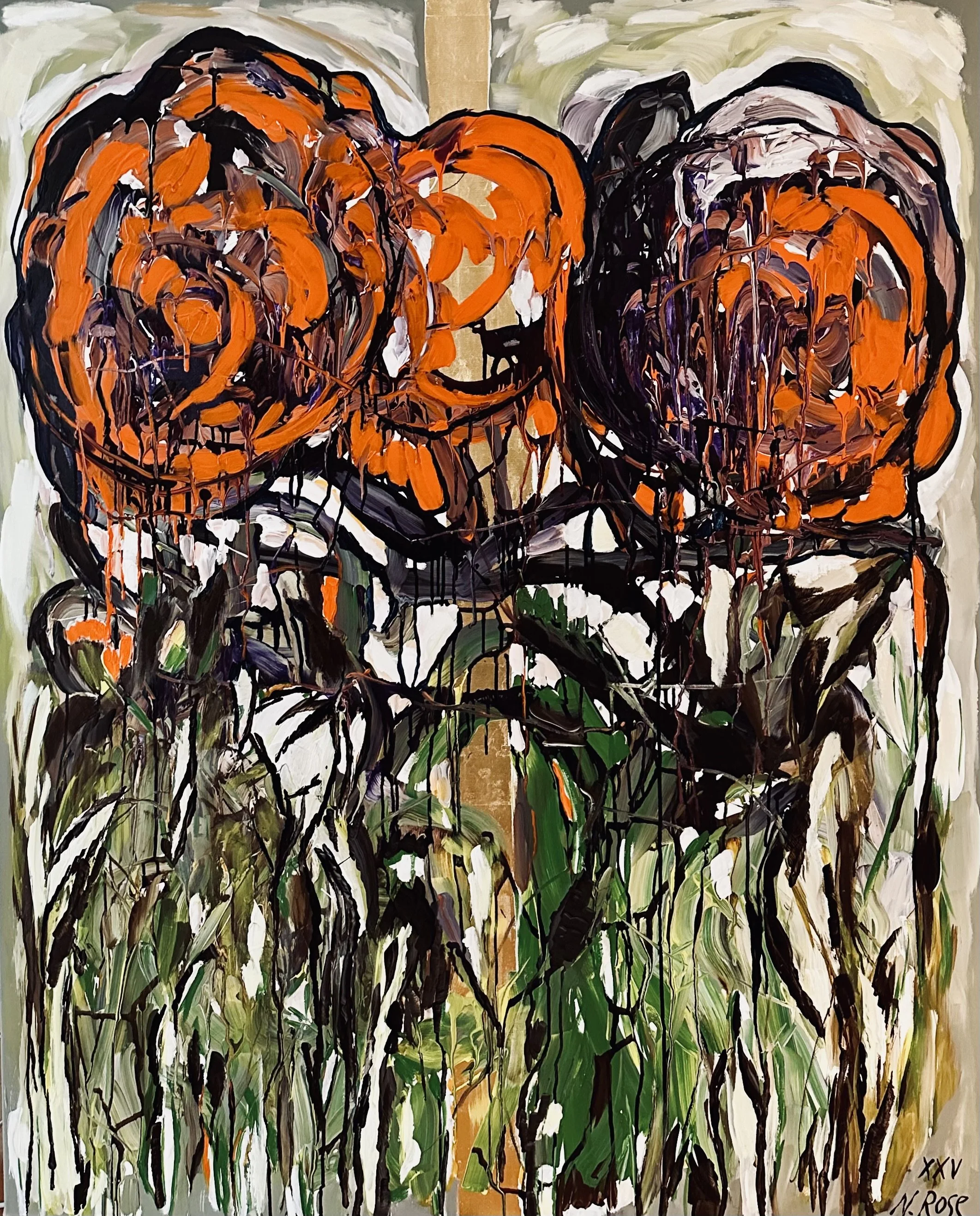
Her painterly vocabulary reflects this emphasis on emotional communication. Broad, energetic brushstrokes establish rhythmic movement across the canvas, while pictograph-like symbols appear intermittently within fields of color. These iconographic elements never function as a stable symbolic language with fixed meanings. Instead, they operate more like fragments of an evolving visual alphabet whose significance changes according to context, color, and composition.
Language itself frequently becomes visual material within Rose's work. Having spent much of her academic and professional life immersed in philology and linguistic study, she approaches written signs not only as carriers of information but also as visual forms possessing aesthetic presence. Letters, symbols, and marks occasionally appear within her paintings, no longer functioning primarily as readable text but as painterly elements integrated into broader compositional relationships.
She has remarked that by emphasizing aesthetics she attempts to grasp language itself. Once transformed into visual form, language becomes ornament while simultaneously revealing its inherent ambiguities. The stability ordinarily associated with words begins to dissolve. Meanings multiply rather than narrow. The distinction between reading and seeing becomes increasingly fluid.
This transformation of language into image contributes to one of the most distinctive aspects of Rose's practice. Rather than separating verbal and visual communication, she allows them to overlap continuously. Her paintings suggest that language itself possesses visual qualities, just as color and gesture may communicate with a linguistic precision that exceeds words.
The influence of her background in literature and philology therefore remains present even within her most abstract works. Every painting emerges from an artist deeply attentive to the structures through which meaning is produced, transmitted, and transformed. Yet instead of relying upon verbal explanation, Rose consistently chooses the openness of visual communication, trusting color and form to articulate complexities beyond the reach of literal description.
Her paintings have often been described as possessing a storytelling quality, although the narratives they contain differ fundamentally from conventional illustration. Stories unfold through successive layers, shifting relationships, and emotional transitions rather than through identifiable characters or sequential events. Every surface contains evidence of previous states, allowing viewers to sense an underlying history even when its precise details remain inaccessible.
This layered narrative structure parallels the operation of memory itself. Human memory rarely preserves events in complete chronological order. Instead, recollections overlap, fade, re-emerge, and transform through time. Rose's paintings reflect this process visually. Earlier gestures remain partially visible beneath later decisions, creating compositions that resemble accumulated memories rather than static images.
Such complexity also explains why her works often reward repeated viewing. Initial impressions gradually give way to subtler discoveries as underlying layers, color relationships, and symbolic forms become more apparent. Rather than offering immediate visual resolution, the paintings continue to unfold over time, encouraging viewers to slow their pace of observation and remain attentive to the richness of the painted surface.
This resistance to immediacy represents a conscious response to contemporary visual culture. Rose has frequently expressed concern that the accelerated rhythms of modern life leave insufficient space for prolonged attention. Images are consumed rapidly before being replaced by others. Painting, in contrast, offers the possibility of sustained engagement. It asks viewers not simply to look but to remain with the work, allowing perception and understanding to deepen gradually.
Her own working rhythm reflects this same commitment to patience. Although ideas frequently emerge late in the evening while reading, thinking, or watching films, she prefers to paint during daylight, relying upon natural light to perceive the full complexity of color relationships. These periods of reflection before physical execution reinforce the dialogue between intellectual inquiry and intuitive painterly action that characterizes her entire practice.
The cumulative result is a body of work in which process remains visibly present. Rather than concealing revision beneath polished finish, Rose allows every painting to retain evidence of its own becoming. Layers, erasures, interruptions, and unexpected transformations all contribute to surfaces that remain alive with the history of their making. Each canvas becomes both an image and a record of thought in motion, embodying the belief that artistic meaning is not imposed upon the work but discovered through continuous conversation between artist, material, and time.
Throughout Rose's career, the visual language of her paintings has evolved without abandoning the central questions that first motivated her practice. Rather than moving through sharply defined stylistic periods, her work demonstrates a gradual deepening of recurring concerns. Color, gesture, language, memory, and communication continue to occupy the center of her artistic investigation, while the relationships between these elements have become increasingly nuanced over time. The continuity of these interests gives her oeuvre a remarkable coherence. Each new body of work expands conversations already present in earlier paintings, allowing ideas to mature organically rather than replacing one conceptual framework with another.
Among the most significant aspects of Rose's practice is her sustained exploration of identity. Rather than approaching identity as something fixed or singular, she understands it as a dynamic condition shaped by history, geography, language, memory, and cultural experience. Having been born and educated in Russia before building her adult life in Denmark, she occupies a position between different cultural traditions. This experience does not produce a divided identity but one that continually negotiates multiple histories and systems of meaning.
Her paintings often emerge from this space between cultures. They neither illustrate autobiographical episodes nor function as straightforward representations of Russian or Danish visual traditions. Instead, they create a visual territory in which different cultural memories coexist, overlap, and occasionally challenge one another. Rose has described her work as creating a visual map of identity in which Eastern and Western ideas of beauty, mythology, and cultural memory intermingle. Rather than resolving these differences, her paintings allow their tensions to remain visible, suggesting that identity itself is formed through continual negotiation rather than stable definition.
The experience of migration has naturally informed this perspective. Living in Denmark since 1981 while maintaining connections to her Russian origins has encouraged an understanding of culture as something fluid rather than fixed. Throughout her work, historical references, symbolic forms, and painterly gestures coexist without hierarchy. Familiar visual traditions are transformed through abstraction until they become part of a broader language capable of communicating across cultural boundaries.
Rose has frequently acknowledged that growing up in the former Soviet Union profoundly influenced her understanding of freedom. Although her paintings do not operate as political statements, the experience of living within that historical context remains an enduring presence in her artistic thinking. Freedom, for Rose, extends beyond political structures into the realm of imagination itself. The ability to create without predetermined limitations, to allow paintings to evolve independently, and to embrace ambiguity rather than certainty all reflect an understanding of artistic freedom that has been shaped by personal experience.
Throughout her career she has described art as the most accurate translator of experiences that words could not adequately communicate. This conviction becomes especially significant in relation to memory. Personal memories rarely appear in her paintings as identifiable events or narratives. Instead, they survive as emotional atmospheres, fragments of color, symbolic traces, and layered gestures that preserve the intensity of experience without fixing it within literal representation. Memory therefore functions not as documentation but as an active creative force.
This understanding of memory aligns closely with the multilayered structure of her paintings. Just as recollections are continually revised by later experiences, the surfaces of Rose's canvases preserve earlier states beneath subsequent revisions. Every layer contributes to the final composition even when it remains only partially visible. Past and present coexist within the same visual field, allowing paintings to embody the temporal complexity of remembered experience.
Historical imagery also enters her work in similarly indirect ways. Rather than quoting historical sources explicitly, Rose absorbs cultural references until they become integrated within her painterly vocabulary. Literature, mythology, visual traditions, and broader cultural history provide conceptual points of departure without ever limiting the paintings to singular historical narratives. The resulting works remain open to contemporary interpretation while carrying traces of historical consciousness beneath their abstract surfaces.
One recurring aspect of her practice is the dialogue between Eastern and Western visual traditions. Rose has spoken about the way her work brings together Russian and Danish worlds while also engaging broader European artistic histories. These encounters are never presented as oppositions requiring resolution. Instead, they become opportunities for productive exchange. Different aesthetic traditions enrich one another, generating new possibilities for abstraction that reflect the complexity of contemporary cultural identity.
Her paintings therefore resist simplistic categorization within national schools of abstraction. Although her Russian origins remain visible through certain cultural references and painterly sensibilities, her decades of life in Denmark have become equally significant. The result is an artistic language shaped through movement between cultures rather than exclusive identification with either one.
Rose has also acknowledged the importance of several artists whose work has informed her thinking, while consistently transforming these influences into something distinctly her own. Among Russian artists she has expressed admiration for Kazimir Malevich, Natalia Goncharova, and Mikhail Vrubel. Their willingness to combine spiritual, symbolic, and formal concerns offered important precedents for her own investigations into abstraction and visual language. At the same time, the expressive intensity of artists such as Emil Nolde, Edvard Munch, Jackson Pollock, Kazuo Shiraga, and Henri Matisse has contributed to her understanding of color, gesture, and emotional communication.
These references should not be understood as stylistic borrowings. Rose's paintings do not imitate individual predecessors. Instead, they reveal an ongoing dialogue with broader traditions of European modernism, Abstract Expressionism, Russian avant-garde painting, and expressionist color theory. What she adopts from these artists is not appearance but permission: permission to treat color as an independent expressive force, to embrace painterly gesture, and to allow emotional intensity to guide formal decisions.
The relationship between color and form occupies a particularly important place within this dialogue. Rose frequently approaches color as the primary organizing principle of the painting rather than as something applied to predetermined forms. This perspective recalls theories advanced by artists such as Hans Hofmann, whose observation that color brings forth form rather than merely filling it resonates strongly with her own practice. Within Rose's paintings, forms often emerge through interactions between colors instead of existing as outlined shapes awaiting completion.
Warm and cool colors continually establish shifting spatial relationships across her canvases. Depth arises through optical interaction rather than traditional perspective. Movement develops through contrasts in hue and saturation. Areas of intense color advance or recede, creating dynamic compositions in which space remains fluid and unstable. Rather than constructing illusionistic depth, Rose encourages viewers to experience color itself as an active force capable of generating rhythm, movement, and emotional resonance.
Her use of pictographic symbols contributes another important dimension to this visual language. These recurring marks often resemble fragments of writing, ancient signs, or invented alphabets. Yet they resist translation into conventional linguistic meaning. Instead, they function as visual events that suggest communication without becoming fully decipherable. Their presence reinforces one of the central paradoxes within Rose's work: painting can communicate profoundly while remaining fundamentally ambiguous.
This ambiguity is intentional. Rose consistently resists assigning fixed meanings to individual symbols or color relationships because doing so would limit the viewer's interpretive freedom. Instead, pictographic forms remain open, allowing associations to emerge according to each viewer's own experiences. Some may perceive traces of language, others references to memory, mythology, or personal symbolism. None of these readings excludes the others.
One of her best-known works, I (2016), illustrates this approach particularly clearly. In the painting, essential brushstrokes simultaneously suggest the letter itself while generating broader rhythmic patterns across the canvas. Language and abstraction become inseparable. The work demonstrates how minimal visual means can produce multiple layers of meaning without resolving them into singular interpretation. The letter functions at once as text, image, gesture, and compositional structure.
This transformation of linguistic elements into painterly form reflects Rose's continuing interest in the threshold where words cease to function purely as language and begin to operate visually. Throughout her career she has explored this border between reading and seeing, allowing written signs to lose their descriptive certainty while acquiring new expressive possibilities through color and gesture.
The visual energy of her paintings is often striking. Broad brushstrokes sweep across expansive canvases with apparent spontaneity, creating compositions that initially appear impulsive or rapidly executed. Closer examination, however, reveals remarkable complexity beneath this immediacy. Every gesture belongs to a much longer process of revision, layering, and refinement. The vitality visible on the surface is therefore not accidental but carefully cultivated through sustained engagement with the painting over extended periods.
This combination of spontaneity and deliberation contributes significantly to the emotional character of her work. Paintings seem simultaneously immediate and contemplative, energetic and reflective. Viewers encounter surfaces that remain alive with movement while also carrying evidence of careful consideration. The balance between these opposing qualities allows Rose's abstractions to avoid both excessive control and uncontrolled improvisation.
Several writers and curators have observed the musical qualities present within her paintings, describing aspects of the work as symphonic. Rose herself has embraced this description because it reflects her own understanding of painting as a form of visual composition analogous to music. Just as a musical work develops through recurring themes, variation, rhythm, and harmony, her paintings construct emotional experiences through relationships among color, gesture, repetition, and contrast.
Her use of color reinforces this comparison. Individual hues operate almost like instrumental voices within an orchestral composition. Some passages become quiet and contemplative, others expansive and energetic. Contrasts establish visual rhythms comparable to musical phrasing. Repeated marks create motifs that echo across the surface much as recurring themes reappear throughout a symphony.
At the same time, Rose avoids reducing music to metaphor alone. She has remarked that she treats her brushes much as a pianist or cellist treats musical instruments. This comparison suggests not imitation but a shared commitment to disciplined expression. Just as musicians shape sound through years of technical practice while remaining open to emotional interpretation, Rose shapes color through equally sustained engagement with the material possibilities of paint.
Underlying these painterly decisions is a consistent belief that abstraction can communicate experiences inaccessible through representational imagery. Rather than depicting external appearances, her paintings pursue internal realities that remain difficult to articulate verbally. Emotional complexity, remembered sensations, cultural displacement, longing, gratitude, uncertainty, and hope all find expression through visual means that deliberately resist simplification.
For this reason, Rose's work cannot be understood solely through formal analysis. Although color, composition, and gesture remain fundamental, they always serve broader questions concerning human experience. Her paintings ask how individuals construct meaning, how memories shape perception, how cultures intersect, and how communication persists even when language reaches its limits. These questions have remained remarkably consistent throughout her career, providing an intellectual continuity that links works created over more than a decade of professional artistic practice.
This sustained commitment to both conceptual depth and painterly experimentation has gradually established Rose as an artist whose work operates comfortably within an international contemporary context while remaining grounded in a deeply personal philosophy of painting. Her exhibitions over the past decade reflect the growing recognition of this practice across museums, galleries, biennials, and international art fairs, where her work has reached audiences throughout Europe, North America, and the Middle East. Those exhibitions, together with her expanding presence in private collections and professional organizations, trace the public development of a career that has continued to evolve while remaining faithful to the principles that have guided it from the beginning.
The public development of Rose's career has unfolded steadily since she committed herself fully to painting in 2010. Although her emergence as a professional artist came after a long career in education, journalism, and information technology, the maturity of her work reflects decades of intellectual preparation and creative reflection. Rather than marking the beginning of an artistic life, her professional debut represented the moment when a lifelong commitment to creative expression found its permanent form.
Her first exhibition, presented in Copenhagen in 2014, established the starting point of her public career and introduced a body of work that already displayed many of the concerns that would continue to define her practice. Questions surrounding communication, abstraction, color, memory, and the expressive potential of painterly gesture were present from the outset, demonstrating an artistic language that had been developed gradually over many years before entering the public sphere.
From this beginning, Rose's exhibition activity expanded rapidly beyond Denmark. Her paintings were soon presented in major cultural centers including New York, Paris, Amsterdam, London, Saint Petersburg, and Barcelona, placing her work within an increasingly international dialogue. Although these exhibitions differed considerably in scale and context, together they demonstrate the broad geographical reach of her practice and the ability of her visual language to communicate across cultural and linguistic boundaries.
Over the following decade, Rose maintained an active international exhibition program encompassing museum exhibitions, biennials, curated group exhibitions, art fairs, gallery presentations, and digital platforms. This sustained activity reflects not only the growing visibility of her work but also its adaptability to a wide variety of exhibition contexts. Whether presented within museums, commercial galleries, international art fairs, or curated thematic exhibitions, her paintings consistently engage audiences through their emotional immediacy and conceptual openness.
Among the milestones in her exhibition history, Rose has repeatedly identified her participation in the International Biennale in Barcelona at the European Museum of Modern Art (MEAM) as particularly significant. First participating in 2022 and returning in 2024, the exhibitions represented important moments within her professional development. For Rose, these presentations affirmed the continuing evolution of her practice within an international museum context while placing her work alongside that of contemporary artists from numerous countries.
Another particularly meaningful achievement was her solo exhibition Regnbue om Natten at Himmerlands Kunstmuseum in Aars, Denmark, presented from September to October 2023. The exhibition marked an important opportunity to present a substantial body of work within a museum setting, allowing viewers to encounter her paintings in greater depth than is often possible in larger group exhibitions. Solo exhibitions occupy a distinctive place within an artist's career because they reveal the continuity of an individual practice across multiple works, making visible the conceptual relationships that unite individual paintings into broader artistic investigations.
In 2024, Rose continued this emphasis on focused presentations through her solo exhibition Blossoming at M.A.D.S. Gallery in Milan. The exhibition explored themes that have long occupied her work, particularly the emotional dimensions of nature, memory, gratitude, and renewal. Rather than depicting flowers as botanical subjects, the paintings transformed experiences associated with blossoming into abstract visual structures in which color, gesture, and layered surfaces communicated emotional states. Works such as Everyday on My Way and Unfading Flowers demonstrated her continuing exploration of memory, beauty, and the intentionally unresolved qualities of non finito, inviting viewers to participate actively in constructing meaning.
Alongside these solo presentations, Rose has consistently participated in major international exhibitions and art fairs that have broadened the visibility of her work. Her paintings have appeared at World Art Dubai, Art Expo New York, Red Dot Miami, SWISSARTEXPO in Zurich, ARTBOX.PROJECT exhibitions in Zurich and Venice, Art Screen TV exhibitions associated with Art Basel and the MAG Montreux Art Fair, as well as exhibitions organized by M.A.D.S. Gallery in Milan and other international institutions. These exhibitions illustrate the breadth of her professional activity while reflecting an ongoing commitment to presenting her work within diverse international contexts.
France has become another significant point of engagement within Rose's exhibition history. Through exhibitions organized by UnisVers'ART, including presentations in Paris, Nantes, Damgan, and Billiers, her work has entered sustained dialogue with contemporary European abstraction. These exhibitions, often presented in historically significant venues including castles, galleries, and cultural institutions, reflect the continuing expansion of her professional network while reinforcing the international dimension of her practice.
Italy likewise occupies an important place within her career. In addition to exhibitions in Milan, Venice, Palermo, Sanremo, Mantua, and Palermo's First International Biennale of Art, Rose has participated in numerous projects organized by galleries and foundations dedicated to contemporary art. These recurring invitations demonstrate an ongoing relationship with Italian exhibition platforms that has developed over several years, allowing her work to reach increasingly diverse audiences.
Denmark nevertheless remains the center of her artistic practice. Throughout her international career, Rose has continued to exhibit regularly in Copenhagen and elsewhere in Denmark through galleries, museums, cultural institutions, and art fairs. Exhibitions including Flower Power, Parade of Colors, Autumn Glory, Art Nordic, Creative Mind, Gallery Bredgade 22, Politikens Boghal, and numerous other presentations demonstrate her sustained engagement with the Danish artistic community while maintaining an active international presence.
Her participation in exhibitions extends beyond conventional gallery spaces. Digital exhibitions, online curated projects, and hybrid exhibition formats have also formed part of her professional activity. Rather than treating these formats as secondary, Rose has embraced them as additional opportunities for communication with audiences across geographical boundaries. This openness reflects the broader conceptual concerns of her practice, particularly her continuing interest in the transmission of ideas through different forms of communication.
As her exhibition activity expanded, Rose's paintings also entered private collections in numerous countries, including the United States, Canada, Spain, Sweden, and Denmark, among others. The international distribution of these collections reflects the capacity of her work to resonate across different cultural contexts while remaining deeply rooted in her own personal and artistic experience. Although abstraction often avoids explicit narrative, its emotional and sensory qualities allow viewers from diverse backgrounds to establish meaningful relationships with individual works.
Professional recognition has accompanied this growing international presence. Rose has received a number of prizes and awards during her career, among which she has specifically identified the Collectors Art Prize as especially meaningful. She has remarked that the award represented confirmation of her aspiration to communicate with a broad and diverse audience, reinforcing one of the central ambitions underlying her practice from the beginning. Recognition, in this sense, is understood less as personal achievement than as evidence that meaningful dialogue between artwork and viewer has taken place.
The Bronze Medal from La Société Académique Arts-Sciences-Lettres in Paris represents a major recognition of Rose’s artistic practice. Rose also exhibited at the Grand Palais in Paris in the 235th Le Salon of the Société des Artistes Français.
Her professional affiliations further reflect her continuing engagement with the wider artistic community. Rose is a member of La Société Académique Arts-Sciences-Lettres in Paris and of Billedkunstnernes Forbund (BKF), the Visual Artists Association of Denmark. These memberships place her within professional organizations dedicated to the advancement of artistic practice while reflecting her active participation in both Danish and international cultural networks.
She is also represented by Galerie Espace Vision'Art in Paris, extending the visibility of her work within the French contemporary art scene and strengthening connections that have developed through years of exhibiting in France. This representation complements her broader international exhibition activity while maintaining close ties to her studio practice in Denmark.
Throughout interviews and public conversations, Rose has consistently resisted defining success exclusively through exhibitions or professional recognition. Instead, she has emphasized the importance of continuing artistic development. Her ambitions remain centered upon producing increasingly communicative, intellectually engaging, and emotionally resonant paintings rather than pursuing recognition for its own sake. She has repeatedly expressed a desire to devote sustained time and attention to creating works that expand the possibilities of her visual language while remaining faithful to the principles that have guided her practice since becoming a professional artist.
Equally significant is her belief in lifelong learning. Rose frequently encourages younger artists to seek education, remain intellectually curious, and resist adapting their work to anticipated public expectations. Authenticity, in her view, requires continual growth rather than the repetition of established formulas. This philosophy reflects her own artistic journey, which demonstrates that creative maturity can emerge gradually through decades of study, professional experience, and sustained reflection.
Her commitment to openness also extends to the evolving nature of contemporary art itself. Rose has observed that today's art world accommodates a wider diversity of artistic approaches than in previous generations. While she does not necessarily embrace every contemporary tendency, she values the increased inclusivity that allows artists greater freedom to develop individual voices without strict adherence to established conventions. This expanded field of possibility has encouraged her own willingness to present work that remains intentionally unresolved, emotionally direct, and unconstrained by expectations of formal perfection.
Today, Rose continues to develop her practice from Denmark while maintaining an active international exhibition program. Her paintings remain rooted in the questions that have guided her work for decades: how color communicates emotion, how abstraction functions as a language, how memory shapes perception, and how painting can express experiences that remain beyond the reach of words. These investigations continue to evolve rather than reaching fixed conclusions, allowing each new work to become part of an ongoing conversation between artist, material, and viewer.
Across more than a decade of professional practice, Rose has established a body of work distinguished by its intellectual coherence, emotional sensitivity, and commitment to the communicative possibilities of abstraction. Her paintings demonstrate that abstraction need not withdraw from lived experience but can instead provide one of its most nuanced forms of expression. Drawing upon a lifetime of engagement with language, literature, history, culture, and visual art, she has developed a painterly vocabulary in which color, gesture, rhythm, and symbolic form operate together as a language capable of addressing experiences that remain difficult to articulate by other means.
Rather than seeking definitive meanings, Rose consistently invites viewers into a process of reflection. Her paintings do not prescribe interpretation but encourage attentive looking, emotional openness, and imaginative participation. They ask viewers to slow their pace, to remain with uncertainty, and to recognize that the richest forms of communication often emerge where language reaches its limits. In this sense, her work continues the lifelong inquiry that began with philology and literature before finding its fullest expression through paint: an inquiry into how human beings communicate, remember, imagine, and ultimately understand one another through forms that extend beyond words. Through that sustained investigation, Natalia Rose has developed a distinctive artistic practice that bridges cultures, disciplines, and modes of perception, affirming painting as both a visual language and a profoundly human act of communication.
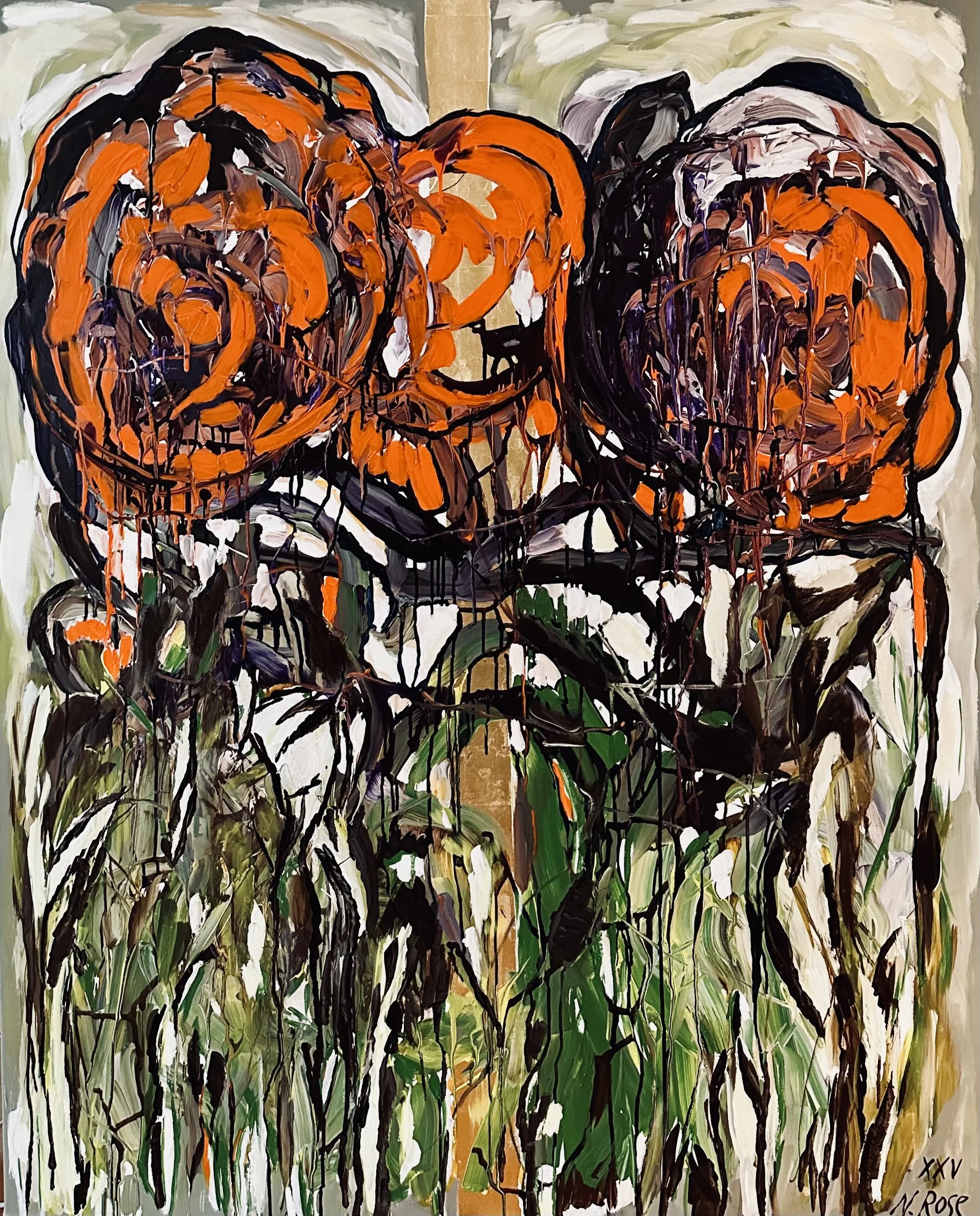
Orange Dream, 2025 Acrylic on Linen, 150x120 cm
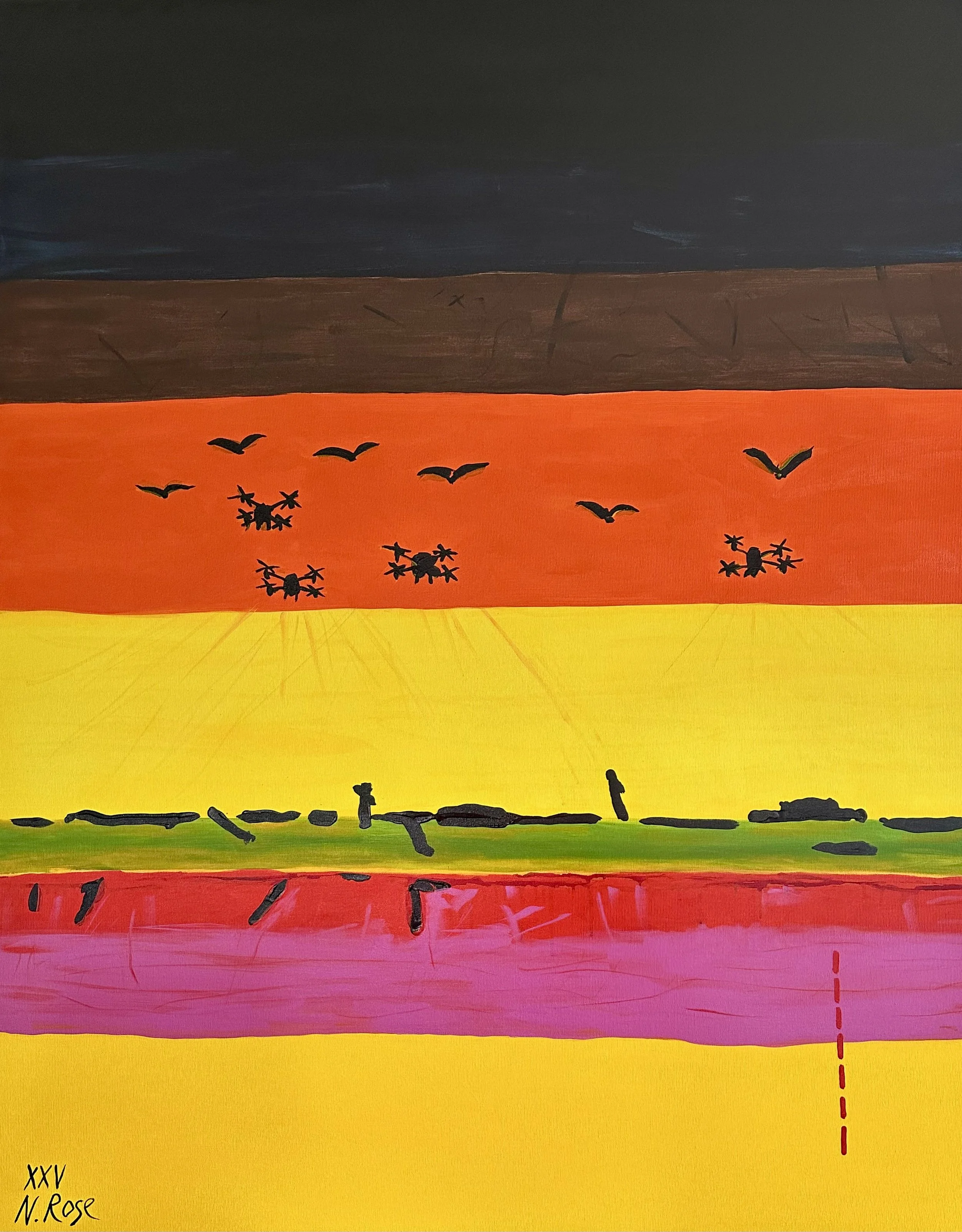
The Birds 2025 Acrylic on canvas 150x120 cm
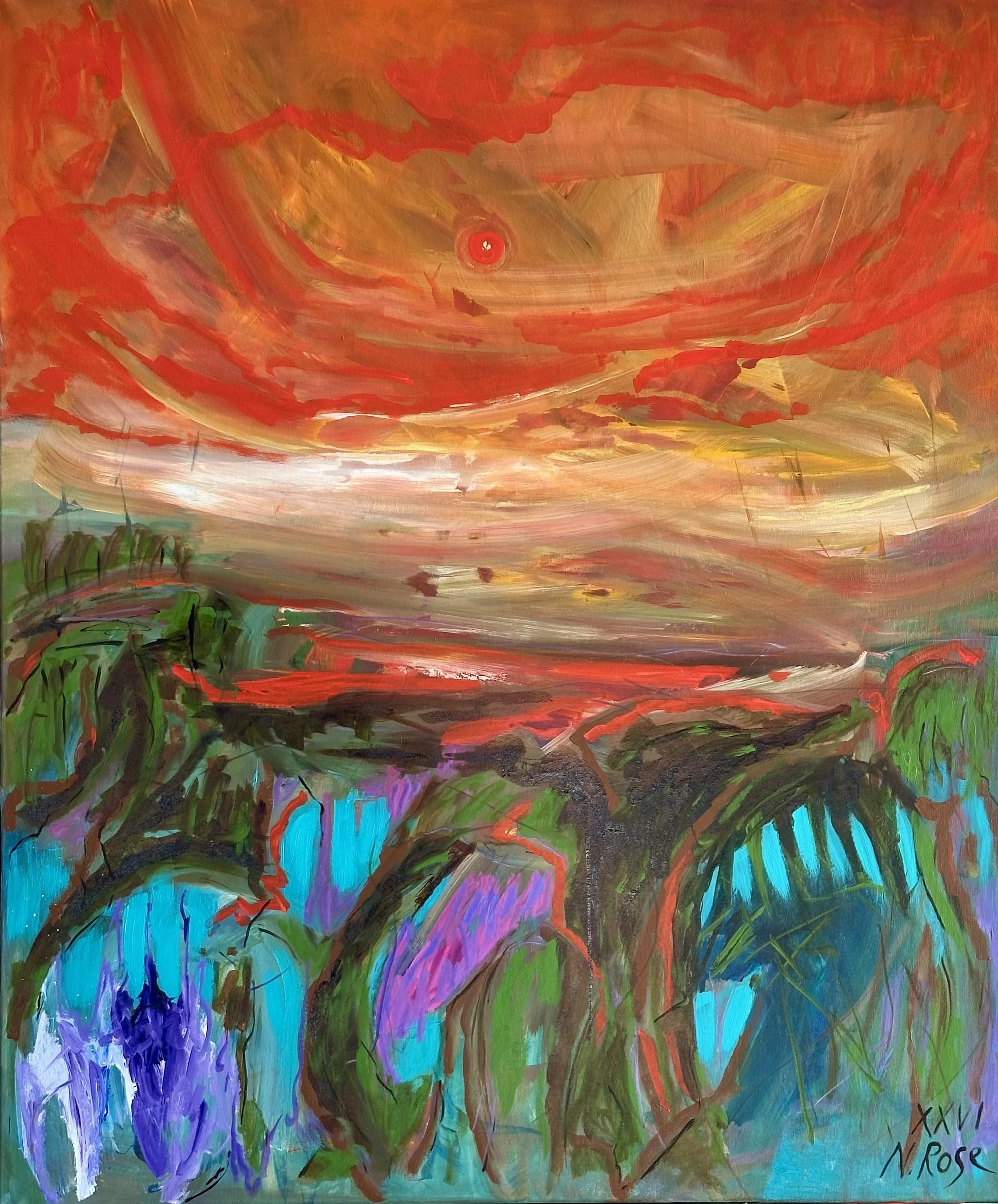
Uden Titel, 2026 Acrylic on Canvas 120x100x4 cm
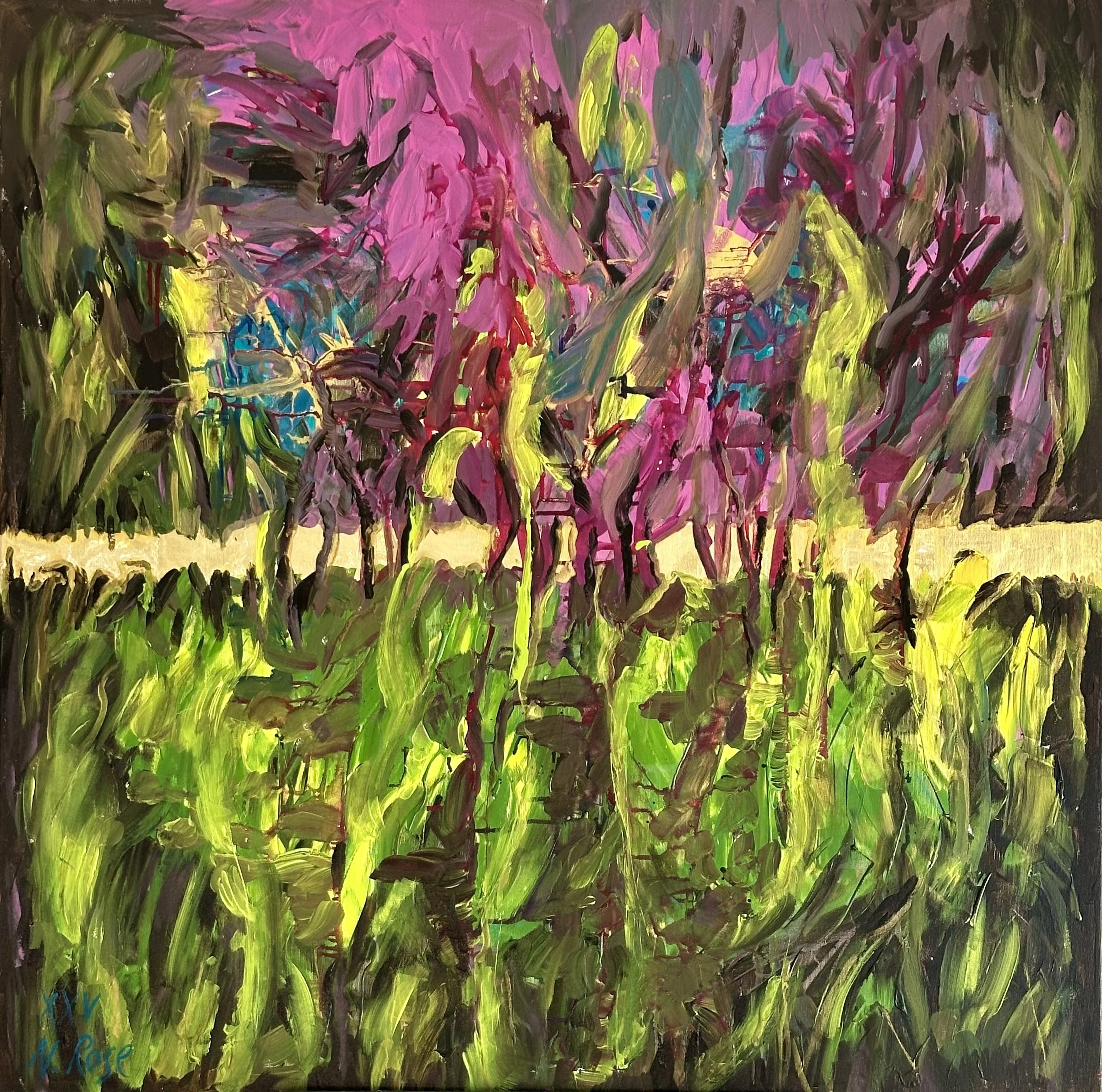
Rose's Garden, 2025 Acryliv and Gols Leaf on canvas, 100x100 cm
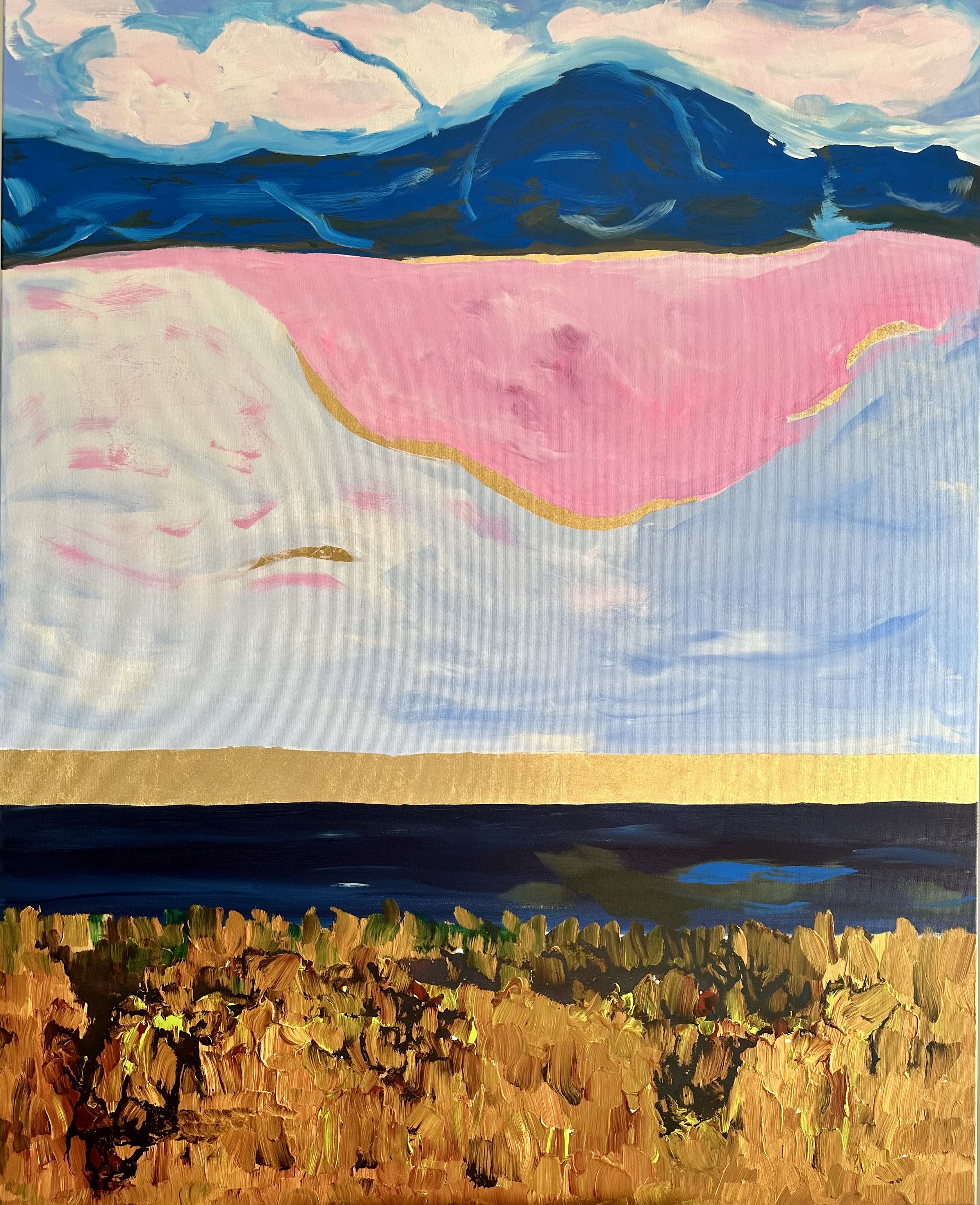
Sky and Stripes, 2026 Acrylic om Canvas 150x120 cm
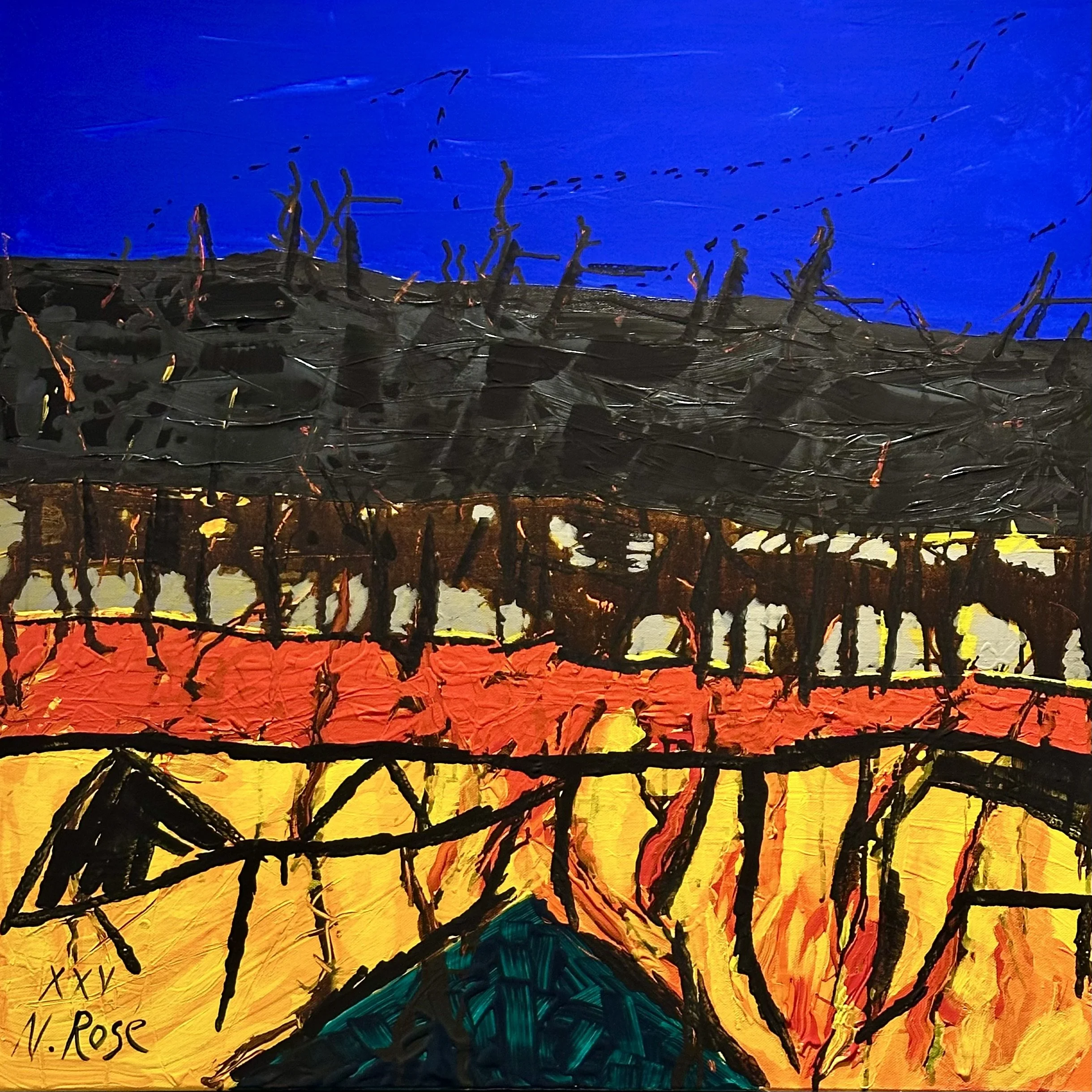
Sky and Stripes, 2026 Acrylic om Canvas 150x120 cm
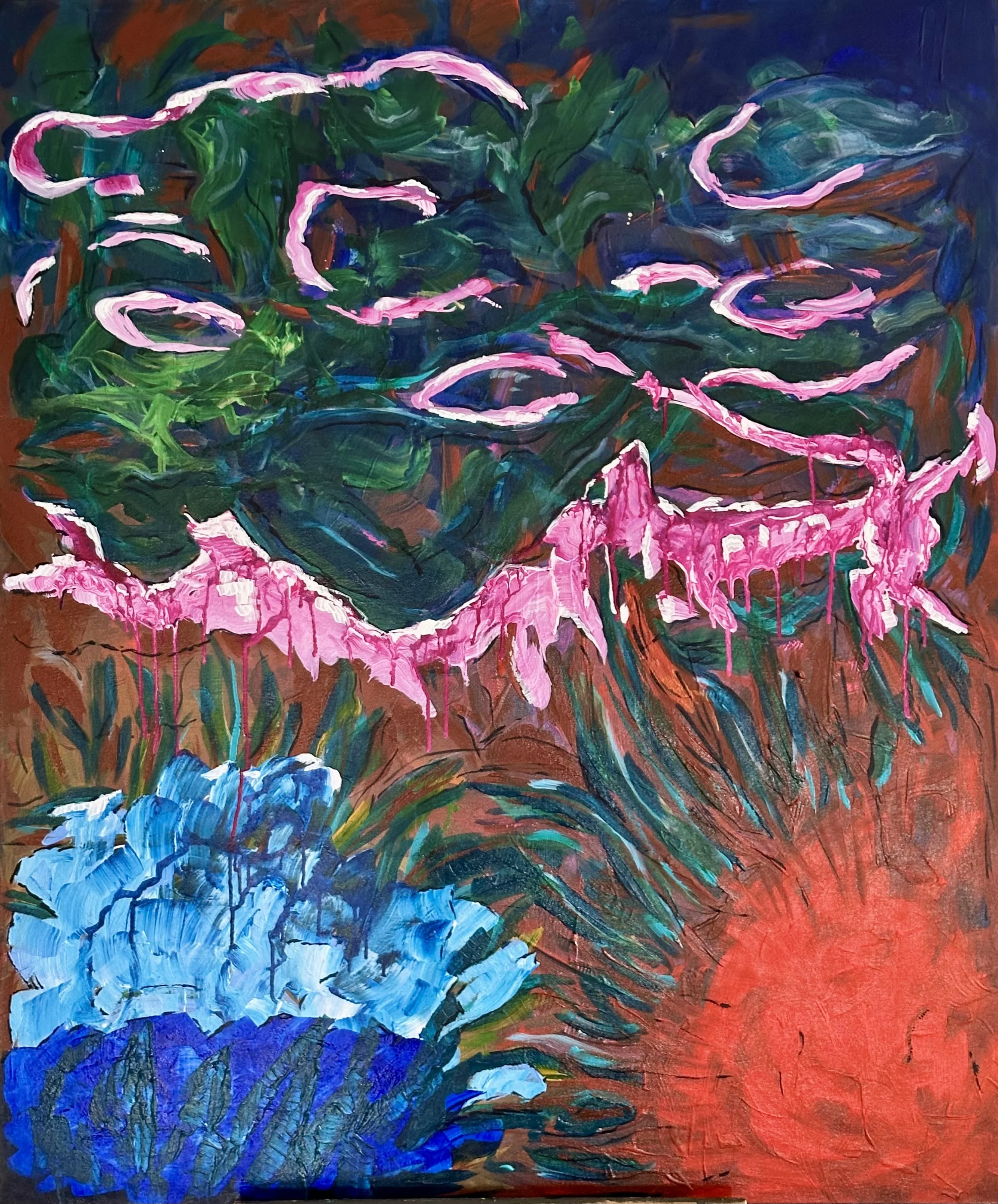
Summer Delights, 2026 Acrylic on Canvas, 120x100 cm
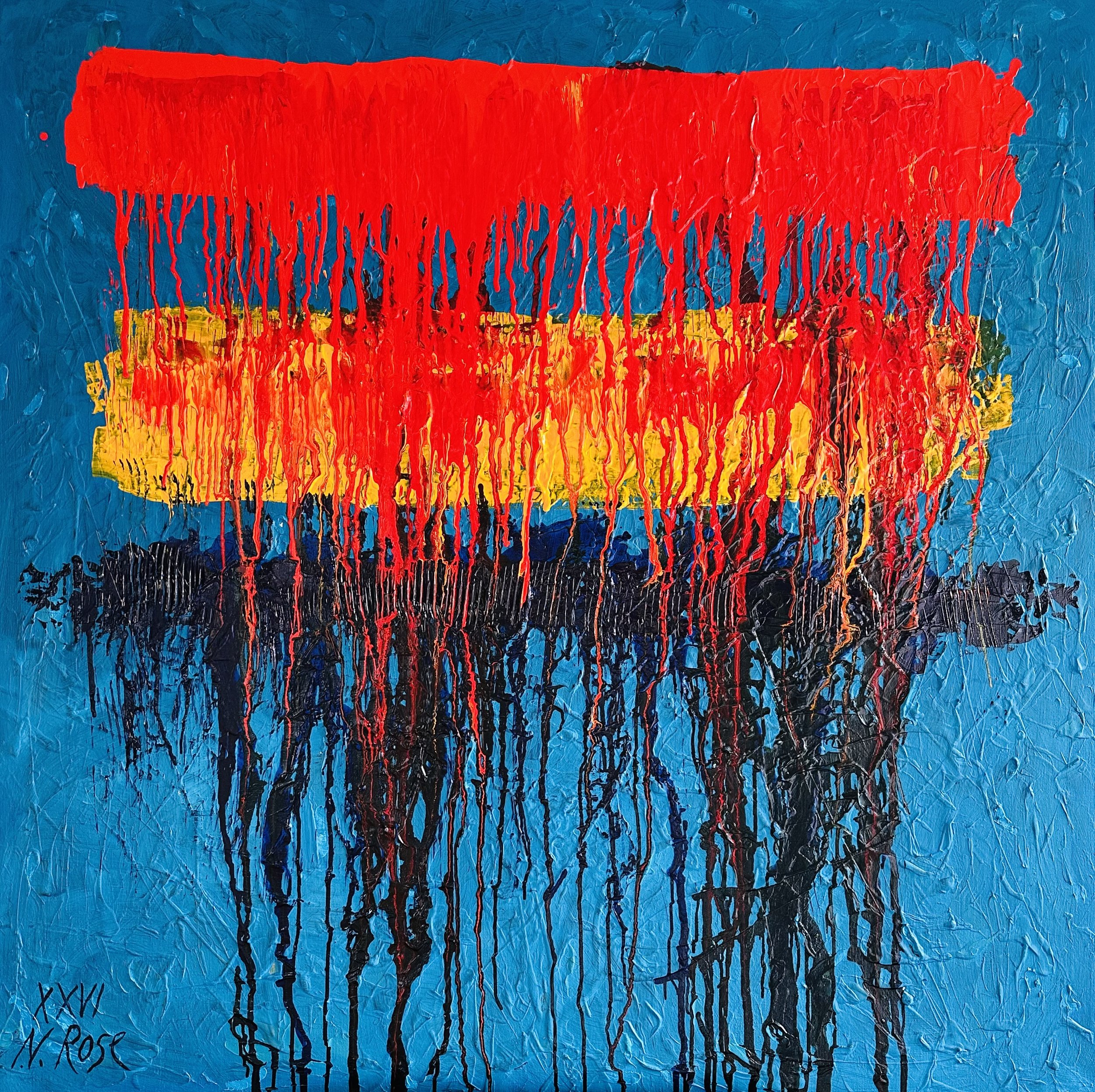
Autumn, 2026 Acrylic on Linen, 120x120x2,6 cm
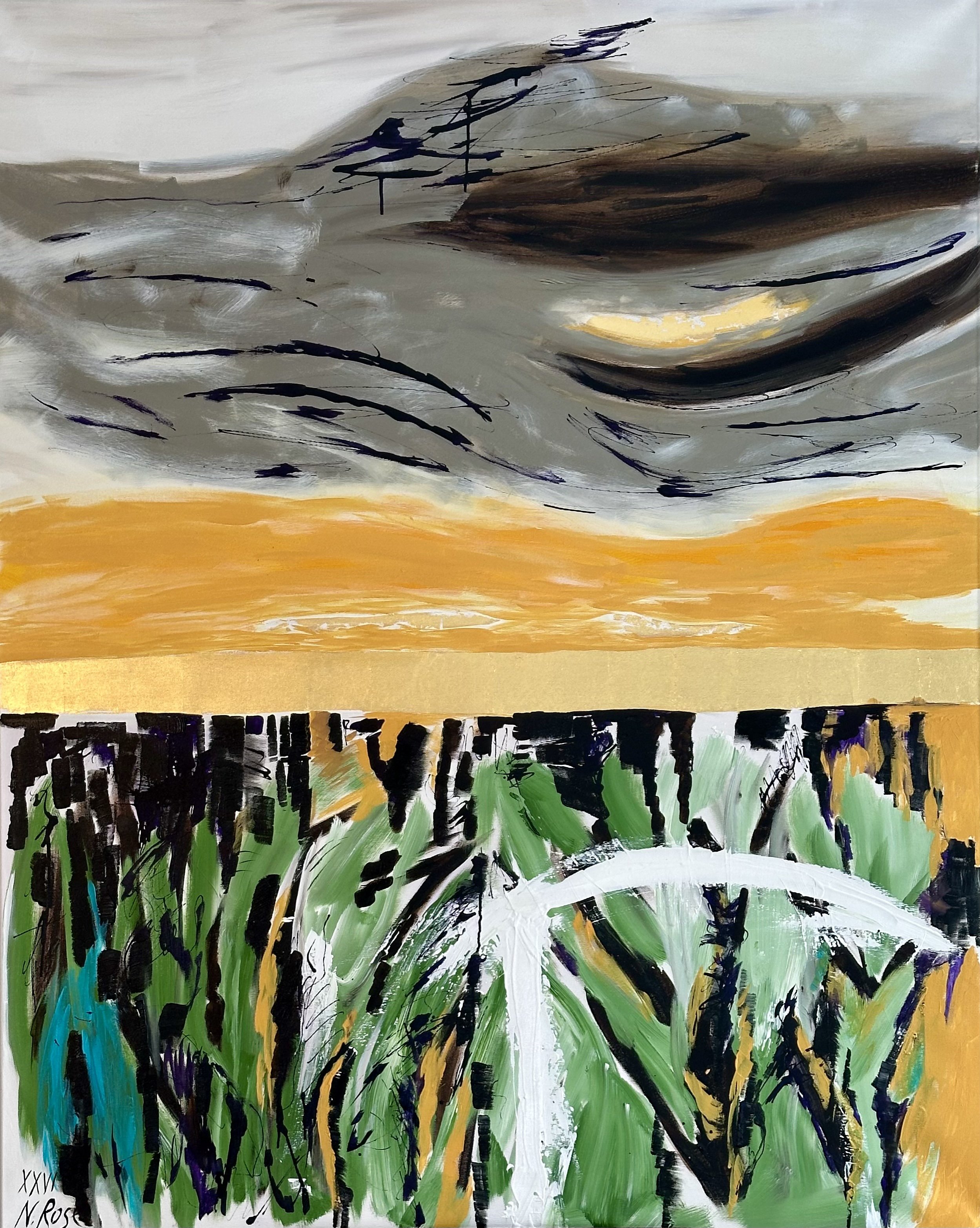
Between Heaven and Earth, 2026 Acrylic on Canvas, 150x120 cm
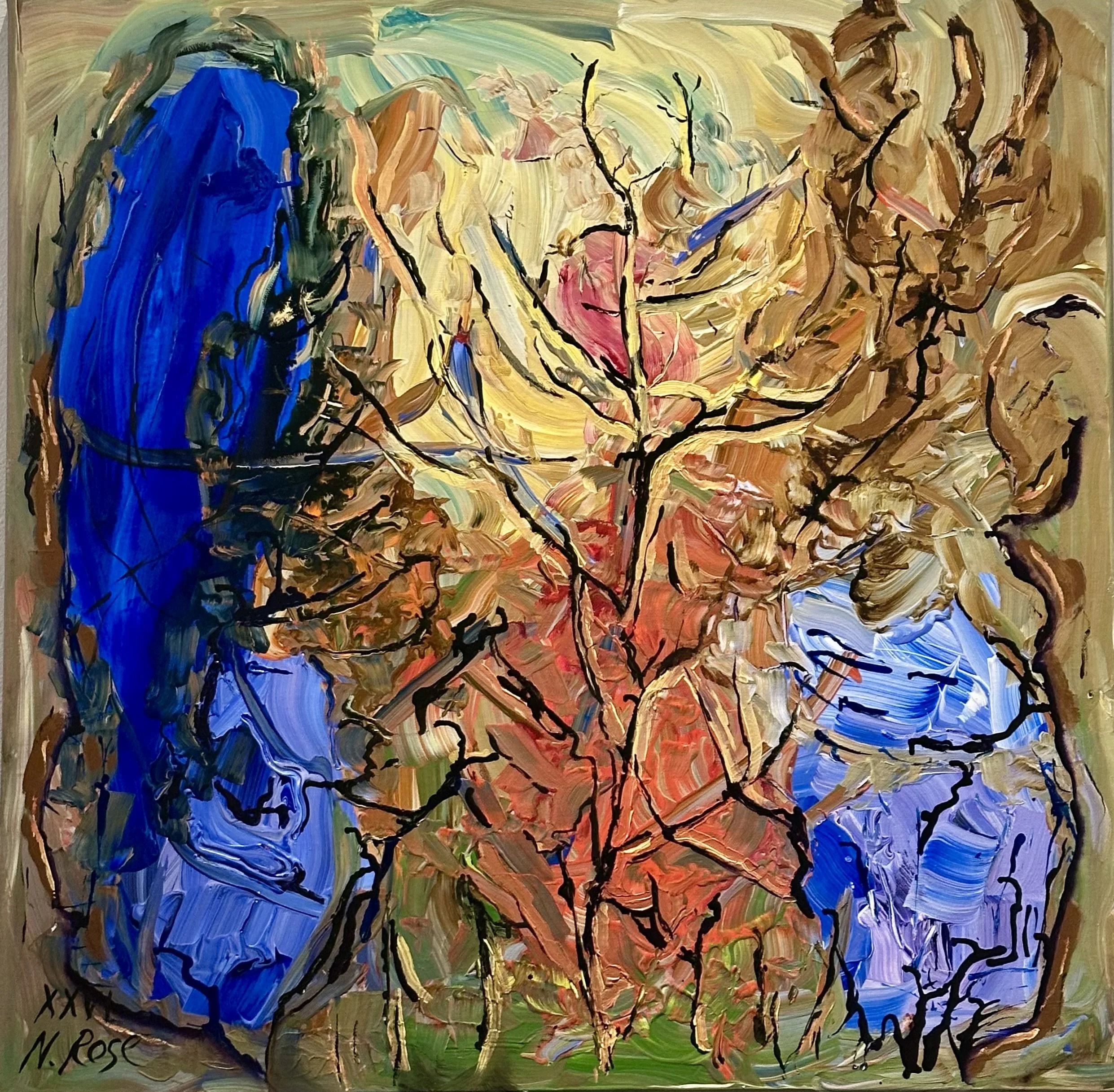
Lonely Tree, 2026 Acrylic on Linen 80x80 cm
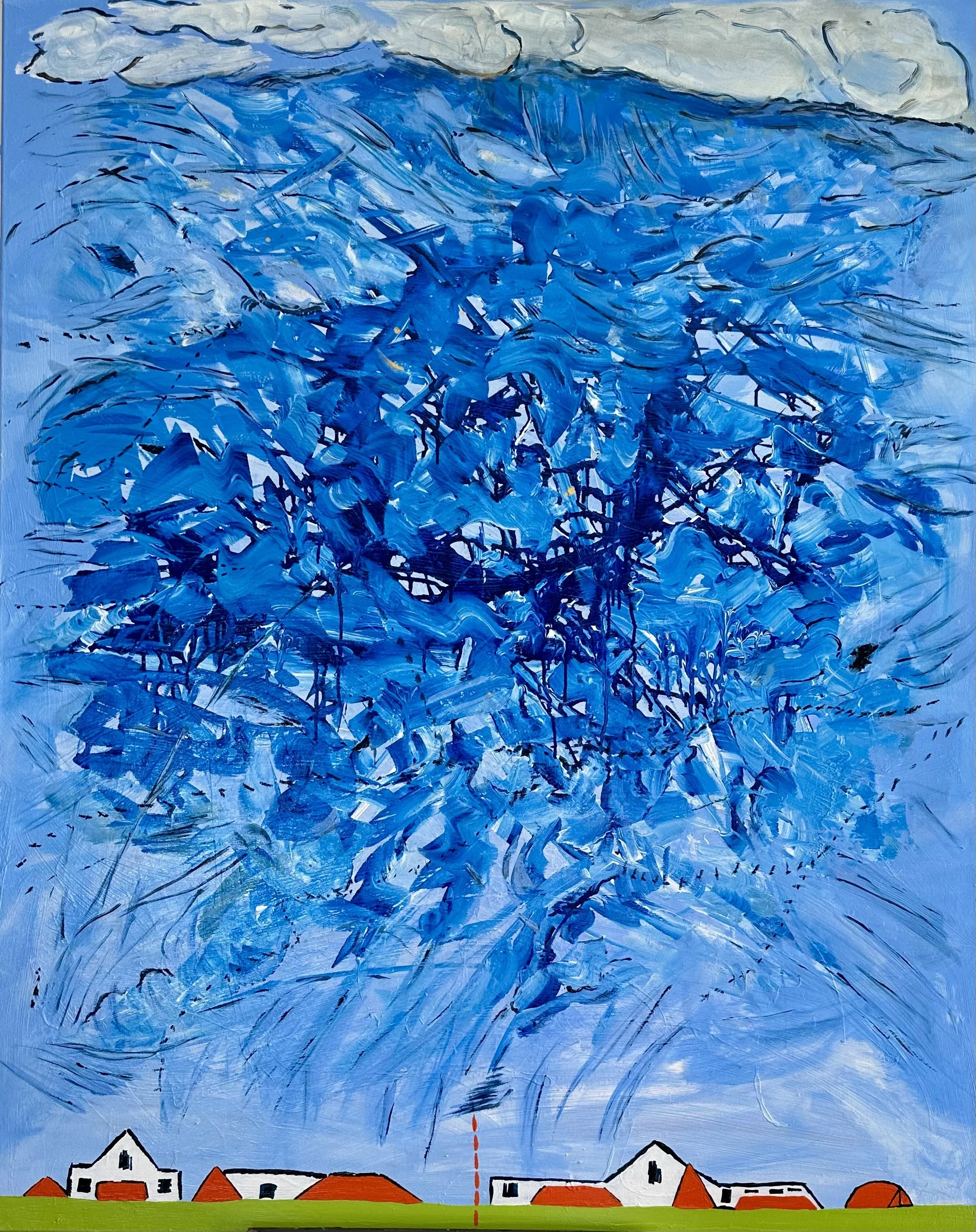
Why the Sky is So High, 2025 Acrylic on Canvas, 150x120 cm

Celebration of Spring, 2025 Acrylic and Gold Leaf on canvas, 100x80 cm
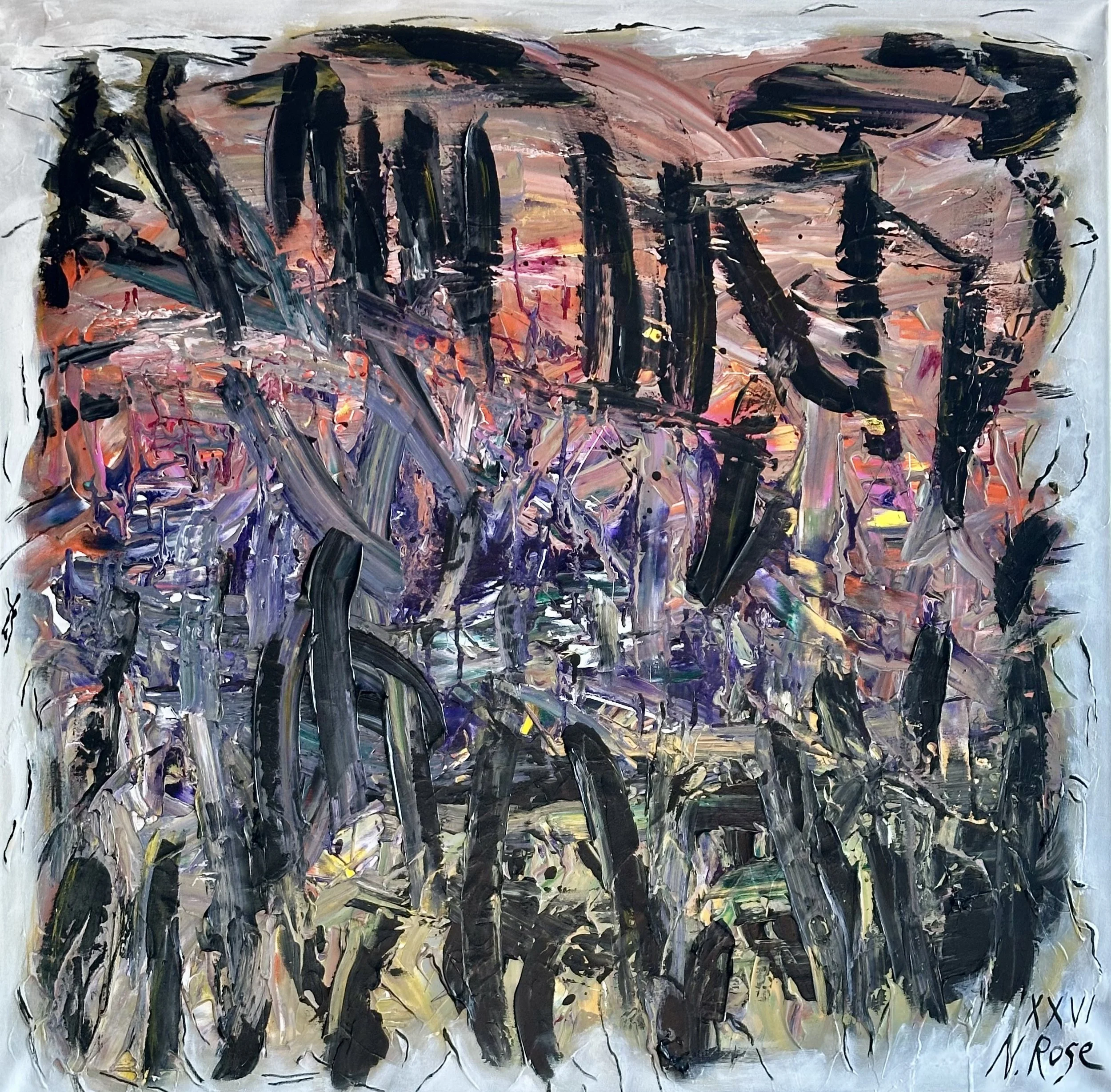
n the Middle og Nowhere, 2026 Acrylic on Canvas 100x100x4 cm
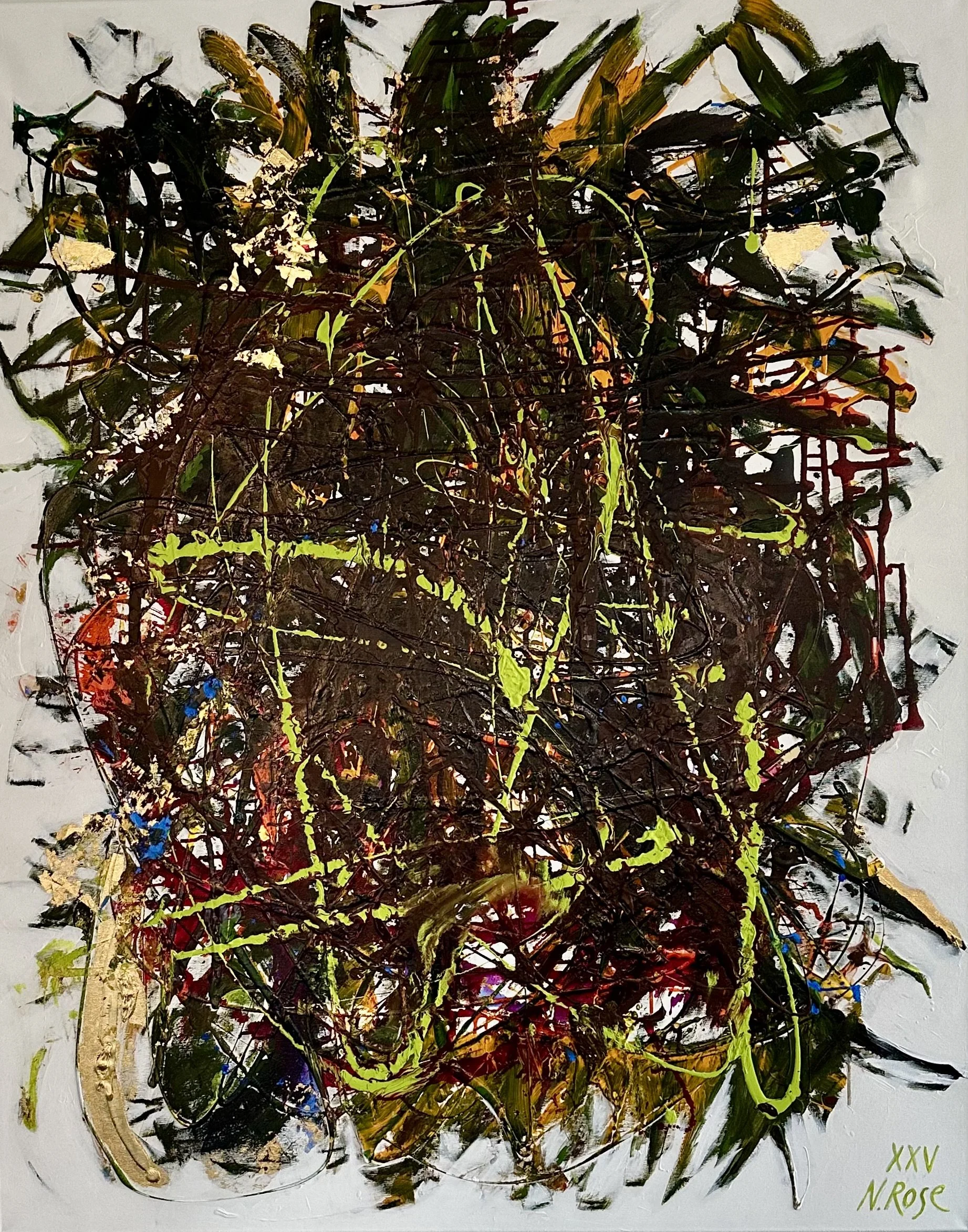
Green Promise, 2025 Acrylic on canvas 150x120x4 cm
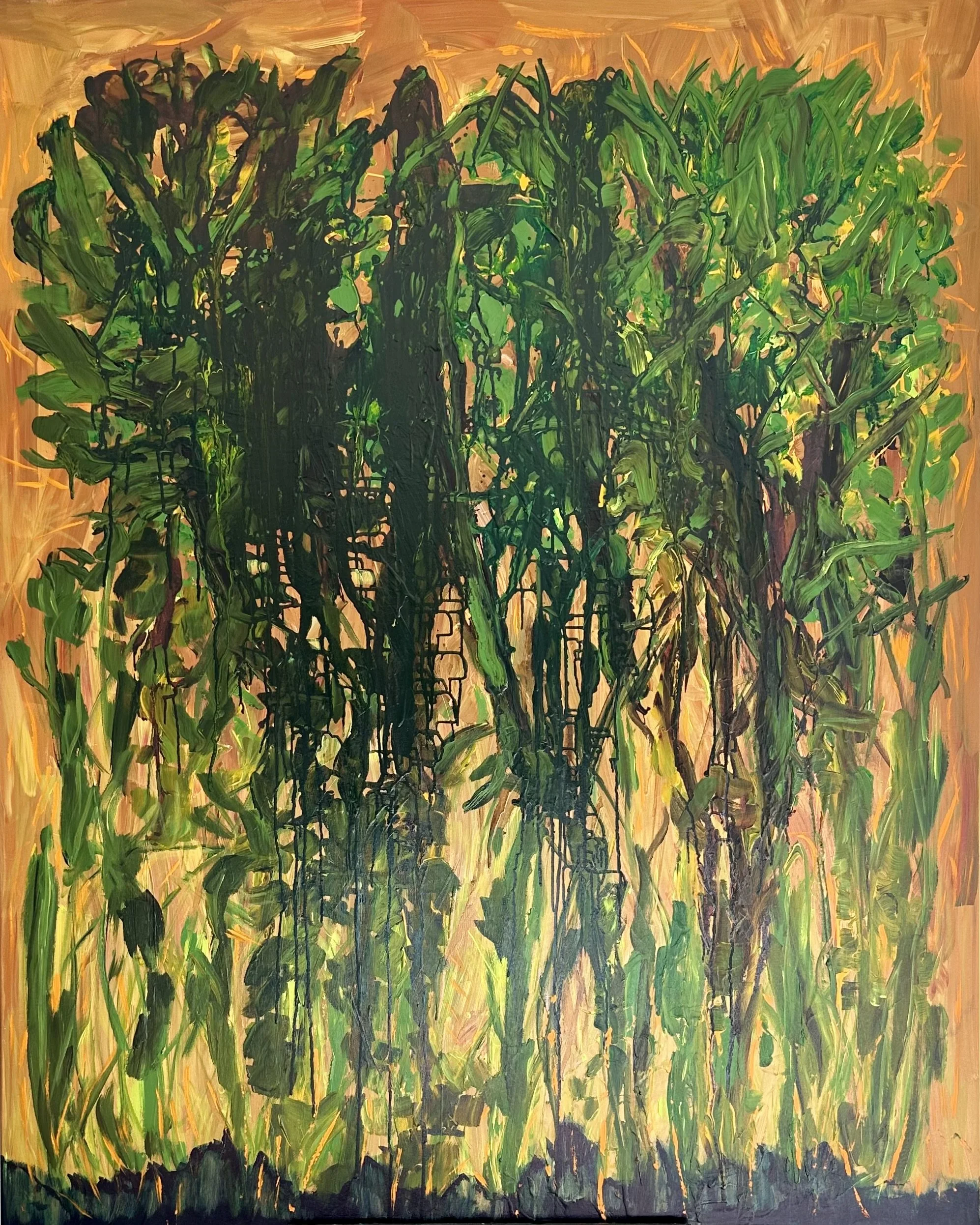
Trees, 2026 Acrylic on canvas 150x120 cm
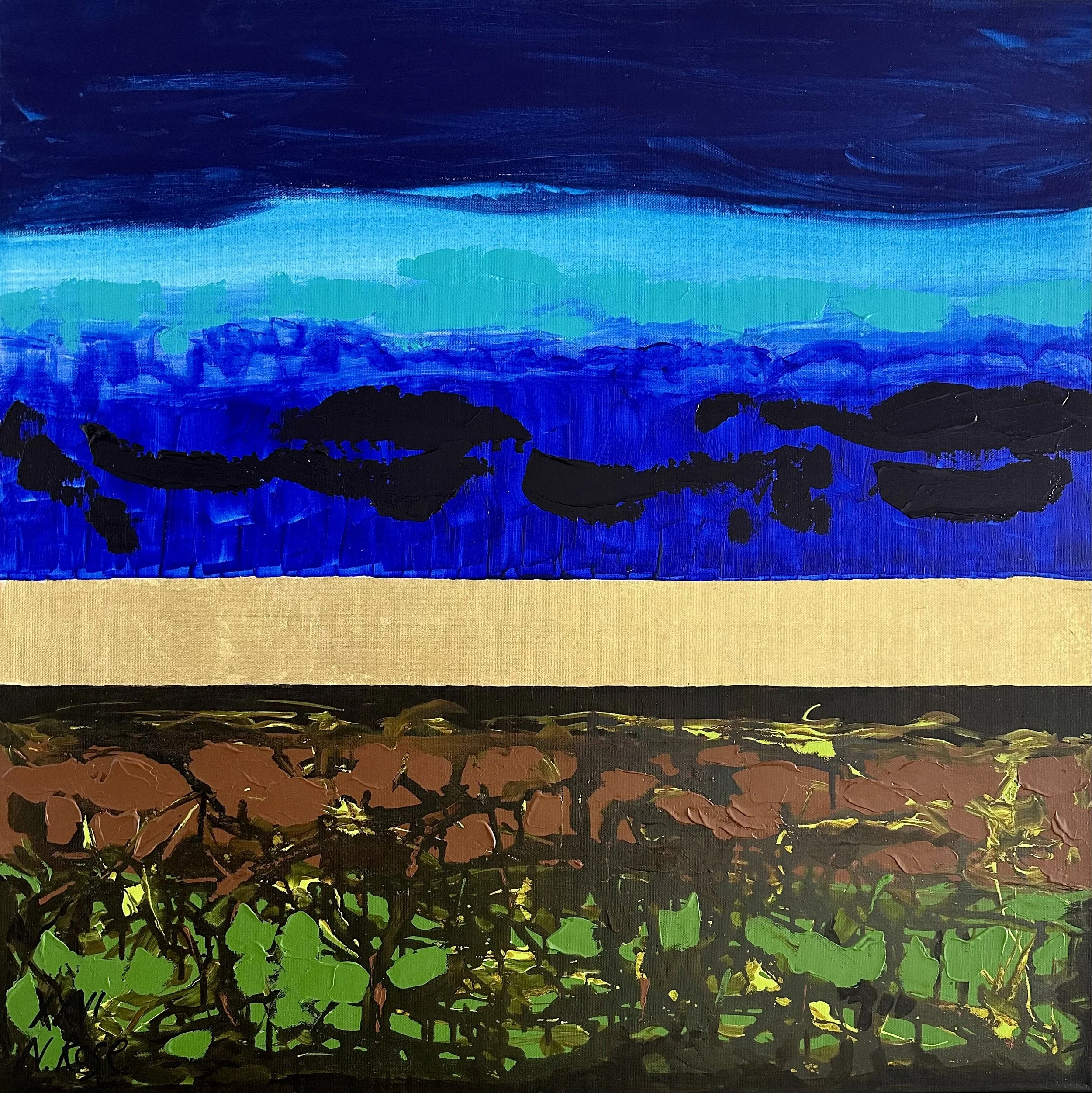
Des Untergang der Sonne, 2026 Acrylic on Linen, 80 x 80 cm