Interview with Nándor Bozsóki
www.bozsokiart.com
https://www.instagram.com/bozsokiart/
https://www.instagram.com/tobbmintfestes/
https://www.facebook.com/profile.php
Nándor Bozsóki – Painter of Emotion and Space
Brushing up on your dreams.
I am a Hungarian painter dedicated to creating unique, personalized artworks that transform spaces and evoke deep emotions. My artistic journey began with decorative wall painting, which gradually led me to the canvas, where I found my true passion. Each painting I create is not just a visual piece but a deeply personal expression—an artwork that tells a story, recalls memories, and becomes a meaningful part of its owner’s life.
I believe that our surroundings should not only be aesthetically pleasing but also emotionally enriching. A painting should be more than just decoration—it should inspire, comfort, and reflect the unique personality of its owner. That is why my process is highly collaborative, ensuring that every commissioned piece aligns with my client’s vision while maintaining my distinct artistic voice.
Through my work, I strive to bring life, energy, and individuality into homes, offices, and public spaces. My greatest reward is seeing how my paintings become the heart of a room, filling it with warmth and meaning.
Artist CV / Resume
Born: June 17, 1974, Bečej, Serbia (Vojvodina)
Based in: Hungary
Artistic Journey
• Initially worked as a decorative wall painter before transitioning to canvas painting in 2016.
• Started exhibiting in 2019, with multiple national and international exhibitions since.
• Works are featured in both physical and online exhibitions worldwide.
Selected Exhibitions & Collaborations
• Luxembourg Art Prize (Three-time participant)
• M.A.D.S. Gallery (Milan & Barcelona)
• Galeria Azur (Berlin)
• Capital Culture House (Rome)
• La Pedrera (Barcelona)
• Artist of the Year 2025 (Florence)
• Holy Art Gallery (London & Los Angeles)
• Index (Saudi Arabia)
• Villa Gyetvai (Balatonfüred, Hungary)
• Otthonok és Kertek Magazine
• Spotlight Magazine
Other Notes
Philosophy: My worldview centres on the delicate balance between opposing forces and the deep connection between humanity and nature. I see art as a way to capture the harmony of contrasts—whether in the tranquility of nature or the tension between purity and passion—and to inspire both emotional depth and spiritual well-being in the viewer.
Artistic Approach: Each of my works is created with passion and creativity, making it a one-of-a-kind piece. My paintings are more than just visual compositions—they are crafted to inspire, to stir emotions, and to provide a sense of belonging.
Commissions: My work is highly personalized, taking into account the client’s vision, preferred colours, and the atmosphere of the space.
Market & Vision: While I have worked with clients across Hungary and internationally, I am open to expanding my presence worldwide. My goal is to make original, high-quality art accessible to those who appreciate uniqueness and craftsmanship.
Nándor, your practice begins from an intuitive, almost improvisational relationship with material and surface, yet it culminates in highly calibrated compositions of energy and stillness. In phenomenological terms, how do you negotiate between the spontaneous gesture of the hand and the reflective consciousness that shapes the final form? Do you see the brushstroke itself as a signifier of emotion, or as an autonomous event within the field of abstraction?
Yes — my process always begins intuitively. Before I think, I feel. There is a moment when I approach the canvas with a kind of playful curiosity, as if I’m discovering something that already exists beneath the surface. The first gestures are spontaneous, almost instinctive; they come from emotion rather than intention. But as the work evolves, another form of awareness enters — a reflective, quieter consciousness that shapes the composition.
For me, the brushstroke is both an emotional signifier and an autonomous event. On one hand, every movement of the hand carries the charge of the moment — tension, release, rhythm, hesitation. On the other hand, once that stroke meets the surface, it becomes its own entity. It interacts with colour, texture, and the surrounding space in ways I often cannot fully predict. That unpredictability is essential. It is where the dialogue begins between energy and stillness, intuition and structure.
In the final work, what may look spontaneous is usually the result of this negotiation: emotional impulse refined through contemplation, and raw movement tempered by balance. I never erase the first gestures; I build around them, allowing them to remain visible as traces of the moment when the painting came alive.
Light Intensity is a perfect example of emotional gesture meeting reflective control. The transitions of light across layered colour fields illustrate how spontaneous movements become calibrated atmospheres.
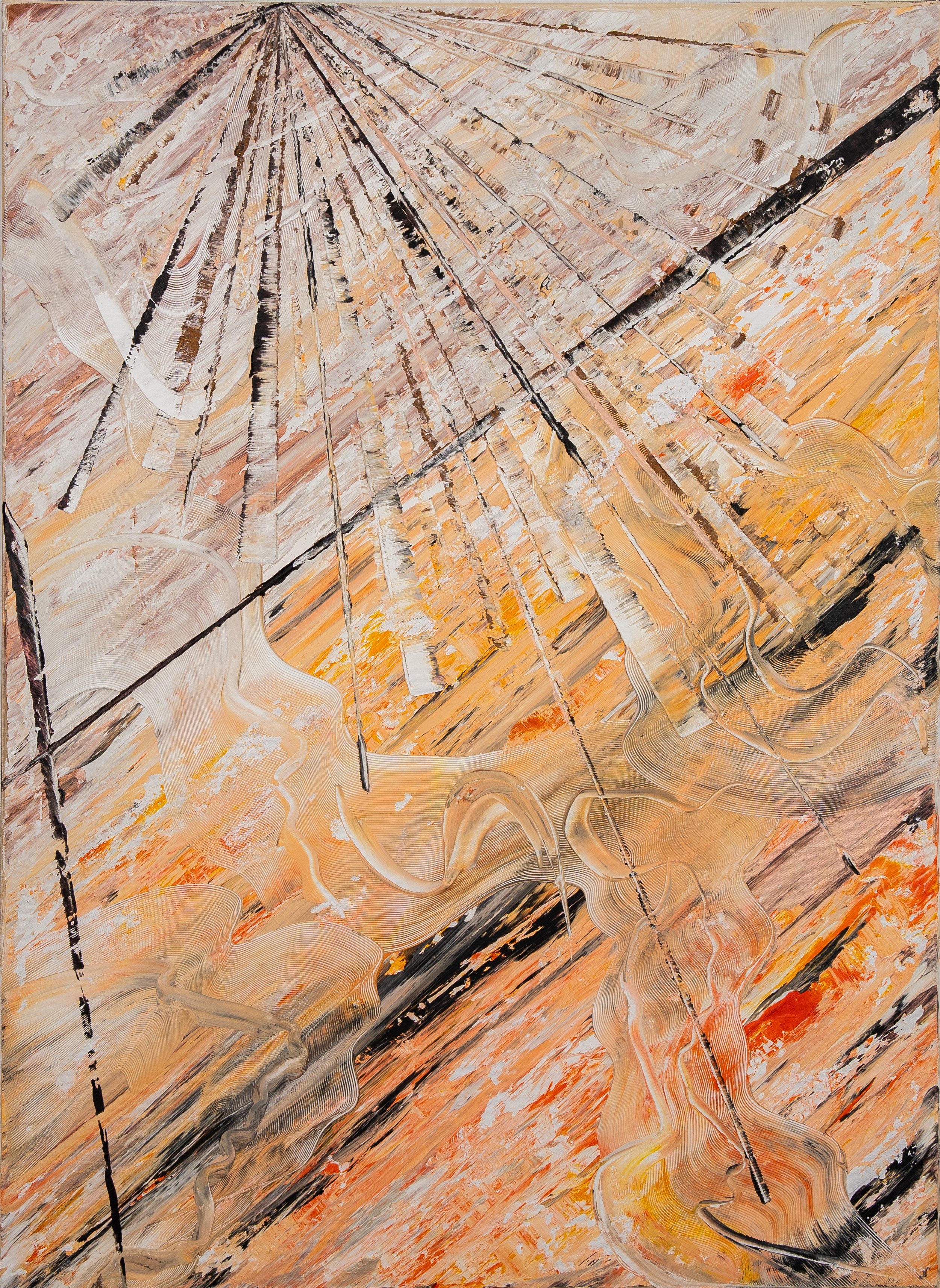
Light Intensity
By painting horizontally rather than vertically, you effectively subvert the traditional relationship between artist and image, between the upright gaze and the frontal picture plane. How does this horizontality alter your conception of authorship and control? Might we read it as a metaphor for democratizing the act of creation, dissolving the hierarchy between the artist’s will and the material’s agency?
Painting horizontally was never a deliberate rebellion; it was simply the way my hands and materials felt most at ease. Over time I realised that this position changes how the paint behaves — colours merge, spread, and settle with a freedom they would not have on a vertical surface. I still guide the process, but the dialogue becomes more balanced. Instead of imposing control, I allow the material to co-create the final image. For me, this horizontality is not a loss of authorship, but a more generous, open way of working.
Matrix is created from intersecting, assertive stripes in red, black, white, and grey. This piece visually reinforces the idea of approaching the canvas from an unconventional, non-hierarchical angle. The horizontal method becomes visible in the controlled layering of directional force.
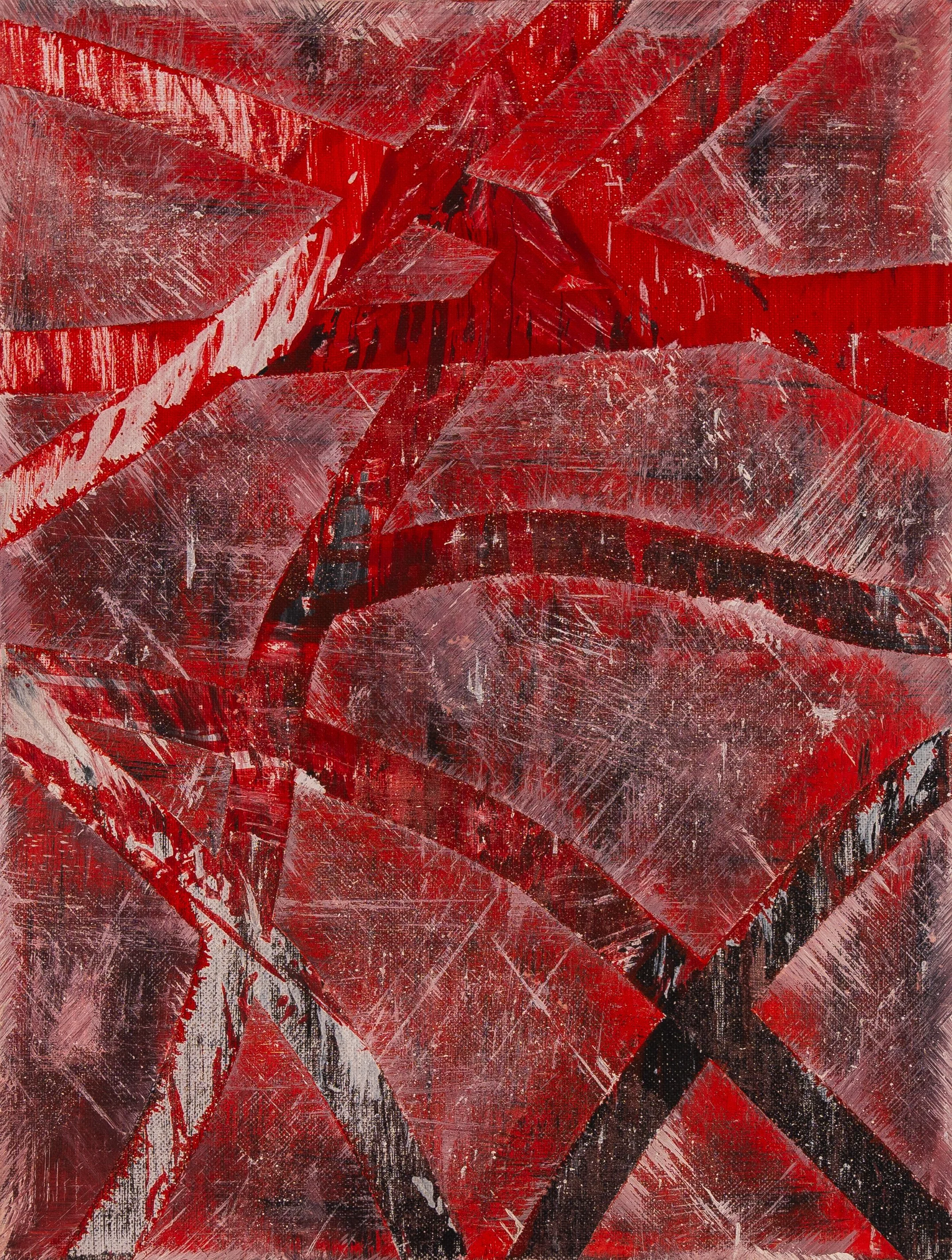
Matrix
You often describe your paintings as “co-creations” with clients, each rooted in dialogue and shared feeling. This approach seems to challenge the modernist idea of the autonomous artwork. How do you reconcile the deeply personal, even spiritual, intent of your work with the demands of a participatory or collaborative creative model? Can abstraction remain pure when it is explicitly relational?
When I speak about co-creation, I don’t mean giving up authorship — I mean opening a door. The conversations I have with clients are not constraints but starting points, moments where two perspectives briefly meet. Their intentions blend with my own inner vision, and the painting becomes a fusion of these energies. This exchange motivates me rather than limits me. Abstraction stays pure because the final language of colour, gesture, and form still emerges through my hand, guided by intuition and something greater than both of us.
Together is centred on relational tension and harmony. Its intertwining red forms on white naturally evoke collaboration, shared emotion, and the merging of visions — an excellent illustration of participatory creation.
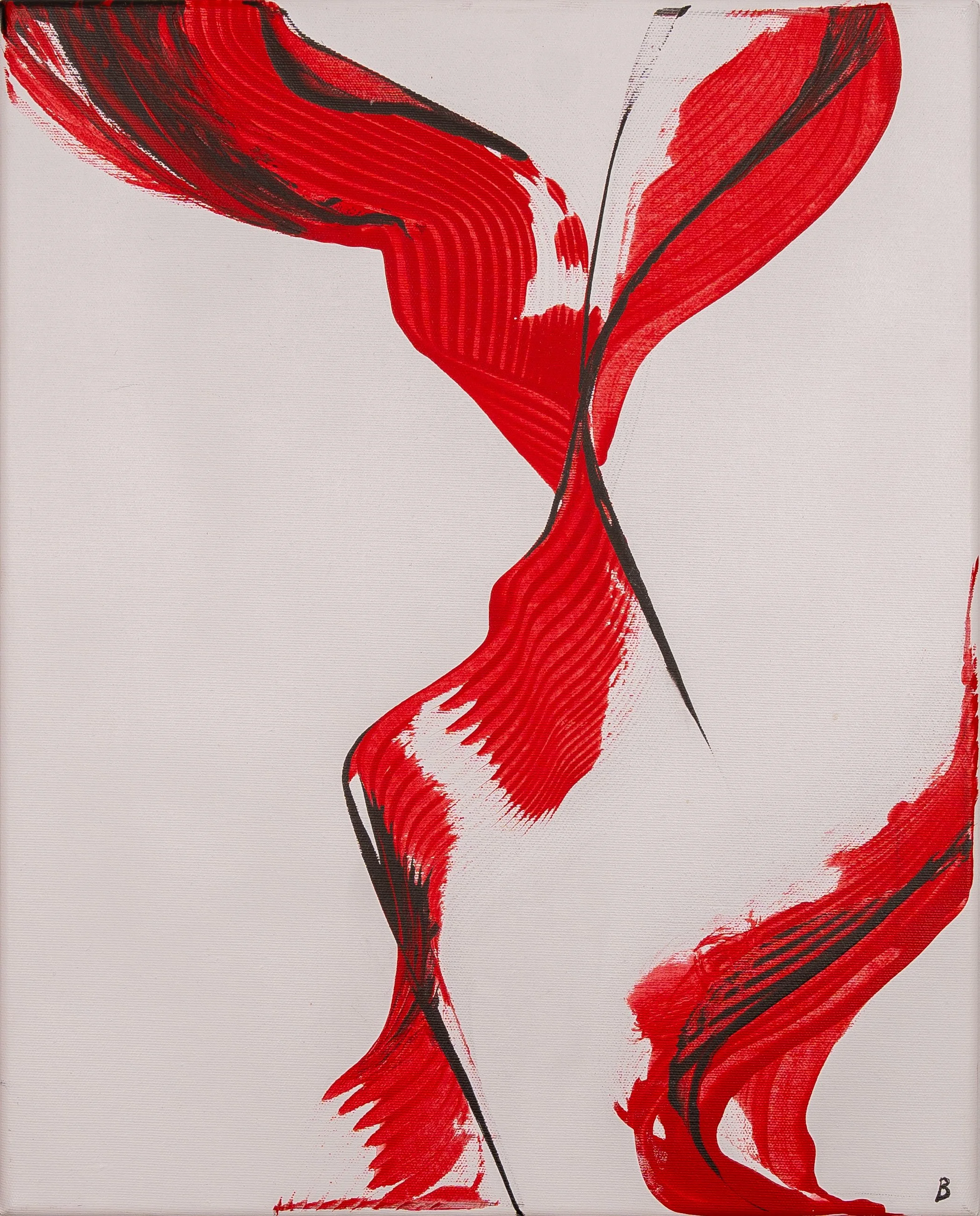
Together
Your worldview, as you’ve said, is centred on “the harmony of contrasts,” a dialectic between humanity and nature. In this light, do you consider your abstract compositions as extensions of the natural world’s organic systems, or as psychic landscapes reflecting interior states? Where, in your view, does the boundary between the external and the internal dissolve?
Harmony between contrasts is not an idea for me but a condition of being. I believe our inner equilibrium depends on staying connected to the Earth, to nature, to the larger universe around us. When that link weakens, something essential in us becomes incomplete. In my paintings, the boundary between outer and inner dissolves the moment this connection is felt: the organic rhythms of nature merge with my own emotional landscape, creating a shared field of energy.
In the Fire is a darker, elemental red-and-black composition that symbolises the meeting of inner emotional intensity with natural force. Perfect for describing where external and internal landscapes dissolve.
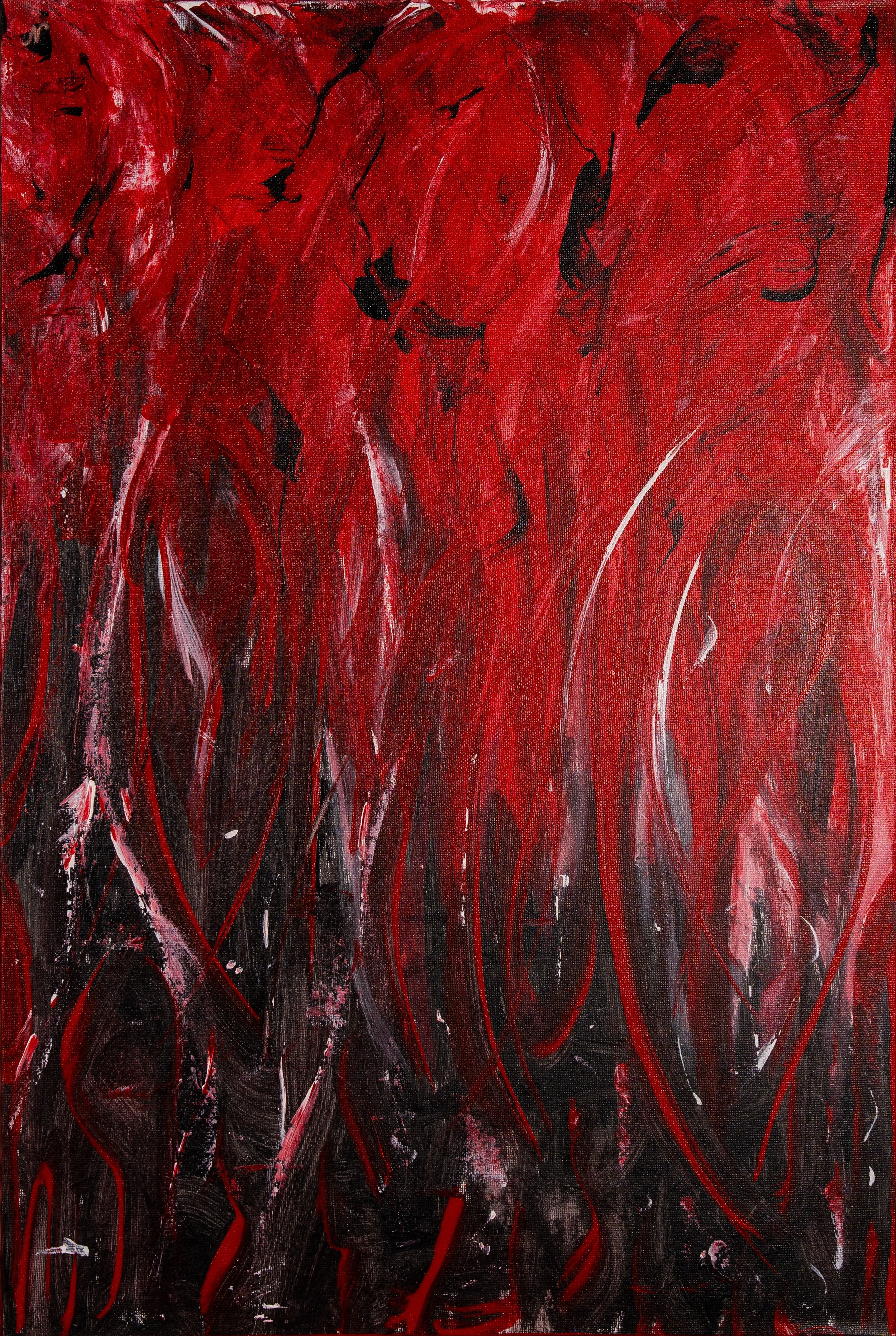
In the Fire
The materiality of your surfaces, the ridges, the glazes, the layered chromatic fields, seems to evoke what might be called a tactile sublime, a sensual immediacy that resists purely optical consumption. In an era dominated by digital images and screen-based art, how do you see the physical presence of texture functioning as a counterpoint to immateriality? Does touch, in your work, become a form of resistance?
The materiality of my paintings is essential: each ridge, glaze, and layered field anchors the viewer in the physical present. In a world increasingly defined by screens, texture becomes a quiet form of resistance—an insistence on slowness, touch, and embodied perception. My surfaces emerge instinctively from mood and environment, and no two works share the same rhythm. They speak most clearly to those who are emotionally open, who can meet the painting on its own vibrational level, beyond digital reproduction.
In Rice Terrace, the sublime atosphere is evoked by the layered cobalt and emerald fields with raised, wave-like ridges and the transcendent light catching the surface.
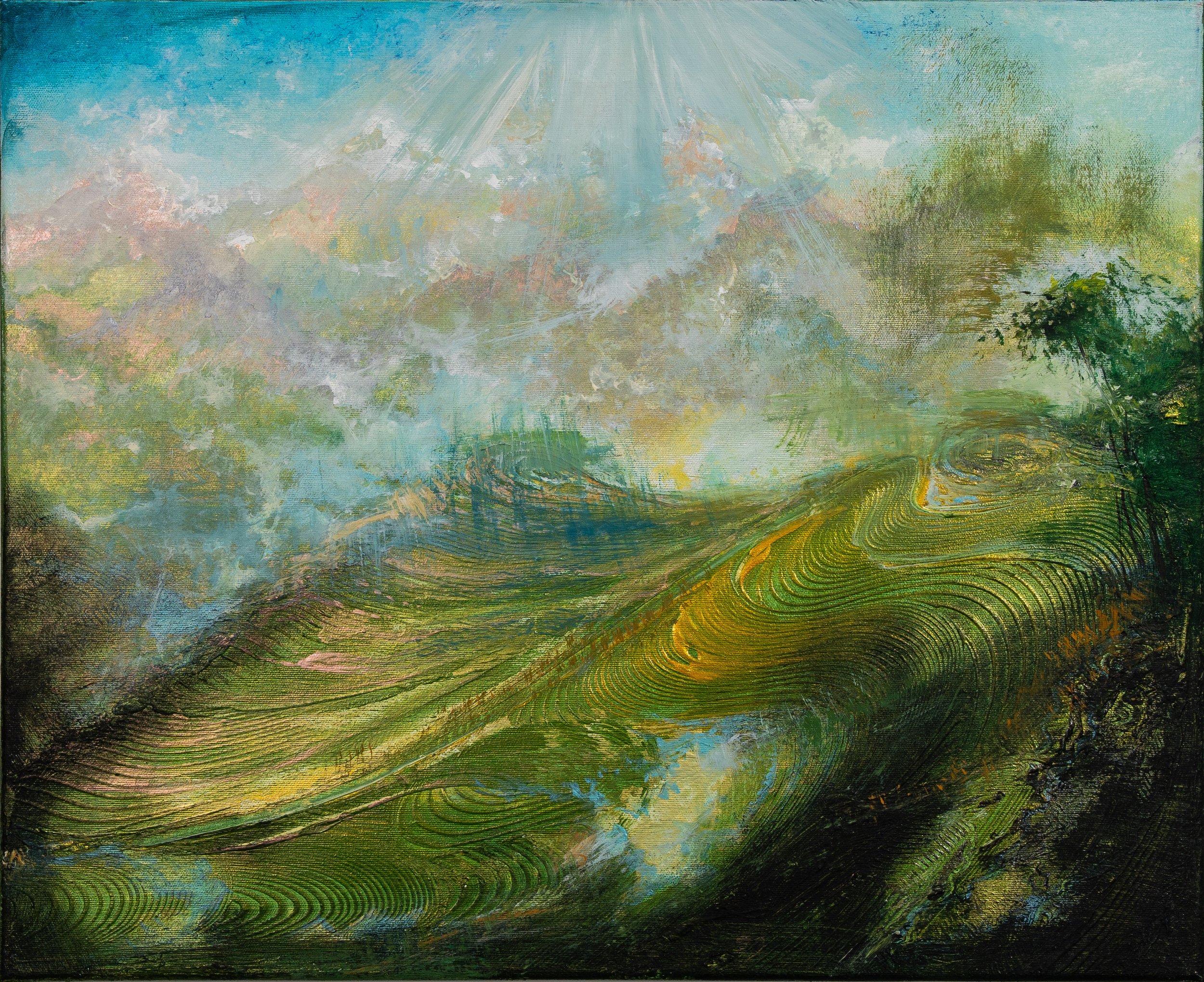
Rice Terrace
Colour appears in your practice not as decoration but as emotional structure, almost linguistic in its capacity to communicate mood and resonance. Do you conceive of colour as having a grammar of its own, one that can be “read” intuitively by the viewer? How do you select or intuit chromatic relationships that evoke specific psychic registers such as serenity, nostalgia, or euphoria?
Colour in my work is never ornamental; it carries its own emotional syntax. I believe colours communicate on a level deeper than language, even if many people aren’t consciously aware of it. Because colour is both energy and perception, it reaches us through instinct as much as through sight. When I paint, certain hues feel as if they call to me, aligning with my mood or inner state. I follow these impulses, allowing intuitive chromatic relationships to shape atmospheres of calm, memory, or intensity.
In Pink Dream, a swirling field of pinks, violets, and soft blues creates a luminous, dreamlike movement, where colour flows intuitively, forming an emotional atmosphere that feels both uplifting and quietly introspective.
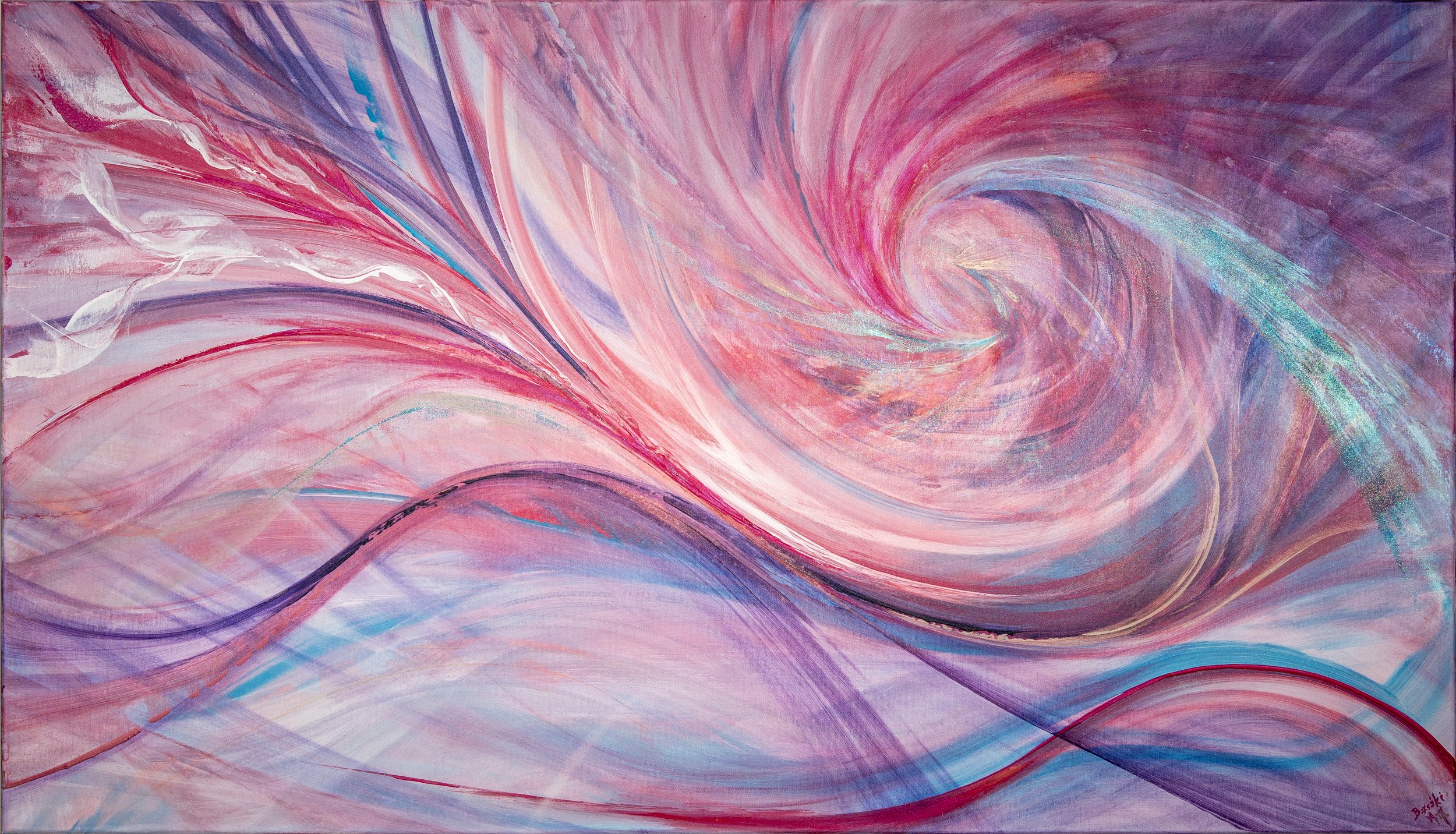
Pink Dream
You have said that each canvas “carries energy,” a notion that borders on the metaphysical. In articulating painting as a conduit of energy rather than representation, do you see yourself aligned with certain traditions of spiritual abstraction, perhaps Kandinsky, Rothko, or the post-Zen minimalists? Or does your concept of energy relate more closely to phenomenological vitality, the body’s own kinetic expression?
Yes, every canvas carries a certain energy. I think of it as a raw material that already holds a hidden form or atmosphere within it; my task is simply to uncover what wants to emerge.
Much like Michelangelo’s idea that a block of marble already contains the sculpture; the sculptor only reveals the figure already existing inside the stone.
In my case, it’s about adding the right colour, texture, and gesture to reveal the inner vibration.
Painting, for me, is an energy transfer, a frequency that can feel light or intense, and this naturally shapes the final work. As for artistic traditions, I don’t align myself with any specific lineage. I follow my own path: an abstract expressionist with an intuitive, spiritual edge.
Mirroring this philosophy, this piece, titled Between planets, reveals hidden frequencies within the raw canvas. Dynamic swirls of blue and copper emerge intuitively, transferring spiritual energy into visible, vibrating form.
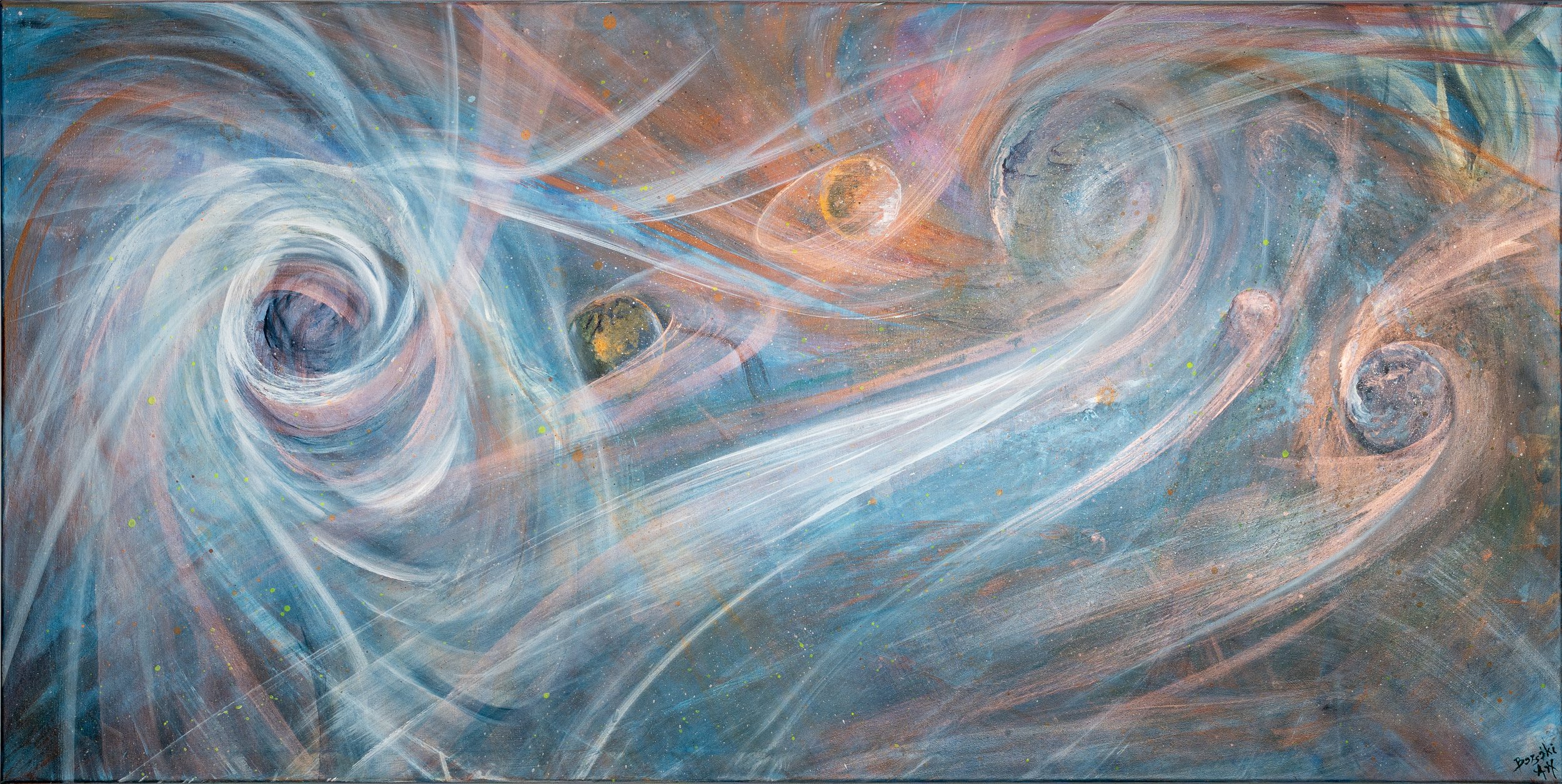
Between planets
You once remarked that “despite all the misery and hardships in the world, life can also be beautiful and colourful.” In the context of contemporary art’s preoccupation with trauma, critique, and deconstruction, how do you justify or defend beauty as a valid and even urgent ethical position? Is beauty, for you, an act of resistance or reconciliation?
Even with all the hardship in the world, I believe life can still be beautiful and full of colour—it depends on how open we are to noticing it and how much effort we make to nurture it. In a time when art often focuses on critique or trauma, I see beauty not as escapism but as a necessary counterbalance. It reminds us that light still exists. For me, beauty is neither resistance nor reconciliation; it is a blessing, a force that rises above negativity. It restores perspective and invites people back into a more hopeful, grounded way of seeing.
This abstract figure, the Guardian Angel, bursts forth in swirling light, a dynamic convergence of warm orange and magenta. It is a powerful, hopeful representation of inner beauty rising above the current negativity.
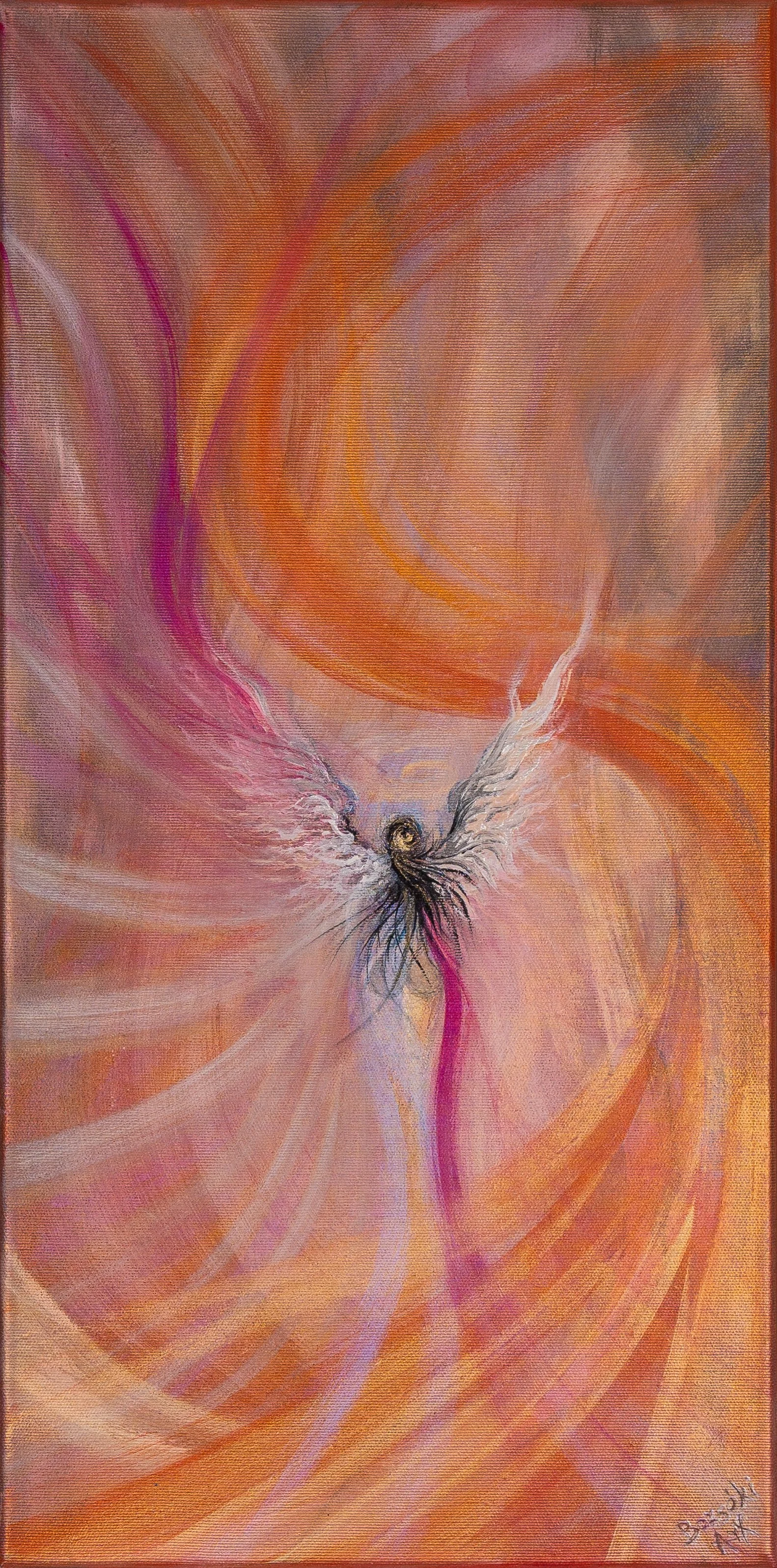
Guardian Angel
You often speak of how your collectors feel that their connection to a piece deepens over time. This suggests that your paintings operate temporally, not just spatially, that they unfold in duration. Do you consciously construct your compositions to invite this kind of temporal engagement, and how do you understand the passage of time within the life of an abstract painting?
When a painting grows closer to its owner over time, it’s no accident. Even when we immediately like something, true connection needs space to unfold. Abstraction works across time as much as in space; it holds forms and energies that remain relevant in any era. My works behave similarly because they draw on things that have always existed—nature, flow, intuition, spiritual charge. These elements don’t fade. As the viewer returns to the piece, new layers become visible, almost as if the painting reveals itself gradually. This slow deepening is what makes the bond enduring and, in a way, timeless.
Towards the Light reveals a deep, cosmic abyss where turbulent blues and greens give way to a brilliant, flowing central light. It embodies a timeless, intuitive energy that gradually unfolds its complexity and meaning.
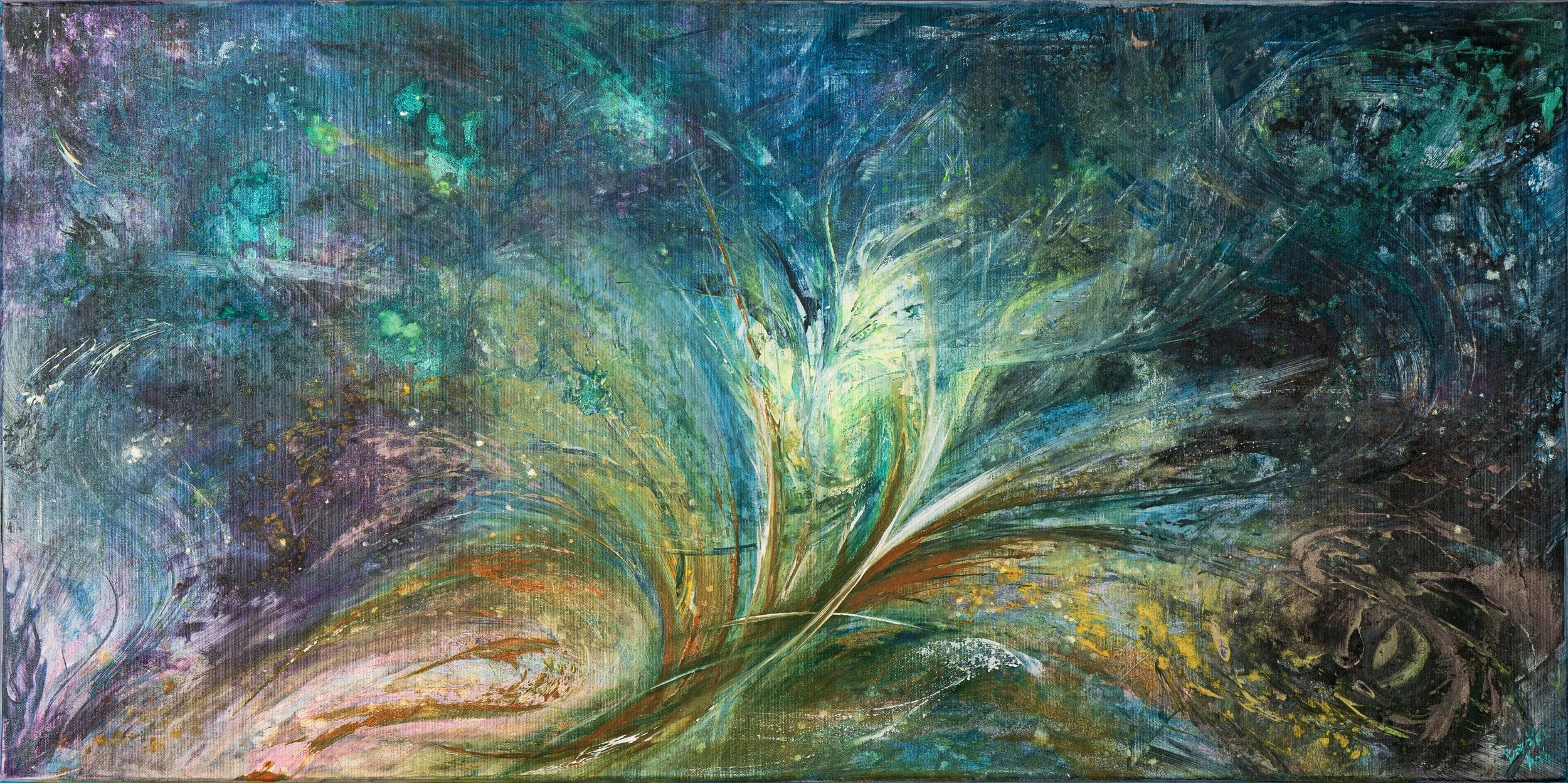
Towards the Light
Your invitation, “Art that resonates with you begins with a shared vision,” implies a dissolution of the distance between creator and viewer. Could this be seen as an ethical model for contemporary art-making, one grounded in empathy and mutual recognition? How might this shared vision challenge the art world’s long-standing separation between aesthetic contemplation and emotional participation?
When a work begins from a shared vision, the distance between artist and viewer naturally dissolves. Whether a piece grows from my own inner world or from dialogue with someone else, the process relies on mutual respect and emotional openness. This collaboration becomes an ethical stance: art is not something contemplated from afar but something entered into. By allowing empathy and recognition to shape the work, the traditional divide between aesthetic form and emotional experience disappears. The result is a unified space where both creator and viewer participate in the same unfolding story.
In the end, everything I create comes back to one simple idea: connection. Whether the impulse is intuitive, emotional, or shared with someone else, each painting is a way of reaching toward harmony — with myself, with others, and with the world around us. I don’t follow strict theories or traditions; I follow what feels true in the moment, what carries energy and meaning. If my work can offer a sense of balance, beauty, or recognition to those who encounter it, then the dialogue is complete. That, for me, is the real purpose of art.
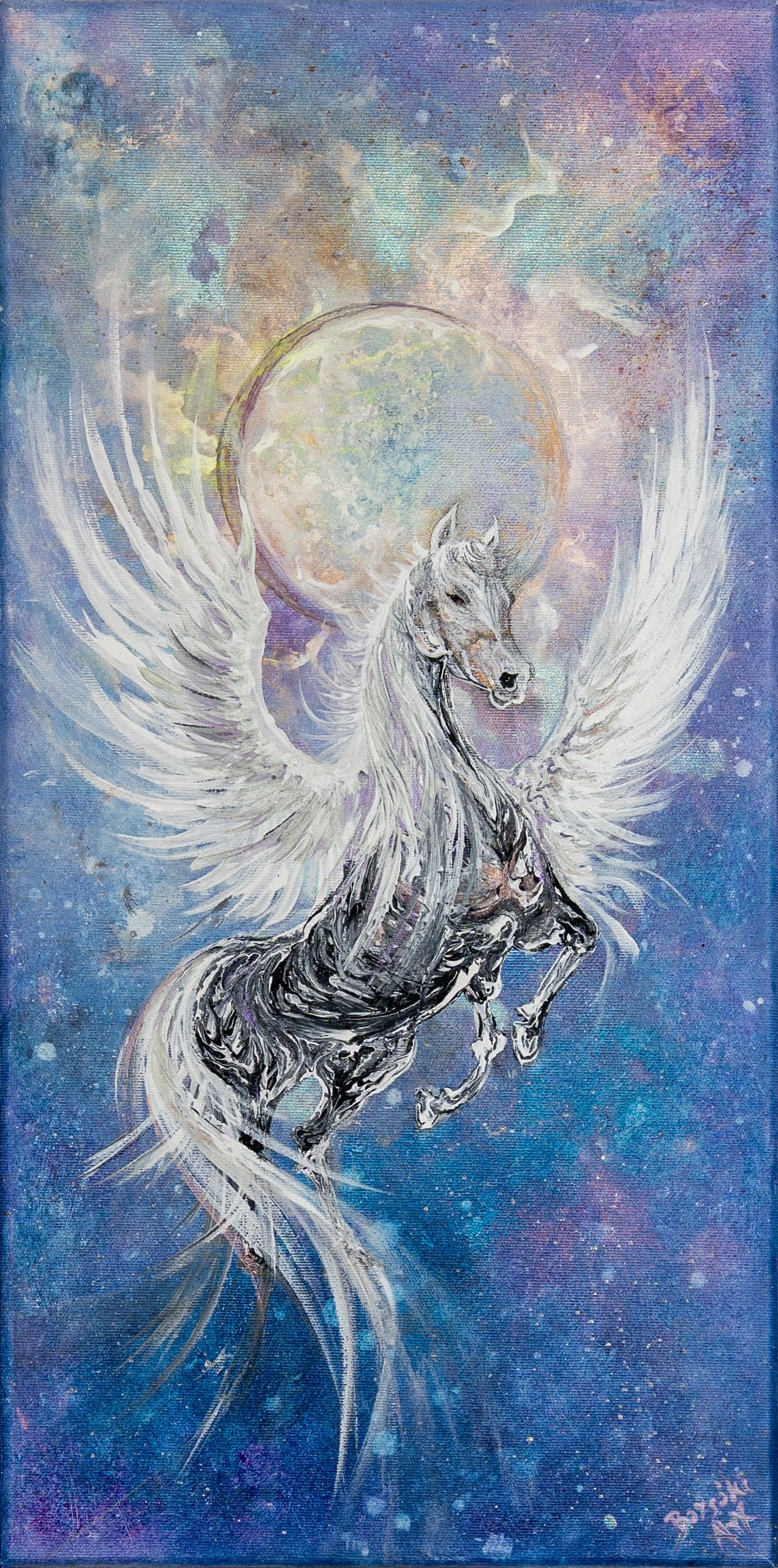
This pair of Pegasus paintings, ascending toward luminous cosmic discs, invites the viewer into a shared vision. They symbolize a mutual journey of hope, dissolving the divide between art and the universal desire for harmony.
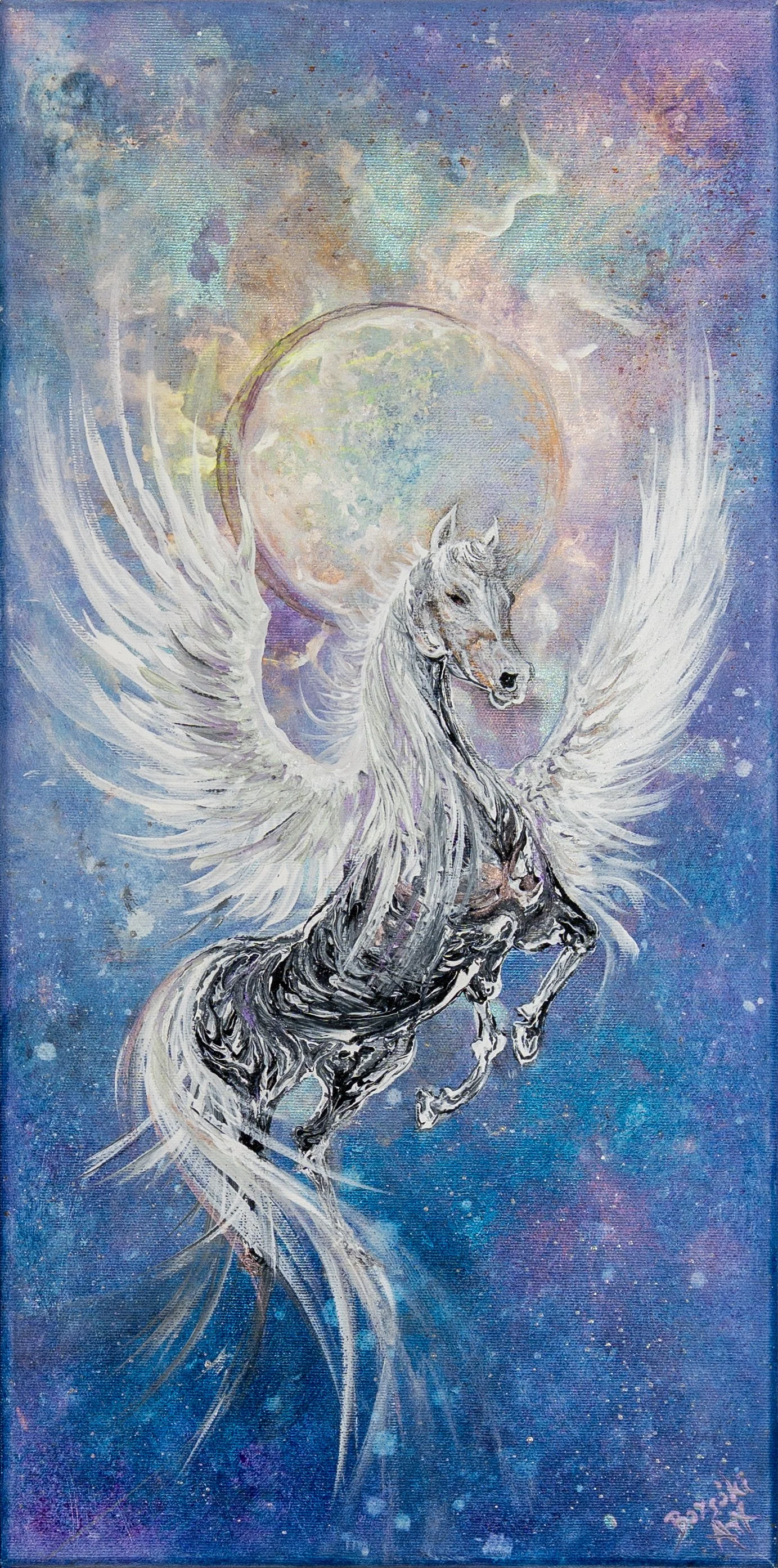
Pegasus I
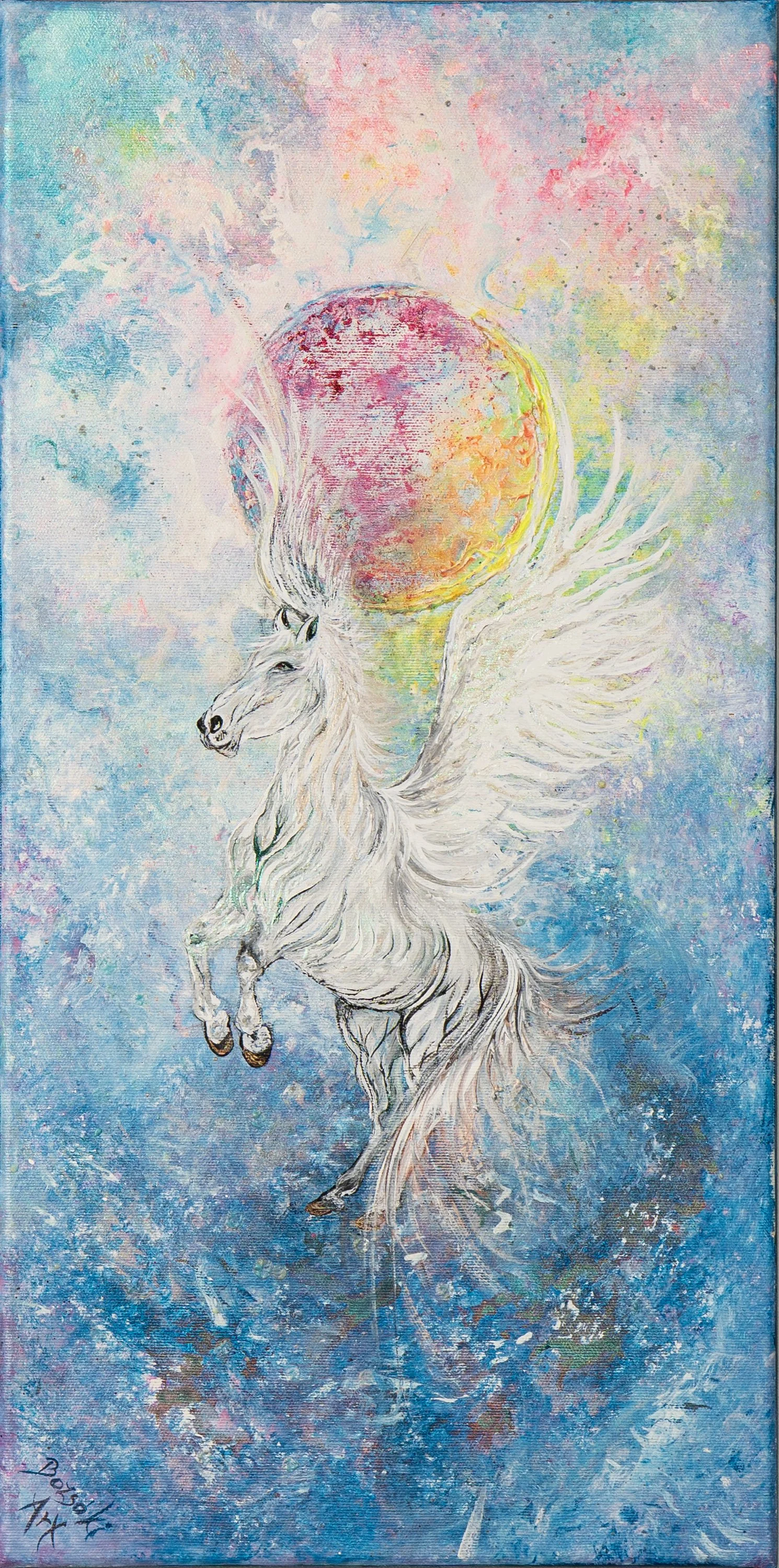
Pegasus II