IRIS FLUIDISM
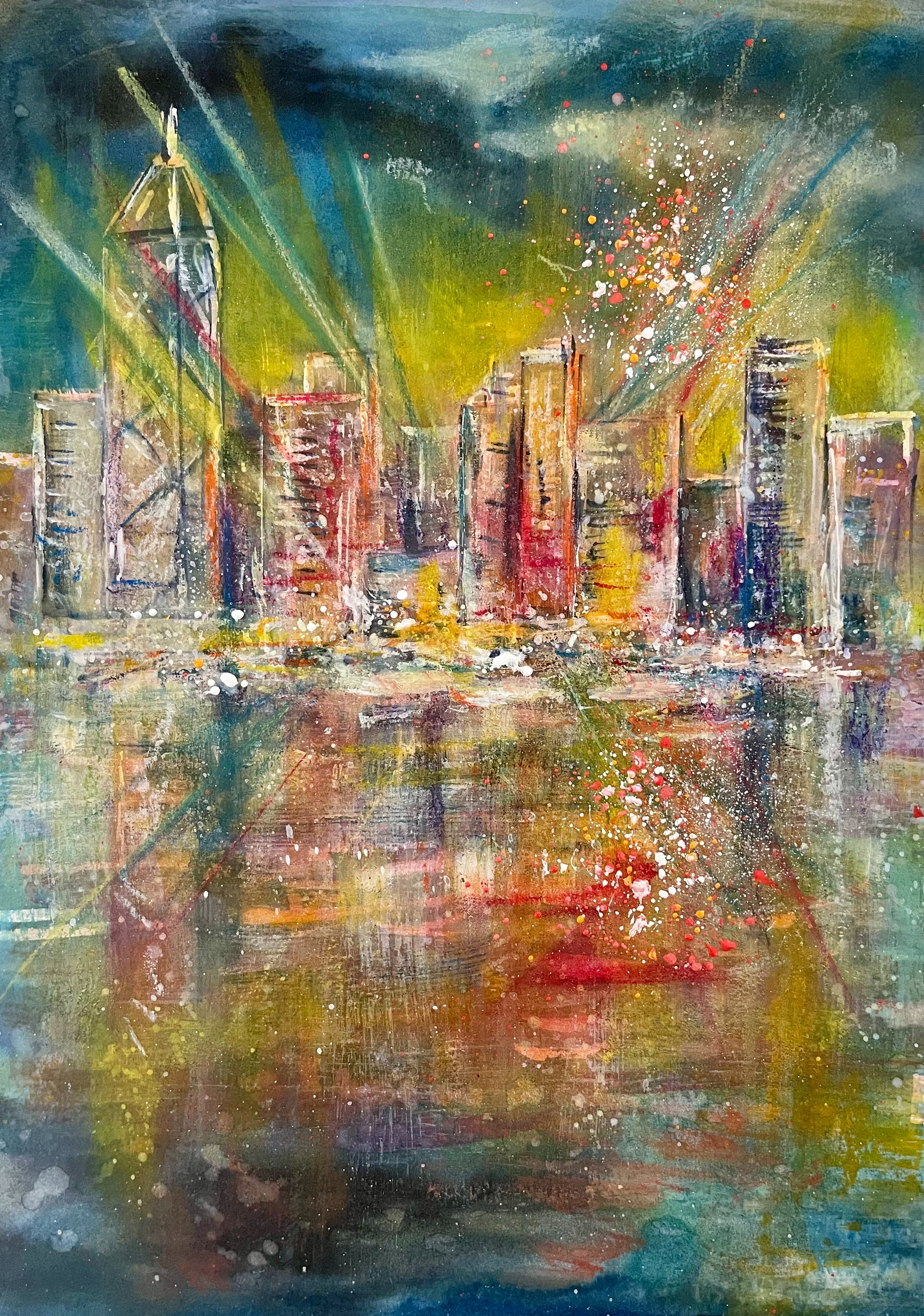
I.R.I.S., an acronym for Individual Running Images of the Spectrum, is the artistic name of Carmen Rieger, a Romanian-born artist who has lived in Austria for more than two decades. Trained in industrial design and formerly active as a furniture designer, she has developed a painting practice grounded in the relationship between structural discipline and organic transformation. Since 2018, this practice has taken shape through IRIS Fluidism, a visual and philosophical language inspired by water, the spectrum of light, and the principle of perpetual change. Her current body of work extends this language into what she defines as Fluid Neo-Cubism, an approach that combines the analytical fragmentation associated with Cubism with the continuous, adaptive movement of fluid forms.
Water is the conceptual foundation of IRIS's work. It is not treated simply as a subject to be represented, nor as a decorative motif, but as a model for understanding existence. Water moves through landscapes, atmospheres, bodies, and living systems. It changes state, adapts to its surroundings, creates pathways, and connects forms that might otherwise appear separate. For IRIS, these qualities make water an image of interdependence, regeneration, resilience, and continuous becoming. Its movement provides both the formal vocabulary of her paintings and the philosophical framework through which she considers identity, emotion, nature, and society.
This relationship with water began during childhood. IRIS spent significant periods in her grandparents' village, where she developed an early fascination with rain and the temporary shapes it produced. After rainfall, she traced the outlines of small pools of water and observed the irregular forms that appeared as water gathered, moved, and disappeared. She sang and danced in the rain, then returned indoors to draw fantasy scenes inspired by those experiences. These activities were initially forms of play, but they established a sustained attention to fluid contours, natural transformation, and the connection between physical movement and imaginative form.
Her understanding of drawing developed from these early observations. Rather than approaching the outline as a fixed boundary, she came to see it as the temporary result of motion. Water could create a shape without becoming permanently contained by it. A pool, ripple, current, or reflection existed only through a changing relationship between matter, light, surface, and time. This awareness would later become central to her conception of the image. In her paintings, form is never entirely stable. It is organized and recognizable, yet continually opened to movement, fragmentation, and renewal.
IRIS's formal education in industrial design introduced a different but complementary understanding of form. Her studies emphasized proportion, structure, spatial balance, and the relationship between aesthetic decisions and functional requirements. Her subsequent work in furniture design required precision and an awareness of how lines, volumes, and spaces interact. It also reinforced her interest in adaptation, since designed forms must respond to the conditions and purposes they serve.
This background remains visible in the internal architecture of her paintings. Although her compositions evoke liquid movement, they are not produced through uncontrolled gesture. Their apparent freedom is sustained by careful planning. Each curve, division, intersection, and transition belongs to a highly organized system. The fluidity of the image does not replace structure. Instead, it redefines structure as something flexible, relational, and capable of transformation. IRIS's experience in design allows her to maintain this balance between visual movement and compositional control.
Nature offered her a way to connect these concerns. She became increasingly attentive to the forms, colors, and functional adaptations found in natural systems. Rivers, lakes, clouds, rain, plants, animals, and the internal circulation of living bodies provided examples of structures that remain coherent without being rigid. Her life in Austria, with its rivers, lakes, forests, and mountain landscapes, strengthened her interest in the relationship between natural environments and human perception. These surroundings reinforced her conviction that fluidity is not the absence of order, but another kind of order, one based on responsiveness, continuity, and change.
The emergence of IRIS Fluidism as a coherent artistic language occurred in 2018. For many years, IRIS had practiced a daily ritual of addressing water with words of gratitude and affection, including "Thank you" and "I love you," while also expressing her wishes. She understands this ritual as a means of focusing her inner energy and entering a state of emotional clarity, purification, and connection.
On April 10, 2018, while experimenting with water and flour in her kitchen, she encountered an accidental image that resembled a fragmented human face. She photographed the formation and spent the following days and weeks studying it. The image was unlike anything she had previously experienced. Its fragmented structure appeared to communicate through the behavior of water itself, prompting an intense period of reflection. From this photograph, she developed a portrait titled Modern Woman.
IRIS regards this event not as the sudden invention of an unrelated style, but as the moment when a visual language that had been developing throughout her life became consciously recognizable. Childhood memories, design training, observations of nature, philosophical interests, experiments with organic forms, and her personal dialogue with water converged. She describes the experience as an awakening, a recognition of something she had long carried within herself. In honor of water as a form of "Fluid Intelligence," she named the emerging language IRIS Fluidism.
IRIS Fluidism is founded on the proposition that everything flows. IRIS's thinking is closely aligned with the ancient philosophical concept expressed by Heraclitus as Panta rhei, or "Everything flows." Within this framework, reality is understood not as a collection of isolated and permanent objects, but as an ongoing process of transformation. Bodies grow, age, heal, and change. Emotions arise, recede, and reappear in altered forms. Thoughts move in succession. Relationships develop through contact, separation, and renewal. Social structures and cultural identities are likewise subject to continuous reconfiguration.
Fluidity therefore operates in IRIS's work at several interconnected levels. It refers to the material behavior of water, the biological composition of living bodies, the movement of emotional life, and the instability of identity. It also describes the social environments in which individuals exist. Human beings are immersed in systems of exchange, communication, memory, and dependence, just as organisms are sustained by circulating fluids. No form exists entirely by itself. Each is shaped through contact with other forms and through the conditions that surround it.
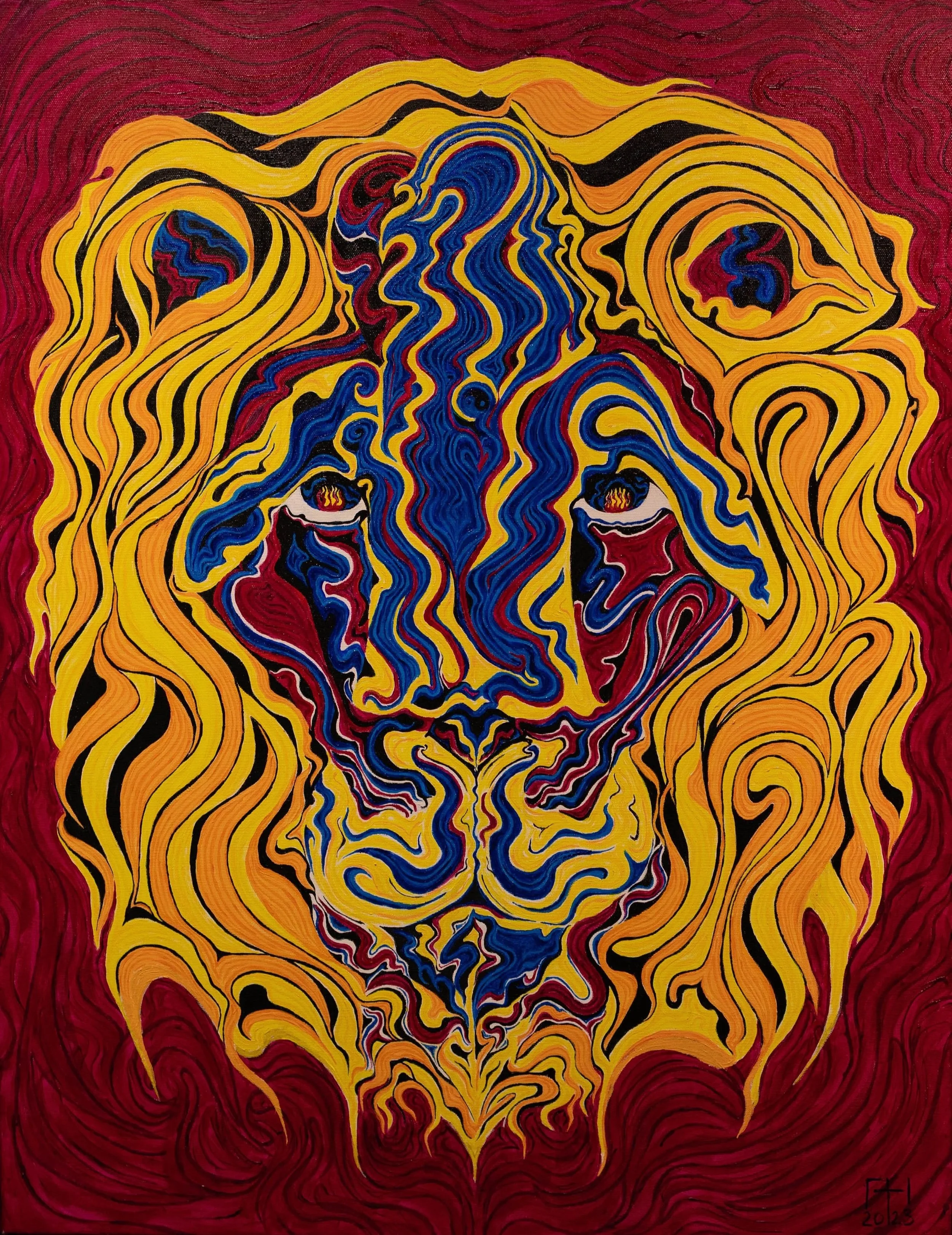
This understanding informs IRIS's treatment of figuration. Her paintings often begin with recognizable subjects, including human portraits, animals, and other living forms. Rather than constructing these subjects through conventional modeling, fixed contour, or descriptive volume, she rebuilds them through networks of fluid shapes and chromatic currents. The figure appears from within an organized field of movement. It is neither fully dissolved into abstraction nor enclosed within a stable representational boundary.
In this way, IRIS Fluidism creates a sustained dialogue between figuration and abstraction. A face remains identifiable, but its identity is distributed across interlocking forms. An animal retains its characteristic presence while being transformed into an arrangement of organic lines and colors. A bird remains connected to the idea of flight. An elephant remains legible as an elephant, even when its body is reconstructed through fluid sections. Recognition persists, but it is never separated from transformation.
IRIS describes this approach as depicting the liquid dimension of a body without destroying its original character. Her interest arises partly from the large proportion of water present in humans, animals, and plants. Rather than treating the visible surface as the complete identity of a subject, she imagines form through the element that circulates within it. The resulting image suggests both exterior appearance and internal movement. Circulation, growth, cellular activity, and the flow of bodily fluids are not illustrated scientifically, but they inform the visual logic of the compositions.
Portraiture occupies a particularly important place in this practice. For IRIS, a portrait is not a fixed record of physical likeness. It is an emergence of character, emotion, memory, and energy through form. When portraying a particular person, she seeks a state of concentrated attention to the subject's presence and expressive identity. In the case of a musician or public figure, she may reflect on the person's music, character, and emotional register while developing the composition. The portrait becomes a structure through which several dimensions of the subject can coexist.
This expanded understanding of portraiture has become increasingly significant in IRIS's Fluid Neo-Cubist Period. Her current direction retains the foundational principles of IRIS Fluidism while introducing a more explicit engagement with fragmentation, multiple viewpoints, and structural deconstruction. Classical Cubism broke objects and figures into angular planes, allowing several physical perspectives to occupy the same image. Fluid Neo-Cubism adapts this principle to IRIS's own visual language. Rather than fragmenting the subject through sharp geometry, she subjects geometric division to a process of melting.
Rigid angles are replaced by organic transitions. Planes remain distinct, but their borders curve, flow, and merge. The figure is broken apart without becoming mechanically divided. IRIS has described this condition through the image of a Cubist portrait made from stained glass and left in the sun. As the glass begins to melt, its fragmented sections retain their relative positions while their edges lose their hardness and flow into one another. This metaphor clarifies the central paradox of Fluid Neo-Cubism: form is deconstructed, yet the means of deconstruction remain liquid rather than crystalline.
Within this new period, fragmentation becomes a means of presenting multiple emotional perspectives rather than multiple physical angles alone. Profiles may face one another, overlap, or occupy contrasting chromatic zones. Different areas of a face can suggest private thought, outward strength, sorrow, self-awareness, memory, or internal dialogue. The portrait does not reduce these states to a single expression. Instead, it allows them to exist simultaneously as parts of one changing identity. Each section contributes a different chapter to the same life.
This approach is evident in the works that define the beginning of the Fluid Neo-Cubist Period. IRIS identifies LOVERS, completed in April 2026, as the work through which the new direction first emerged. The development continued through THE FIRST AUDITION and reached a more mature stage in SHE LIKES SELFIES, RAW GRACE, and THE QUEEN OF HEARTS. Together, these paintings establish the technical, structural, and spiritual principles of the period while remaining part of the broader evolution of IRIS Fluidism between 2018 and 2026.
A defining feature of these works is the introduction of deep violet lines that bind the fluid sections into a continuous matrix. Earlier organic shapes no longer operate as isolated islands of color. They are connected by a calculated visual network that moves through the subject, background, and symbolic elements. IRIS conceives these violet lines as energy channels, comparable to an internal nervous or circulatory system. Their function is both structural and conceptual. They organize the composition while making visible the principle that no element exists independently.
The violet matrix also clarifies the relationship between freedom and discipline in IRIS's practice. The lines appear fluid, but their placement is carefully determined. They guide the eye through the image, establish rhythm, separate and reconnect chromatic fields, and maintain the integrity of the subject. Their movement is controlled without becoming static. The resulting structure reflects IRIS's central understanding of water: it follows a course while continually adapting to the conditions it encounters.
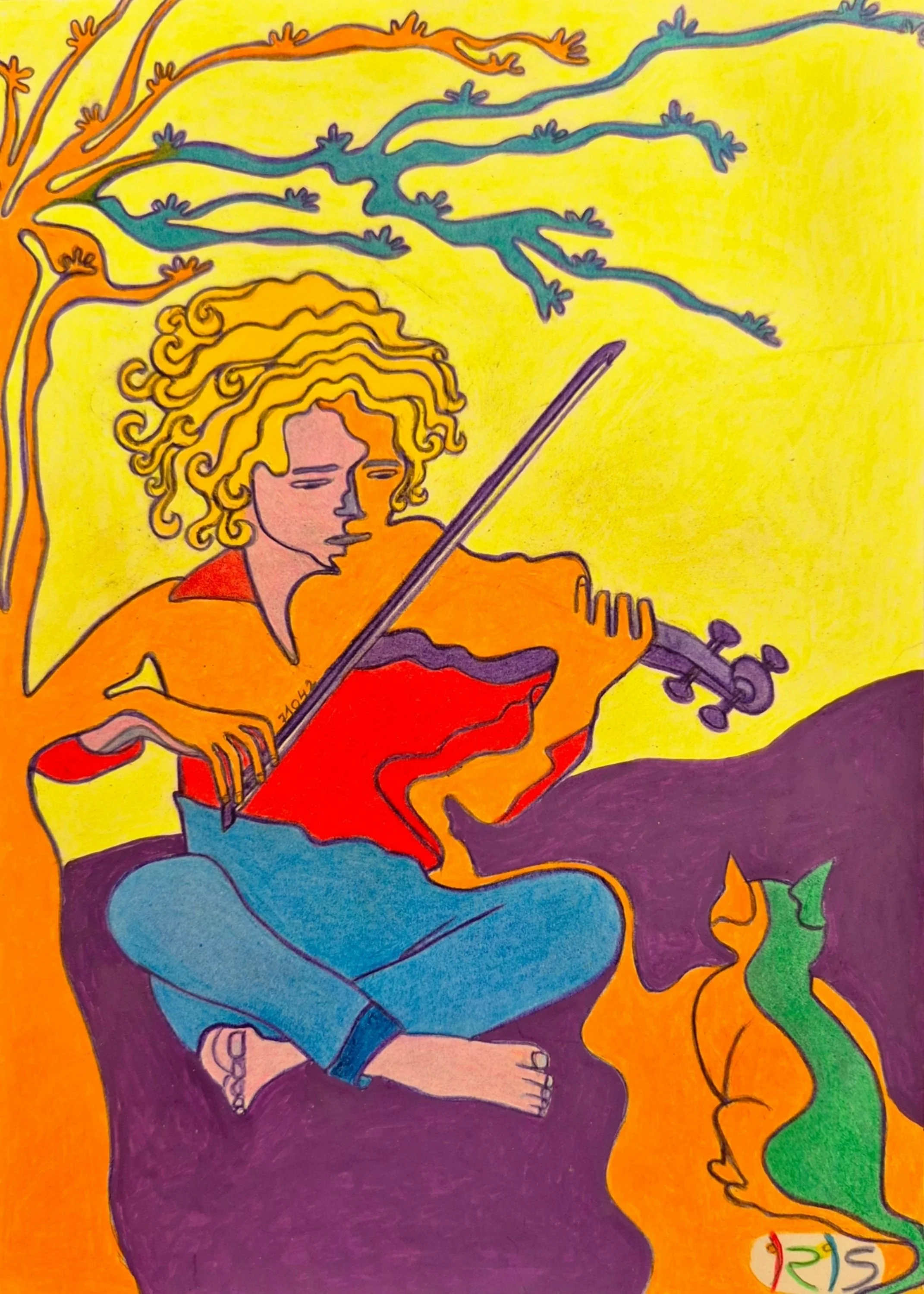
Her creative process begins with drawing. She develops the chosen subject through repeated sketches, usually using colored pencils on A4 paper. The initial drawing may be altered many times before reaching a satisfactory resolution. This stage is both the most demanding and the most absorbing part of the process because it establishes the entire internal architecture of the painting. In a portrait, the position of every principal line is critical. Even a minor change can alter the expression or compromise the identity of the subject.
Once the preparatory drawing is complete, IRIS transfers it to a much larger canvas. Scaling the image requires considerable precision. A variation that appears slight during enlargement can distort the relationships among features, curves, and sections. The transfer is therefore not a loose interpretation of the sketch, but a carefully controlled reconstruction. Each detail must preserve the proportions and expressive balance established in the original drawing.
Color is applied only after this structure has been secured. IRIS works primarily with acrylic paint on canvas, using brushes and strips of tape in varying widths, lengths, and shapes. The tape helps define the bands and fluid divisions that compose the image. Acrylic paint is suited to her process because its vibrancy and rapid drying allow her to build clear, precise areas of color. Colored pencils provide similar control during the preparatory phase, enabling her to test structural relationships before moving to canvas.
Throughout her work, IRIS uses the seven colors of the rainbow and the shades created by combining them. This palette has remained consistent since the beginning of IRIS Fluidism. It functions at once as a formal system, an emotional language, and a philosophical statement. The colors establish visual unity across the complexity of the compositions, allowing numerous shapes and divisions to remain connected within a coherent field.
For IRIS, the colors of the rainbow are also states of happiness. She associates them with joy, vitality, and the emotional intensity she experiences while painting. Their significance is linked to the formation of the rainbow itself, produced when light is refracted through water. The spectrum therefore brings together two of the foundational elements of her work: water and light. It becomes a bridge between material and immaterial experience, between the visible world and the energies, feelings, and spiritual associations that she believes move through it.
Color does not merely fill the forms after they have been drawn. It gives them identity, rhythm, and emotional resonance. Contrasting hues can separate psychological states, while adjacent shades create transitions between them. The full spectrum supports the paintings' movement between distinction and unity. Each color retains its individual force while participating in a larger chromatic system, reflecting IRIS's broader view of existence as a relationship between singularity and interdependence.
The tension between control and spontaneity remains central throughout the process. IRIS does not imitate the literal appearance of flowing water through uncontrolled paint. Instead, she studies the principles of fluid movement and translates them into a constructed visual language. The forms appear free because their structure allows them to breathe, adapt, and move. Their freedom is not accidental. It is achieved through discipline.
This balance echoes the dual nature of water itself. Water can be forceful, turbulent, and transformative, yet it can also calm, heal, and restore. IRIS seeks a comparable equilibrium in her paintings. The compositions are visually active, with dense networks of lines, colors, and interlocking forms, but they are intended to offer an experience of coherence rather than confusion. Movement and stillness remain present at the same time. The viewer is invited to follow the energy of the image while also finding a space for contemplation.
IRIS's daily relationship with water influences the emotional conditions under which she works. Before beginning a piece, she creates a quiet physical and mental space. She may meditate or observe water, attending to its movement and to the way light interacts with its surface. Her ritual of gratitude reinforces her sense that the creative process is collaborative rather than entirely self-directed. She does not understand herself as imposing a fixed idea upon passive material. Instead, she seeks to enter a condition of attention in which form can reveal itself through the dialogue among observation, memory, emotion, and disciplined construction.
This inner state is essential to her conception of authenticity. Technical control alone is not sufficient. The work must carry the emotional concentration through which it was created. IRIS understands water as a silent collaborator, a presence associated with healing, sensitivity, and communication beyond words. When she feels connected to this presence, she experiences greater calm and clarity. The resulting painting becomes more than a representation of a subject. It becomes a record of sustained attention and a visual dialogue among form, color, movement, and energy.
Spirituality is inseparable from this process. IRIS considers water a sacred gift that sustains all forms of life and connects the planet's biological systems. It circulates through the bodies of humans, animals, and plants, moves through rivers and oceans, rises into clouds, and returns as rain. This cycle provides a material image of continuity and shared existence. Water is both intimate and planetary, present within the body while also shaping environments and climates.
Her work asks viewers to recognize this shared dependence. The fluid forms and interwoven colors mirror lives that intersect, merge, separate, and remain part of a larger system. Water becomes a universal language through which IRIS addresses empathy, responsibility, and care for the natural world. Her paintings are intended to heighten awareness of the balance that sustains life and of the obligation to protect the element upon which that life depends.
Within the Fluid Neo-Cubist Period, this spiritual dimension is extended through the inclusion of numerical sequences and sacred symbols. IRIS discreetly integrates selected numeric codes into the structures of her paintings. She associates these sequences with joy, healing, the release of past emotional trauma, spiritual protection, emotional resilience, and alignment. They are not positioned as separate inscriptions detached from the image. Instead, they are embedded within the compositional network, participating in the same system of lines, forms, colors, and symbolic relationships.
IRIS understands these sequences as vibrational elements. In her view, a painting should not only be seen, but also felt. The artwork can operate as a space in which visual perception, emotion, and spiritual attention meet. Her interest in energy healing, vibrational frequencies, quantum physics, and numerical systems informs this aspect of the work. These disciplines are not presented as scientific demonstrations within the paintings. They enter the practice as sources of reflection on the relationship between visible matter and invisible energy.
The duality of the visible and invisible is one of IRIS's recurring concerns. Her figures remain physically recognizable, yet they are reconstructed through forms intended to suggest emotional, energetic, and spiritual dimensions. The visible body becomes an entry point into internal states that cannot be represented through likeness alone. Color, fragmentation, rhythm, and symbolic structure allow the image to hold several levels of experience at once.
This duality also shapes her understanding of identity. Identity is not treated as a single, permanent essence. It forms and reforms through memory, emotion, social contact, private reflection, and changing circumstances. Fluid Neo-Cubism allows IRIS to present the subject as both coherent and multiple. The fragmented portrait remains one person, but that person contains contrasting states and perspectives. The self is structured, yet never final.
Her work extends this principle beyond the individual. IRIS sees fluidity as a metaphor for contemporary cultural and social conditions in which identities, relationships, and boundaries are continually changing. Forms in her paintings join, separate, overlap, and transform, producing visual microcosms of a world defined by movement and interdependence. This perspective does not erase difference. Rather, it locates difference within a shared field of connection.
The affirmative character of IRIS's practice is deliberate. She seeks to bring beauty, hope, love, and emotional openness into contemporary visual culture without denying the difficulty or complexity of lived experience. Her paintings include sorrow, division, trauma, and internal conflict, but they do not treat these conditions as final. Fragmentation becomes part of a process through which form can be reorganized. Fluidity makes transformation possible.
For IRIS, hope is not a form of avoidance. It is an ethical and emotional orientation grounded in interdependence. The recognition that lives are connected carries responsibilities toward other people, other species, and the environments that sustain them. Love and empathy are understood as necessary conditions of collective existence, comparable in their importance to the water that moves through every living body.
She hopes that viewers encounter the paintings as spaces of meditation and emotional resonance. The dense compositions ask for sustained looking. Recognizable faces or figures may first establish contact, after which the eye moves through chromatic currents, violet channels, symbolic elements, and numerical sequences. The image is intended to unfold gradually rather than communicate through a single immediate reading.
Through this process, IRIS seeks to bypass purely rational interpretation and create a direct emotional response. She hopes viewers may experience balance, calm, vitality, connection, or a change in their emotional state. The objective is not to prescribe a uniform reaction, but to provide a visual environment in which contemplation becomes possible. The paintings invite viewers to consider themselves not as isolated observers, but as participants in the same continuous movement represented on the canvas.
IRIS understands art itself through the metaphor of a river. Art carries emotion, memory, and consciousness across time, linking individual acts of creation to a larger historical continuum. Each artwork enters an existing current and continues beyond the moment of its production. Within this understanding, the artist is not the absolute origin of meaning, but a point of passage through which inherited perceptions, experiences, and energies are translated into visible form.
IRIS Fluidism belongs to this flow as both a personal language and an evolving system of thought. Its development from childhood observation to the 2018 awakening, and from its initial organic vocabulary to the current Fluid Neo-Cubist Period, reflects the principle it articulates. The practice does not remain fixed. It changes while retaining its foundational commitment to water, movement, interconnection, and transformation.
Fluid Neo-Cubism is therefore not a rejection of IRIS's earlier work, but its continued evolution. It introduces greater structural complexity, a more explicit deconstruction of the figure, a matrix of violet energy channels, and an expanded symbolic language. At the same time, it preserves the fluid contours, rainbow spectrum, spiritual orientation, and disciplined process that define IRIS Fluidism.
Across these developments, IRIS's paintings remain focused on the relationship between order and change. They break form apart in order to reconsider how it might be reunited. They allow the figure to remain recognizable while exposing it to movement. They organize color into complex systems without reducing its emotional force. They connect physical bodies to wider natural and spiritual networks. Through these relationships, the paintings present reality as neither static nor chaotic, but as an evolving structure sustained through flow.
For IRIS, water remains the clearest expression of this condition. It is life, movement, memory, adaptation, and renewal. It is present within the individual body and across the planet. It can separate and connect, reflect and distort, soothe and transform. In its continuous passage through different forms, it offers a model for understanding existence itself.
Her practice gives visual form to that passage. Each painting is conceived as a moment of stillness held within movement, an organized structure that remains open to transformation. Through fluid lines, fragmented figures, chromatic spectra, violet networks, and embedded symbols, IRIS constructs images in which matter and energy, visibility and invisibility, private emotion and shared existence remain inseparable. IRIS Fluidism and its Fluid Neo-Cubist evolution propose that identity, nature, and consciousness can be understood not as fixed entities, but as interconnected currents within an enduring process of becoming.
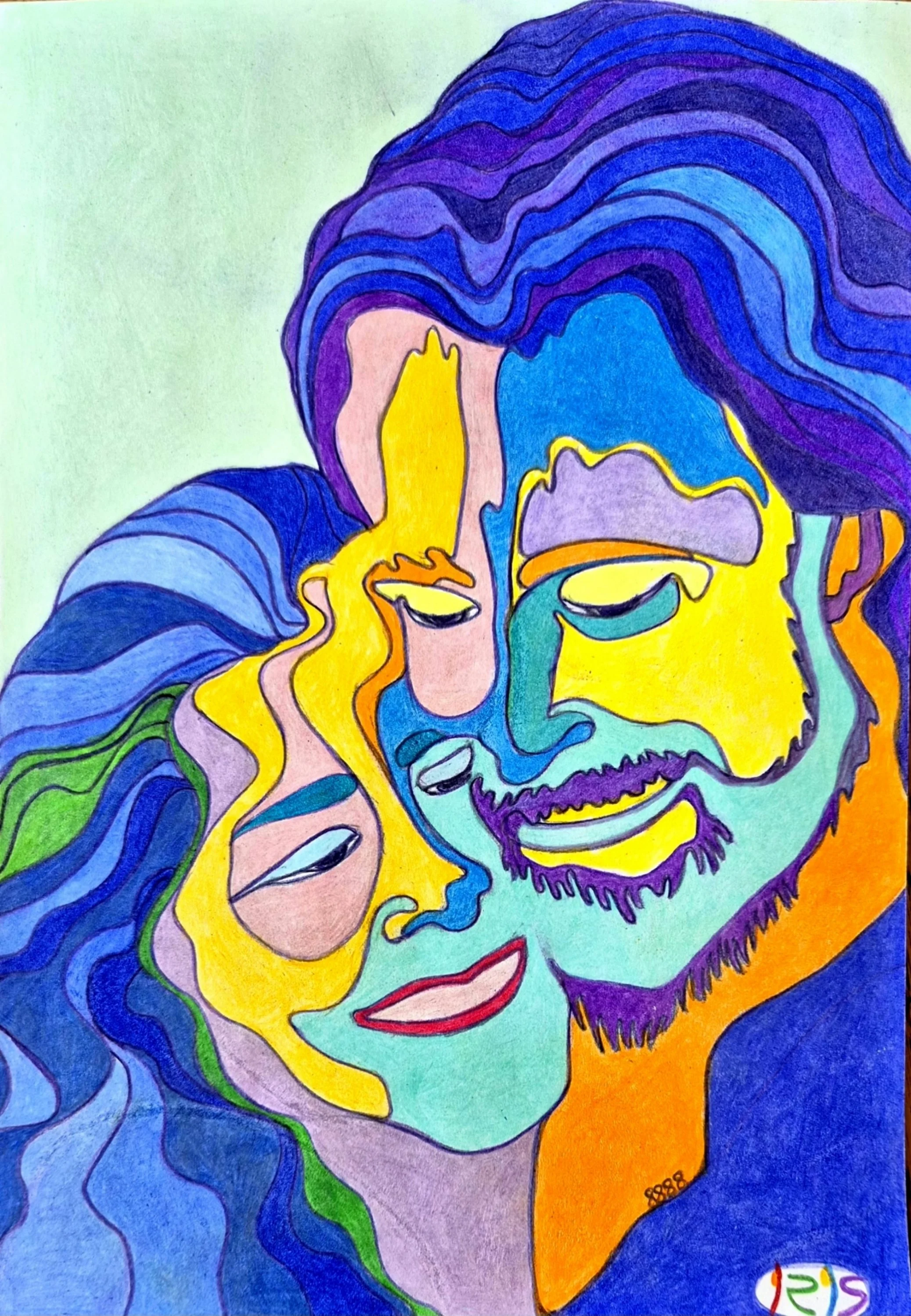
LOVERS, 2026. Color pencils on paper, 29.7x21cm
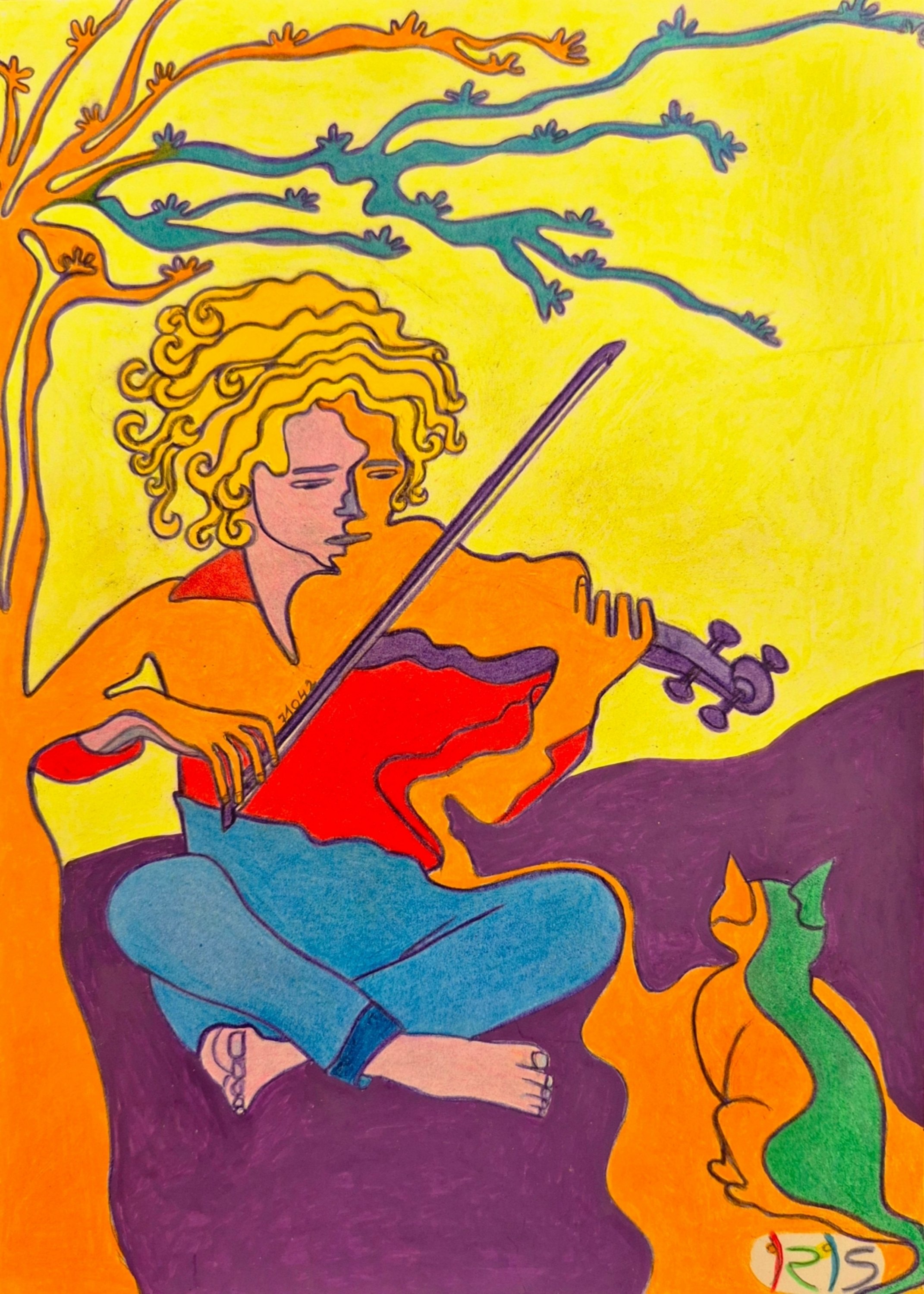
THE FIRST AUDITION, 2026. Color pencils on paper, 29.7x21cm
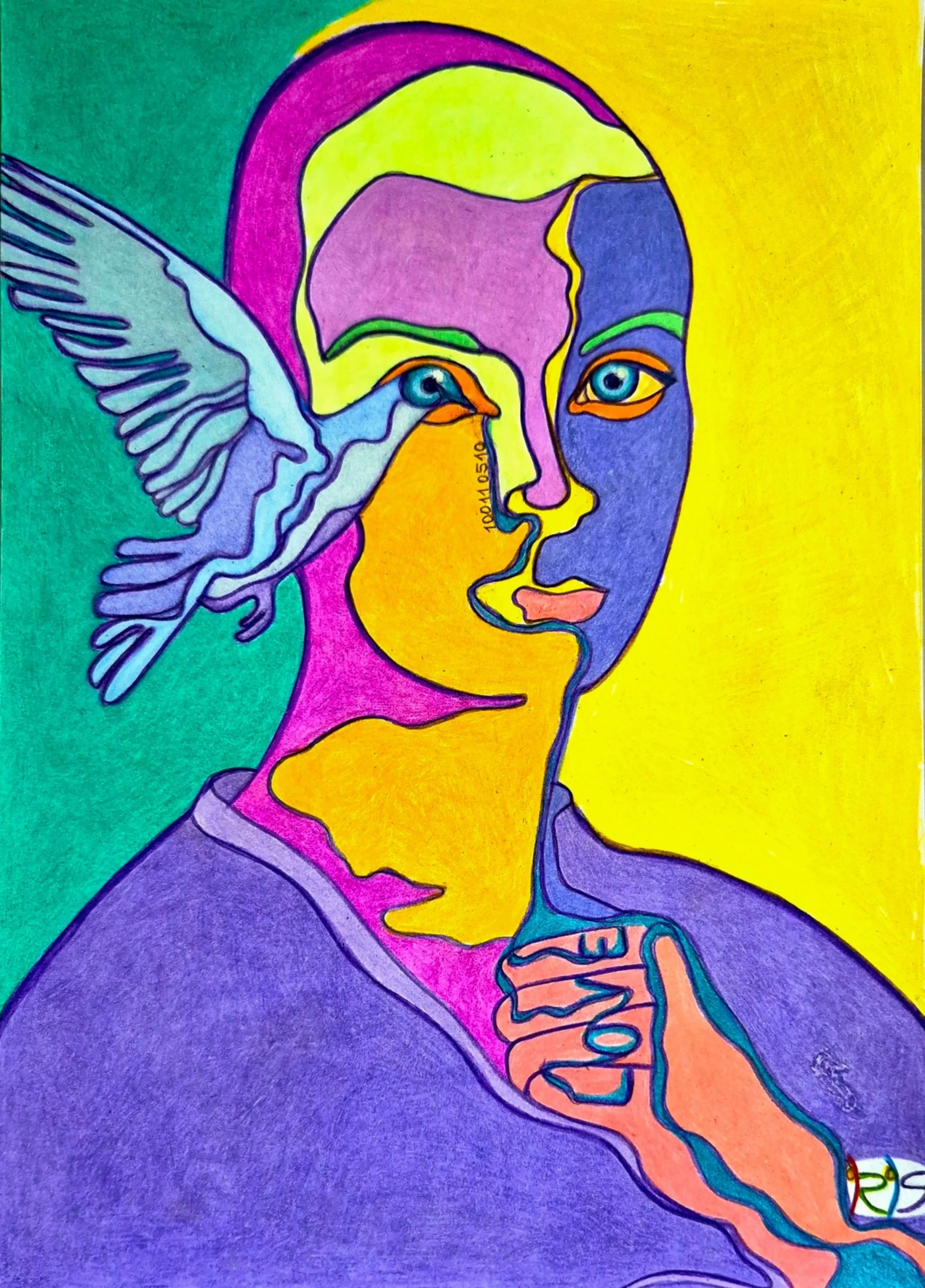
RAW GRACE, 2026. Color pencils on paper, 29.7x21cm
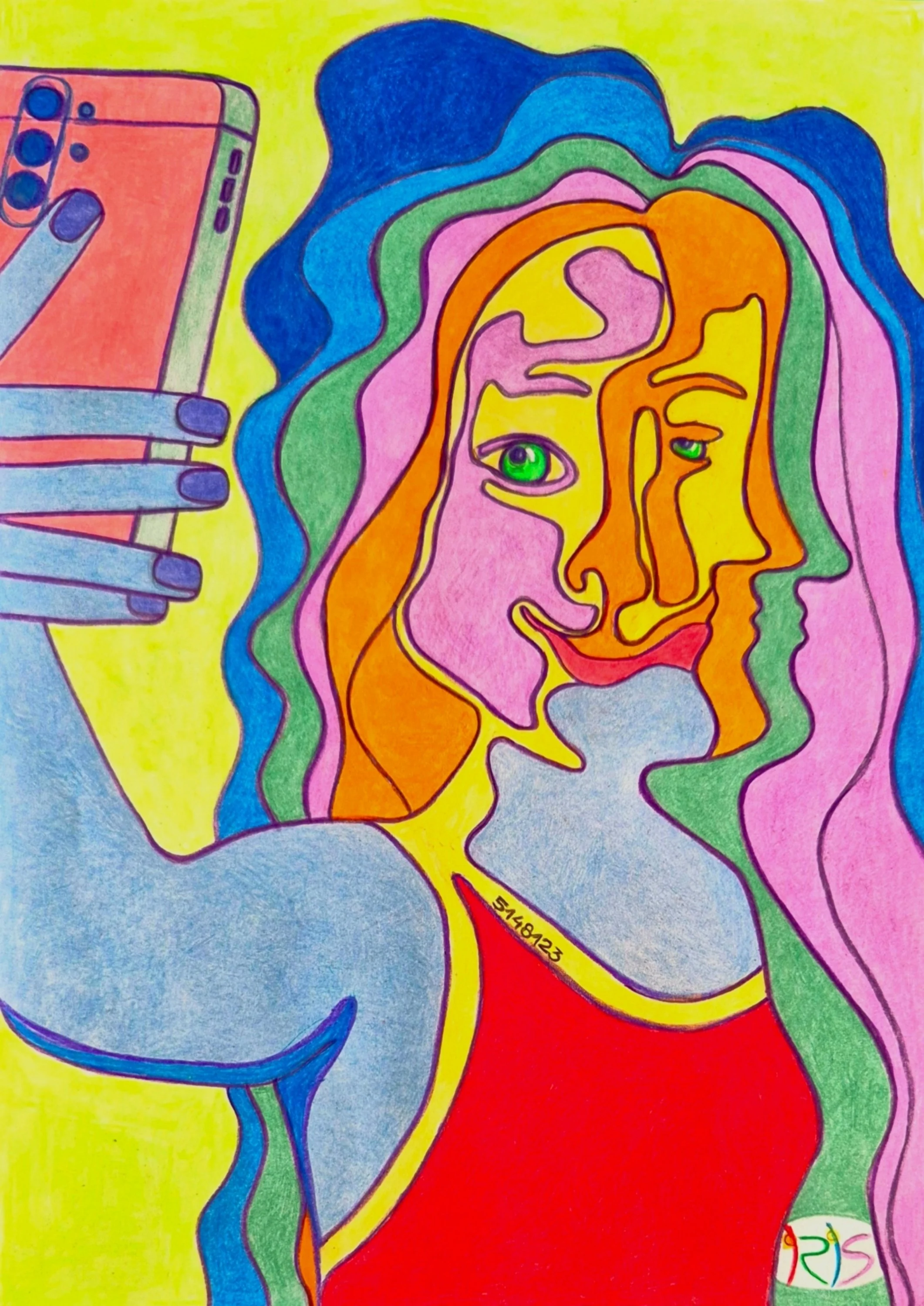
SHE LIKES SELFIES, 2026. Color pencils on paper, 29.7x21cm
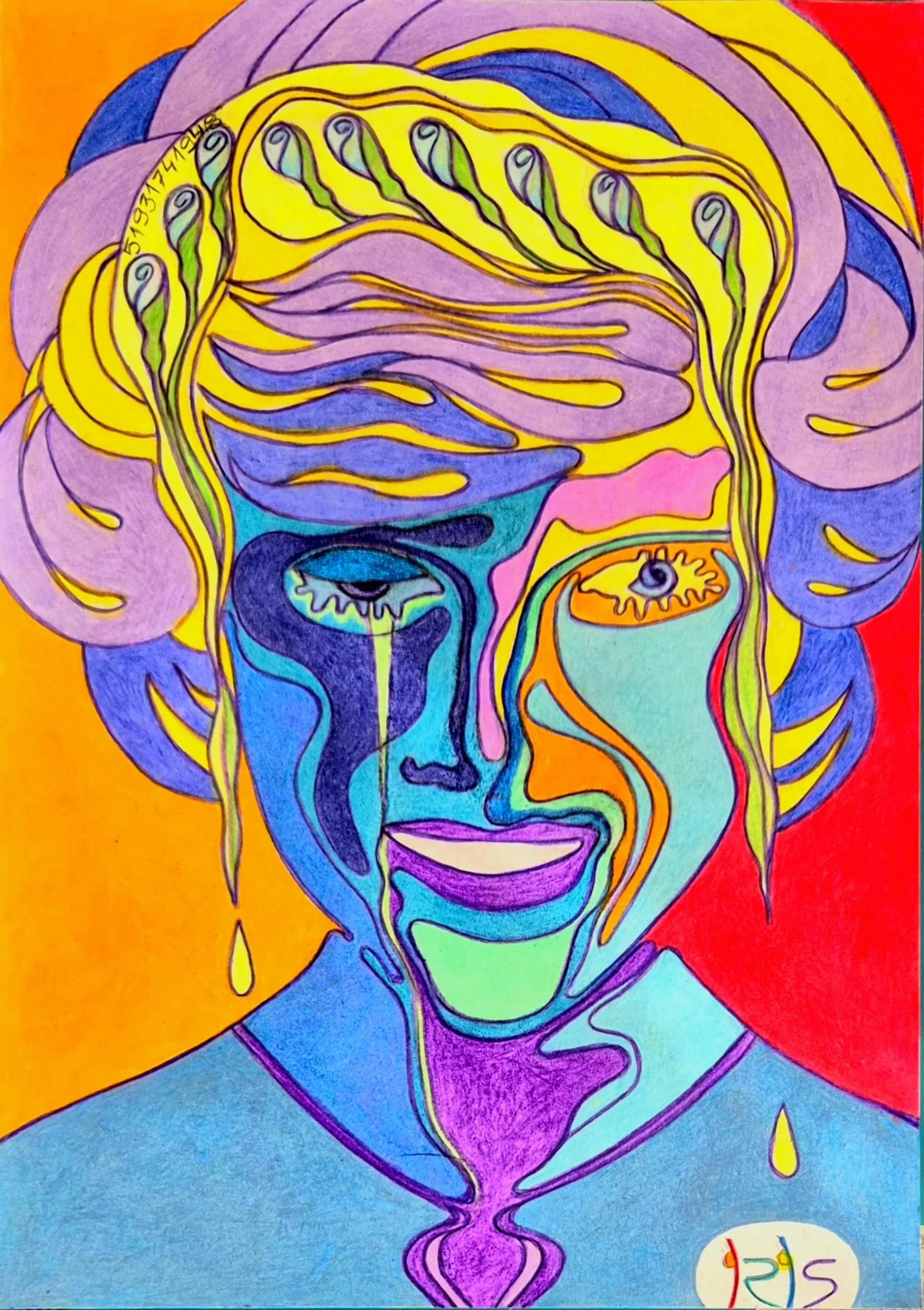
THE QUEEN OF HEARTS, 2026. Color pencils on paper, 29.7x21cm