Christophe de Callataÿ
Biography
• International CEO, contemporary artist, and philosophical painter exploring the future of humanity.
• Selected among the 100 Artists of Europe and named CEO of the Year 2026 for Transatlantic Relations.
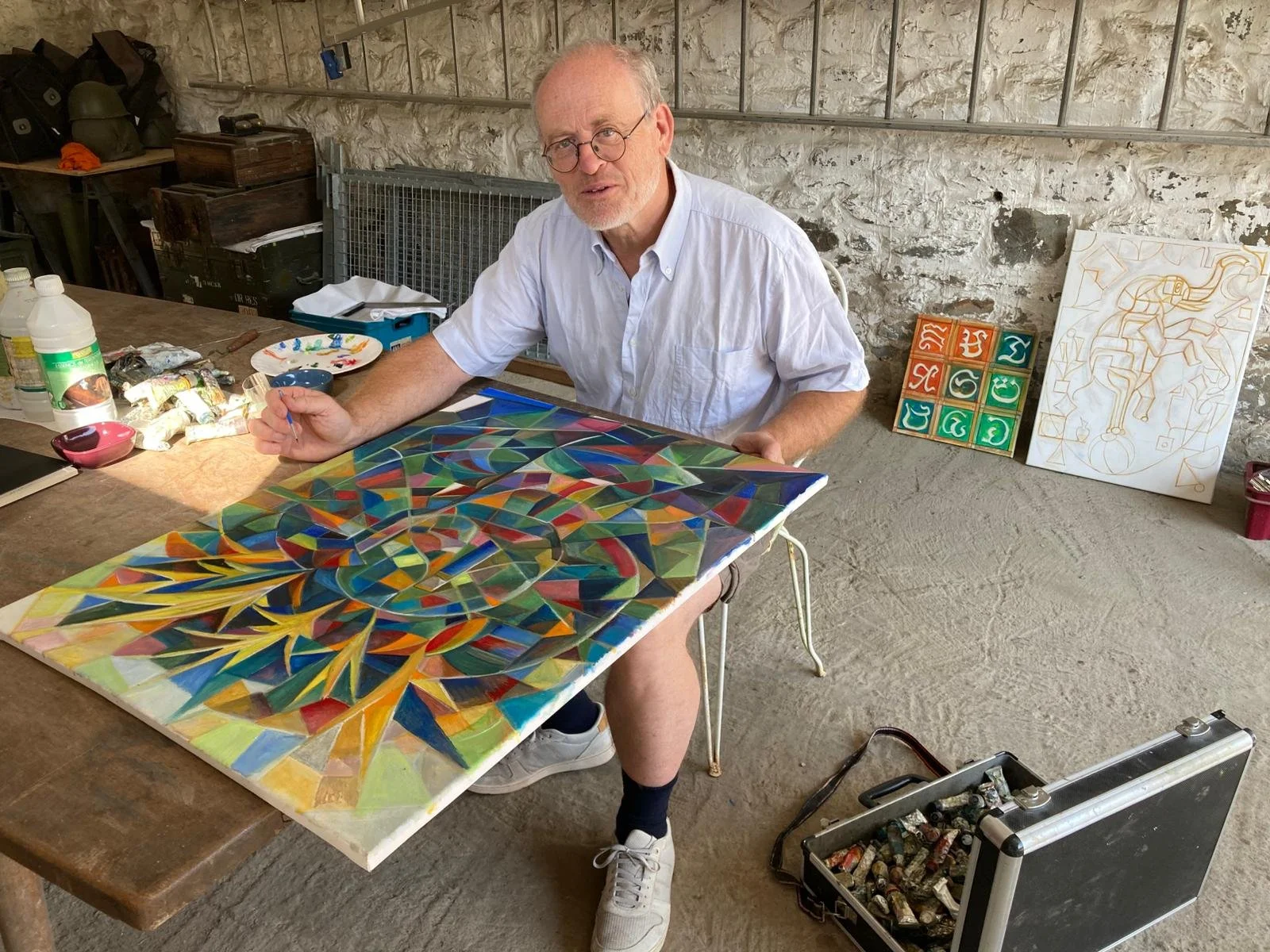
Christophe de Callatay is a contemporary artist whose philosophical body of work explores the future of humanity. His experience of several decades in international affairs, notably as a CEO, provides the starting point for an artistic inquiry into the transformations of our world, the fragility of our societies, and the destiny of mankind.
His work lies at the intersection of oil painting, philosophy, and poetic imagination. His paintings explore the major questions and tensions of our time: civilisation and chaos, spiritual quest and disenchantment, the pursuit of a glory that can be both blind and ephemeral, the fragility of democracies, the climate emergency, artificial intelligence, and the uncertain future of humanity.
Each work is accompanied by a title and a short text that extend its narrative and philosophical dimension. Together, his paintings form a vast narrative and humanistic mosaic, evoking the stained-glass windows of an imaginary cathedral that would illuminate, work after work, the history and destiny of humanity.
A self-taught artist, Christophe de Callatay discovered painting at an early age. At the age of thirteen, he won first prize in a national painting competition organised by the ADAC (Association des Arts et de la Culture) and the Royal Museums of Fine Arts of Belgium, already revealing a strong sense of composition, colour, and visual storytelling.
Christophe holds university degrees in philosophy and law from UCLouvain (UCL), journalism and international relations from the Université libre de Bruxelles (ULB), and management from Solvay Business School. As a Fellow of the Belgian American Educational Foundation (BAEF), he also studied filmmaking at Boston University.
He subsequently pursued a career in association management and international public affairs, holding a number of executive positions. Since 2016, he has served as CEO of the American European Community Association (AECA), a Brussels-based international organisation dedicated to promoting transatlantic dialogue.
Founded by the President of the European Commission and the Prime Minister of Belgium, AECA brings together stakeholders committed to strengthening relations between Europe and the United States.
His experience as an international leader now directly informs his artistic perspective: an understanding of power relations, an observation of technological and geopolitical transformations, and a first-hand encounter with the forces reshaping our societies.
Alongside his professional responsibilities, he has spent several years developing a personal pictorial language that does not fit neatly within the traditional categories of abstraction or figuration. His intensely coloured and symbolic paintings have become a means of exploring more broadly the human condition and its possible futures.
In 2025, Christophe de Callatay presented his first solo exhibition at Galerie Michel Ange Fine Arts in Brussels. He was also selected for 100 Artists of Europe, a publication dedicated to contemporary European art.
His oil painting ‘The Territories of the Imagination’, exhibited at ArtWeek Basel, received an award from the Circle Foundation for the Arts.
Around fifty of his paintings are currently exhibited in the head offices of a major private bank in the heart of Brussels. His work is also featured on various art platforms, in specialised art magazines, and through online galleries.
Today, Christophe de Callatay is developing this body of work as an artistic inquiry into a fundamental question: what are we becoming, and what kind of future are we creating - and leaving behind - for generations to come?
Artist Statement
Painting, for me, is a way of thinking. Each canvas begins with a question rather than an answer: How do civilizations rise and fall? Why do human beings seek gods, glory, and meaning? Can we remain joyful while witnessing the fragility of our world? And what becomes of humanity in the age of artificial intelligence?
My work is an ongoing visual inquiry into the human condition. Each painting is conceived as a chapter in a larger narrative, where mythology, history, nature, and contemporary society converge. Together, these works form a mosaic of ideas and images, tracing a journey from the origins of the world to the uncertain future we are creating for ourselves.
I draw inspiration from ancient civilizations and mythologies across the globe, from the intelligence and rhythms of the natural world, and from the many places I have travelled to and called home. Sacred animals, deities, symbolic landscapes, and archetypal figures inhabit my compositions, creating spaces where memory, imagination, and reflection intertwine. My work also pays homage to the countless artists, both anonymous and celebrated, whose creativity has shaped our shared cultural heritage.
Colour lies at the heart of my visual language. I embrace vibrant, luminous palettes not simply for their aesthetic appeal, but as an affirmation of life. Even when exploring environmental destruction, the illusion of power, the fragility of democracy, or the profound transformations brought about by technology, I seek to preserve a sense of harmony and hope.
For me, beauty is not an escape from complexity, but a way of approaching it - an invitation to look more closely, question more deeply, and remain open to possibility.
Although self-taught as a painter, my artistic practice is rooted in a lifelong engagement with philosophy, law, journalism, and international relations. Before devoting myself fully to painting, I spent decades working at the intersection of politics, economics, and the media in Brussels, at the heart of the European Union.
These experiences continue to shape my perspective, connecting intimate questions about human existence with the wider political, cultural, and historical forces that determine our collective destiny.
Each painting bears a title and subtitle, extending its meaning beyond the image and opening another layer of interpretation. I invite viewers not simply to look, but to pause, explore, and contemplate - to find their own connections and discover themselves within narratives that are at once ancient and profoundly contemporary.
Ultimately, my paintings celebrate humanity's enduring capacity to imagine, question, and create. They reflect my belief that art remains one of the rare spaces where beauty, mythology, and critical thought can coexist freely. A space in which we can confront the contradictions of our time, reconsider our place in the world, and perhaps glimpse new ways of understanding both ourselves and the future we share.
https://www.christophedecallatay.com/
https://www.instagram.com/christophedecallatay/
https://www.linkedin.com/in/christophedecallatay/
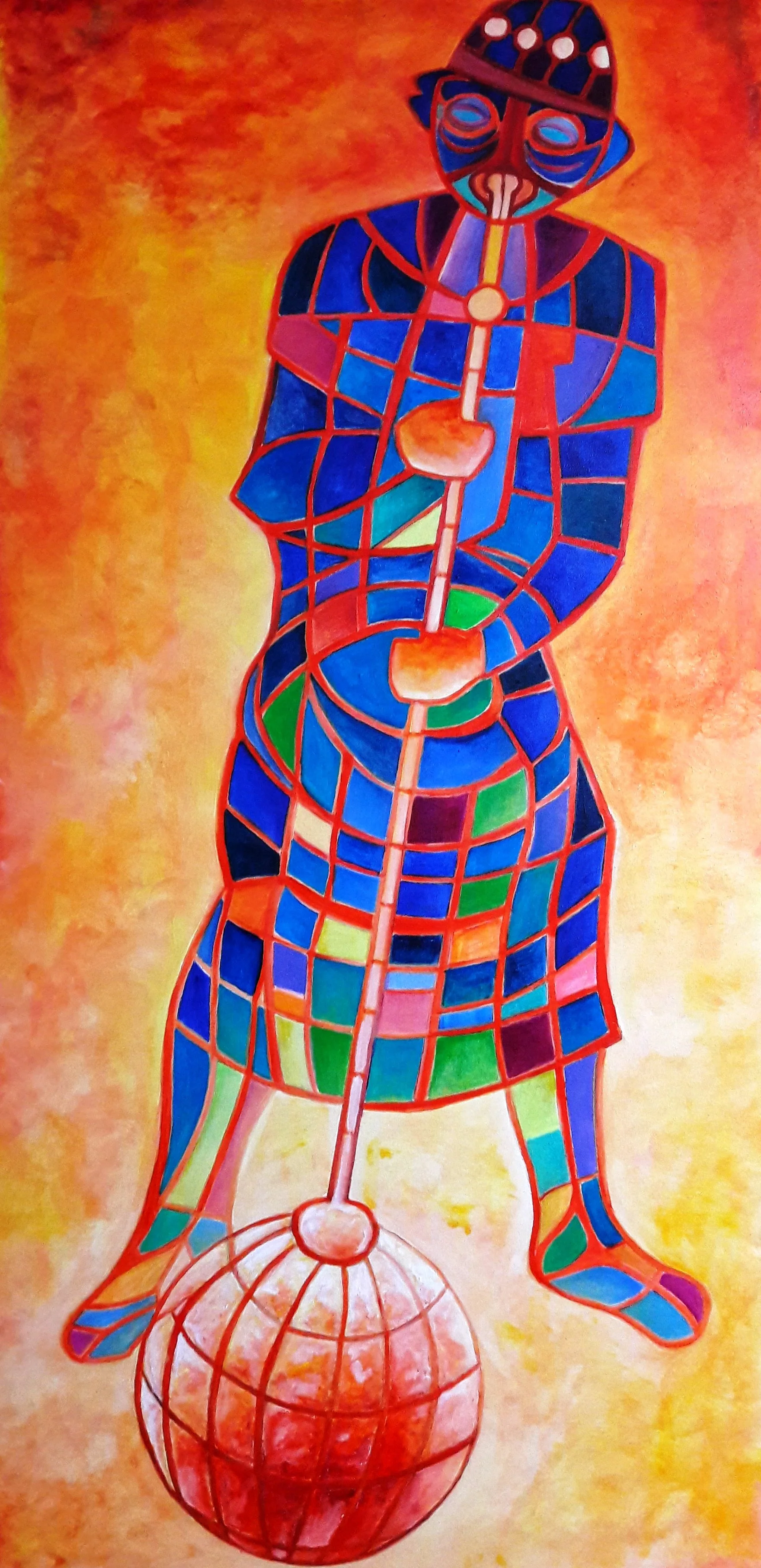
The Creation of the World (2020)
The beginning of everything. The moment when the universe emerges in a silent and intimate breath.
From a single breath, the creator, himself depicted as a glassblower in a glass mosaic, takes us from nothingness to being.
The world is born, fragile and evanescent like a crystal bubble.
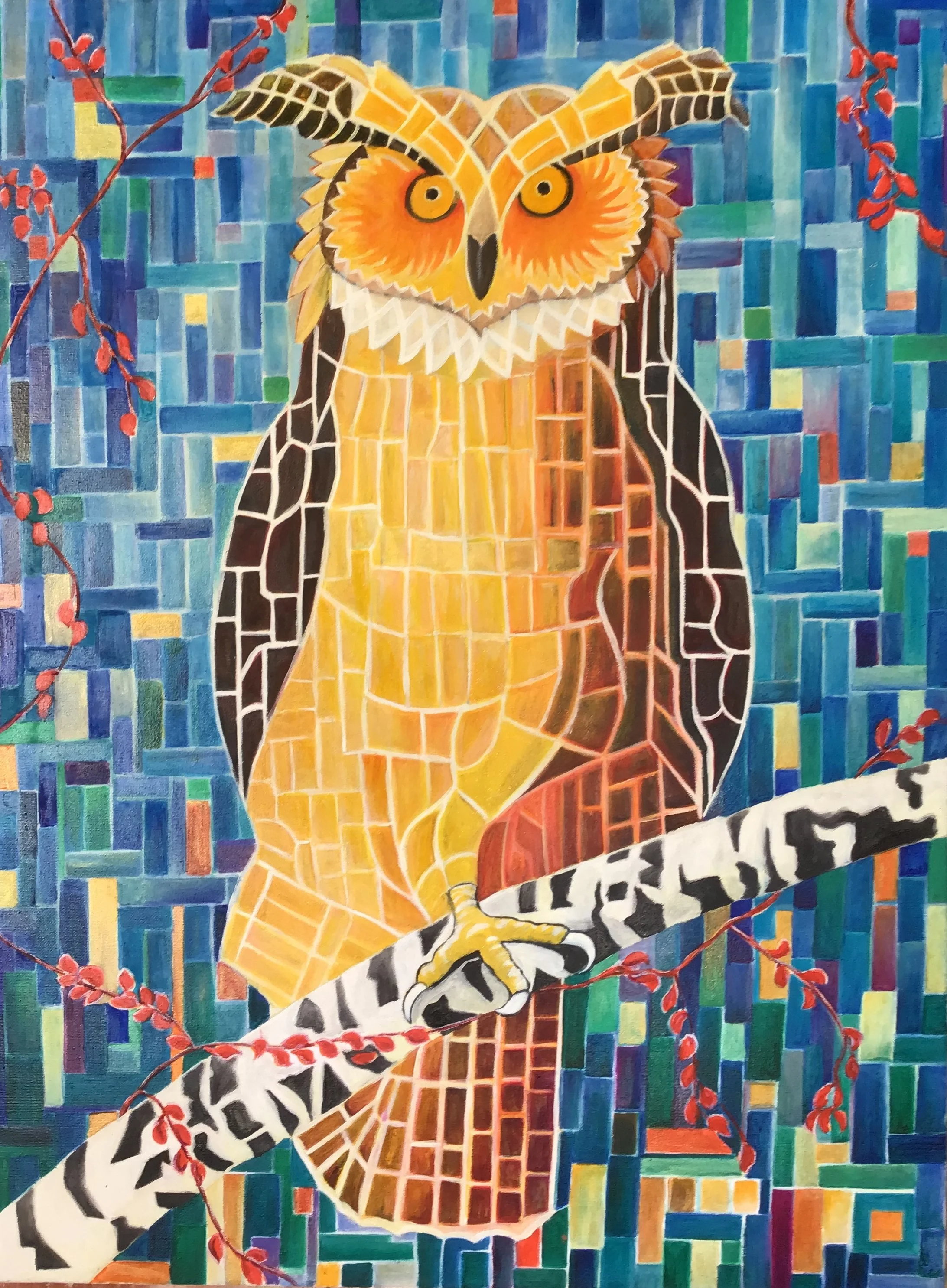
All the World’s Wisdom Standing on One Leg (2021)
As a timeless guide through darkness, the owl has symbolized wisdom and foresight since antiquity.
With its unblinking gaze and poised stance on a single leg, it embodies the delicate yet essential balance of thought—holding steady in the shadows to illuminate uncertainty and face the unknown.
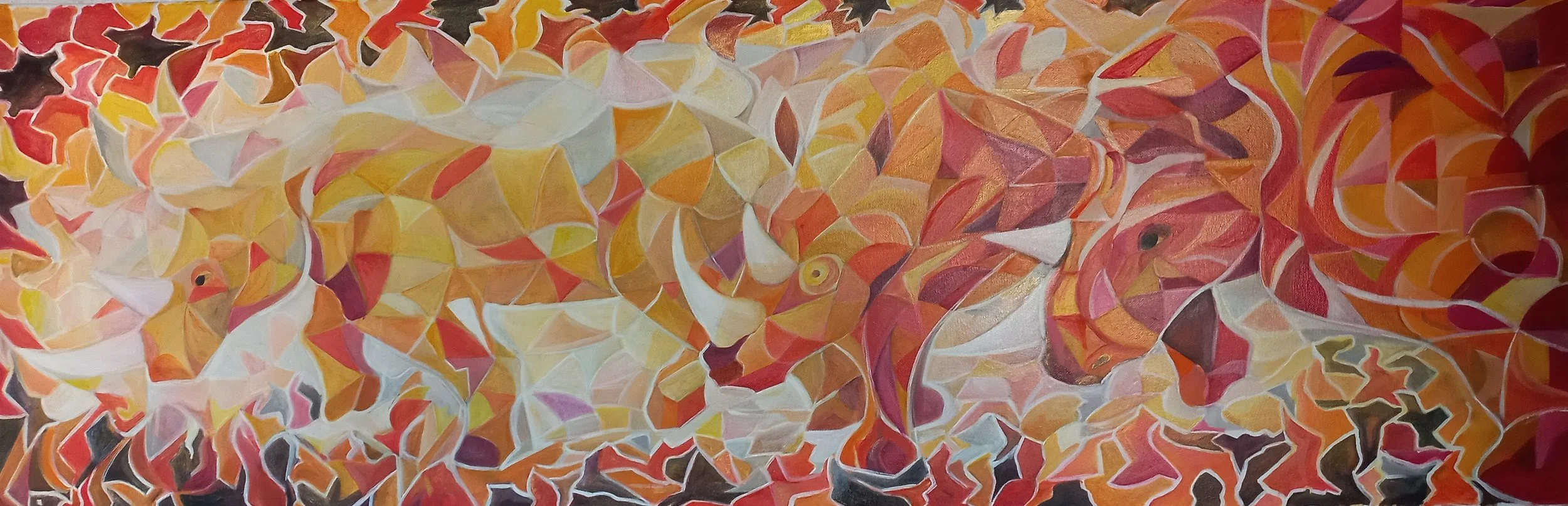
The Relentless and Crushing Charge of Time (2020)
Time marches on like a herd of rhinoceroses, massive and relentless.
Each second is a pointed horn, each minute a heavy step that kicks up the dust of existence.
It can neither be stopped nor slowed down; it continues its blind course, crushing memories, dreams, and certainties all together in its momentum.
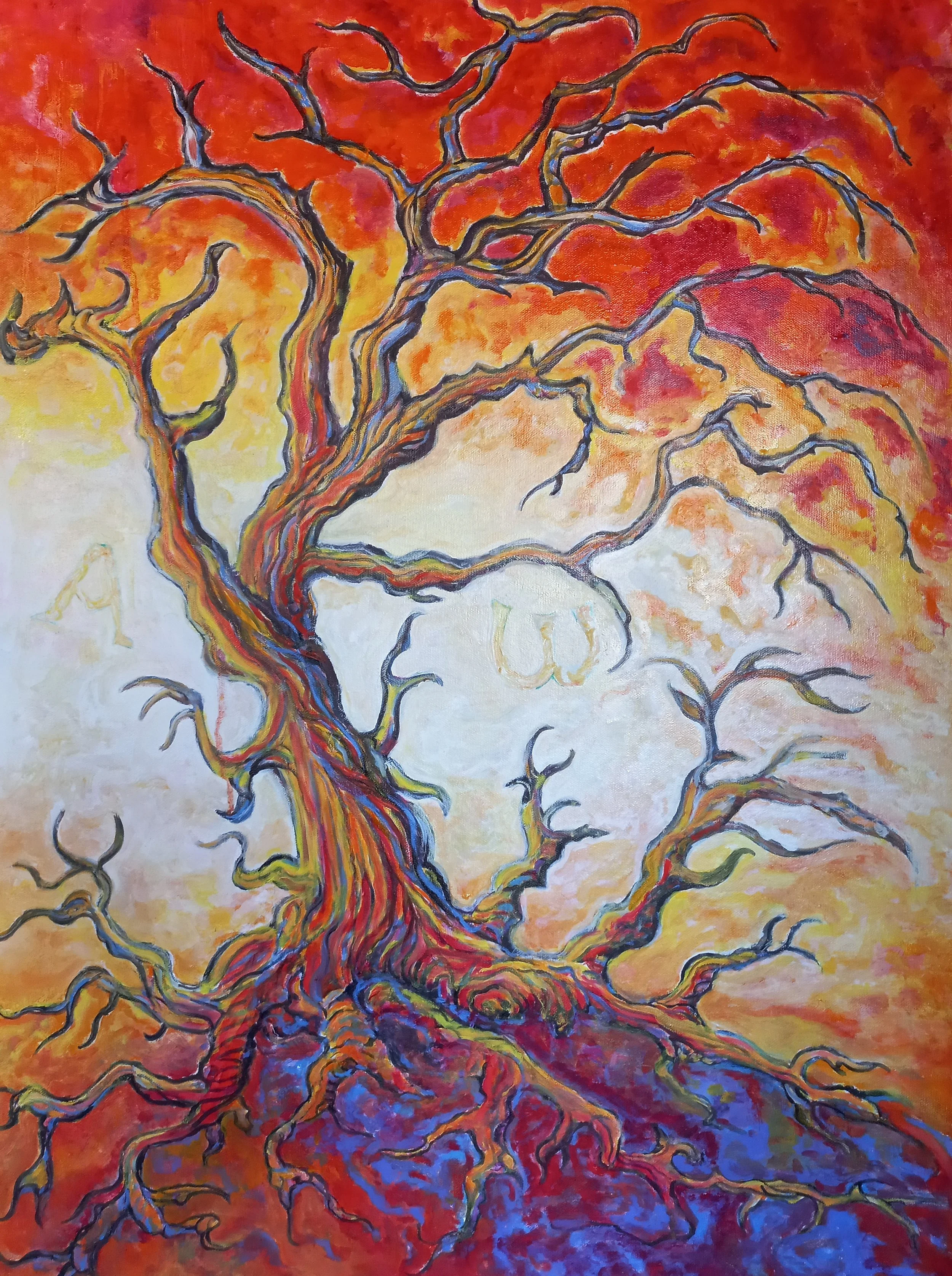
The Tree of Ignorance (2024)
Eating the forbidden fruit gave humanity knowledge of both good and evil, marking the beginning of what is known as the human condition.
Yet this tree bears neither fruit nor leaf — its scorched form evokes both the desolation of drought and the weight of human awareness, oscillating between the pursuit of knowledge and the burden of knowing. Its roots twist through tormented soil while its branches reach toward a burning sky.
From beginning (А) to end (Ω), it traces the fragile path of existence — between spiritual elevation and existential burden.
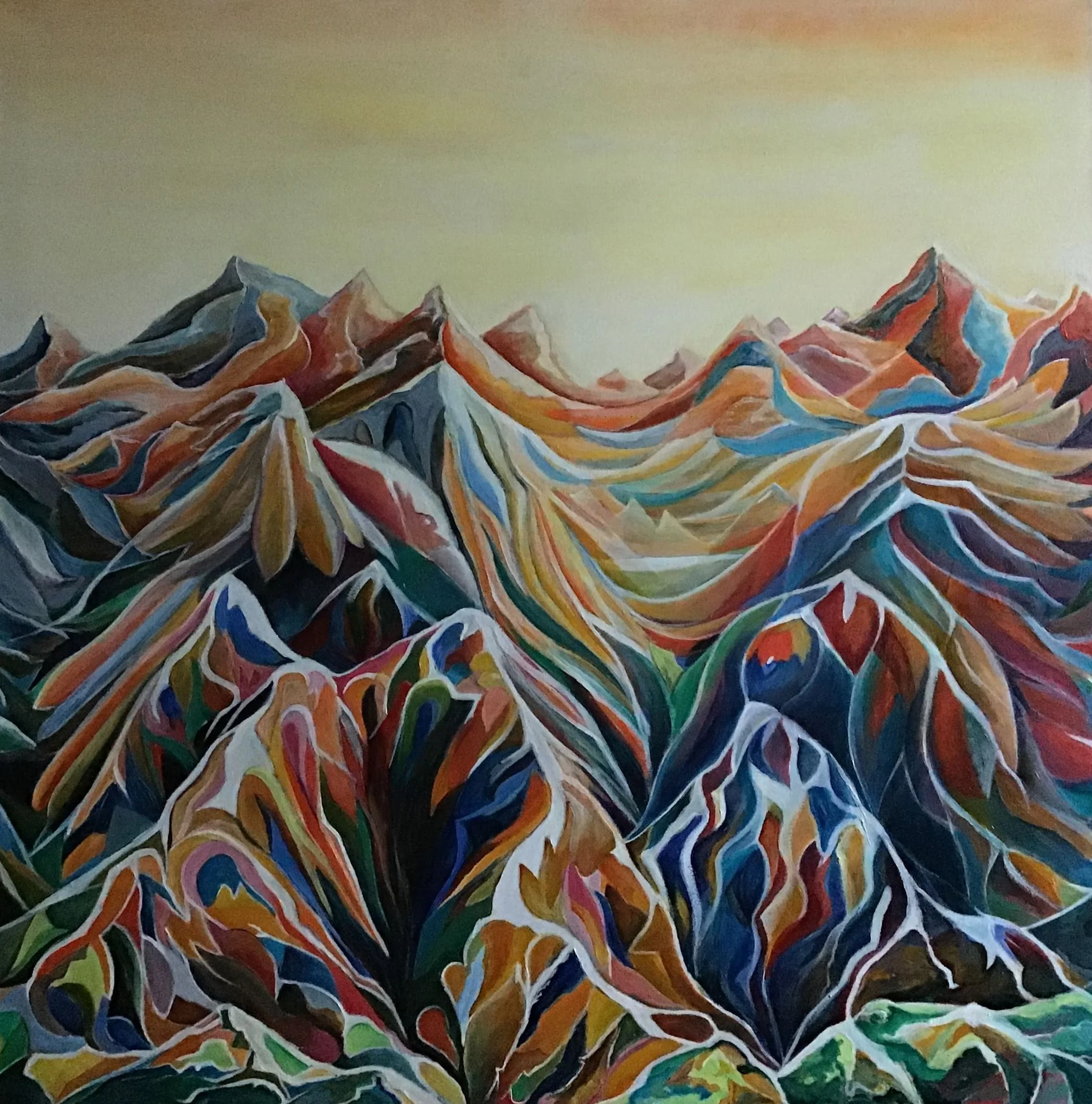
The Territories of the Imagination (2019)
These mountains are not landscapes alone but inner realms, where a multitude of colors gives voice to the full range of human feelings.
Their stillness is not emptiness but resonance — a sanctuary of solitude, where life and spirit meet in quiet majesty.
And for the attentive eye, two birds have made their nest within these sacred territories.
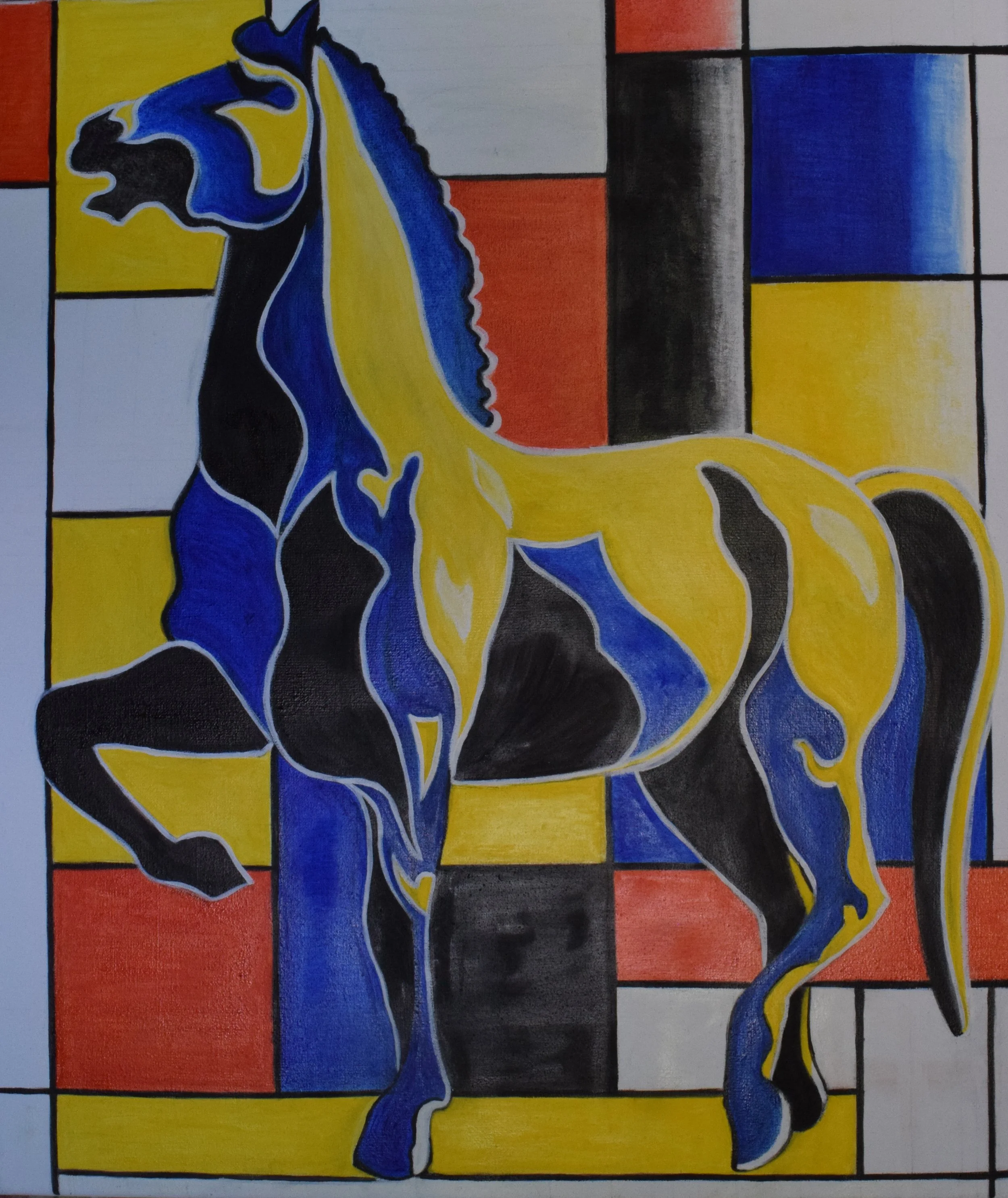
Equus (2018)
Across cultures and mythologies, the horse — man’s most faithful companion — is universally recognized as a symbol of nobility and harmony. Paying homage to Piet Mondrian’s iconic compositions, this painting is built upon the three primary colors—yellow, magenta, and cyan—from which all others derive.
This minimal palette functions on both a literal and figurative level, where primal vitality intersects with modern abstraction.
Cast in light and shadow, the horse emerges not merely as a creature of strength, but as an enduring emblem of beauty and spirit.
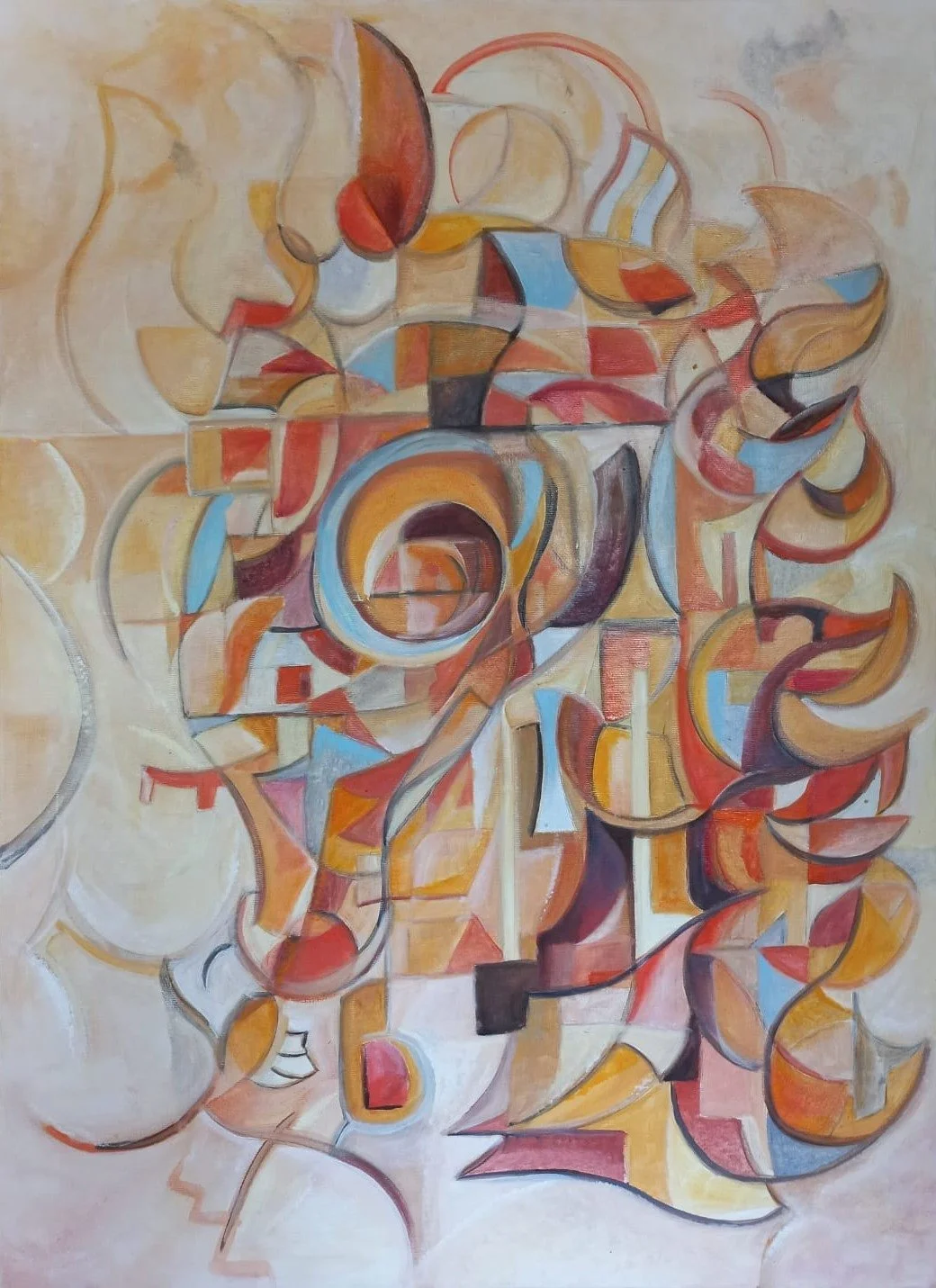
The Inner Horse (2026)
At the threshold between abstraction and figuration, a horse’s head emerges from a shifting weave of forms. Like an image rising from deep memory, it speaks of an awakening—of intuition, consciousness, or a long-dormant calling.
The horse becomes a messenger of the inner voice we each carry. A timeless symbol of freedom, vitality and mastery, it invites us to recognize the gifts within us and give them a path into the world.
For each of us carries an inner horse. To listen, to tame, and ultimately to ride it is to answer the call of our own legend. The Inner Horse reminds us that the greatest journey is not to conquer the world, but to become the rider of our own life.
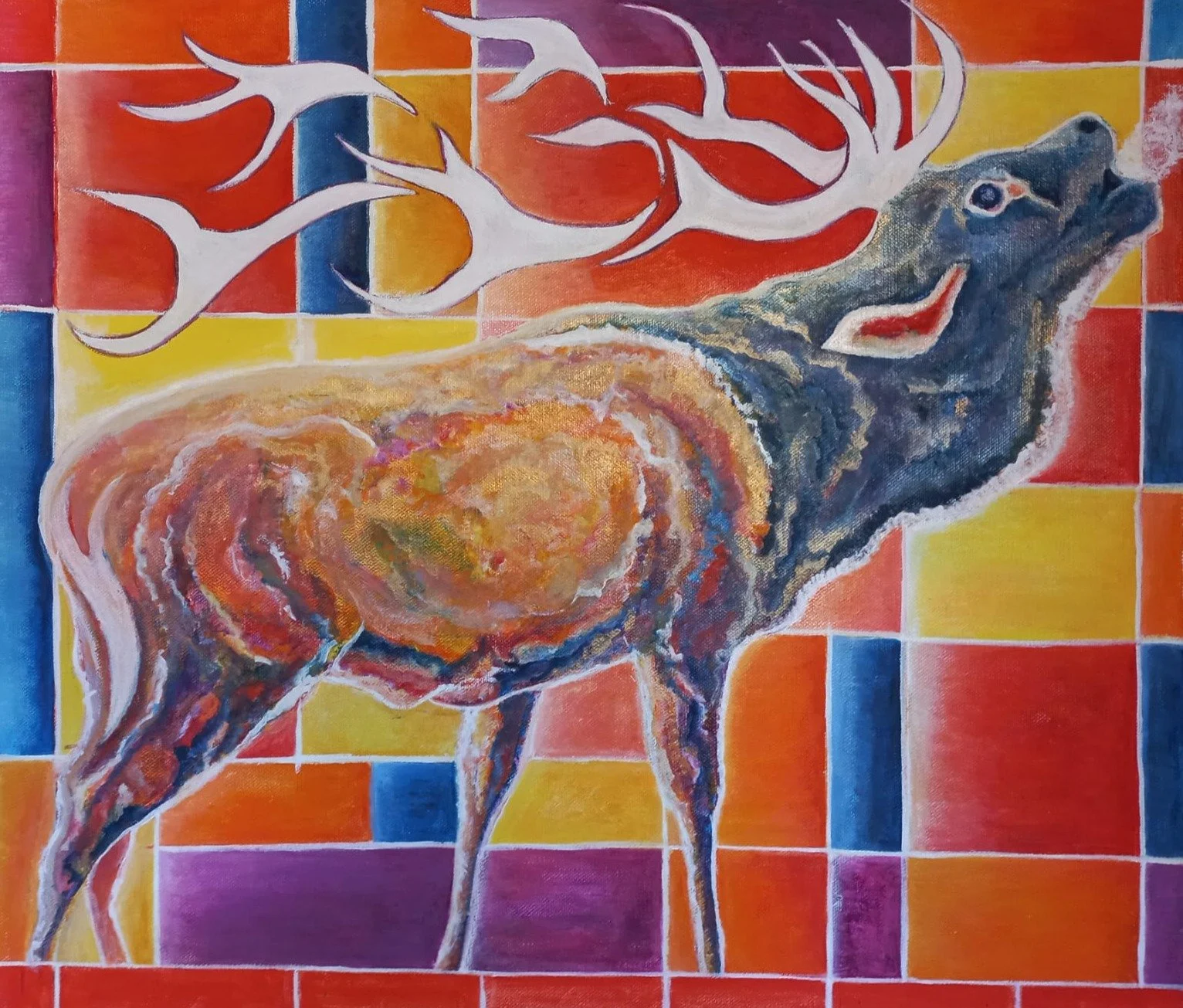
The Cry of Nature (2025)
A great stag, the king of the forest, painted in vibrant hues, lifts its head toward the sky, its antlers dissolving into soaring birds.
Its raw cry echoes Edvard Munch’s The Scream—yet here, it is not humankind lamenting modern anxiety, but nature itself crying out for survival.
The stag, a symbol of renewal through the cyclical shedding of its antlers, becomes a metaphor for biodiversity under threat. Behind it, colourful geometric patterns evoke the fragmented, fast-moving contemporary world, contrasting with nature’s fragile vitality.
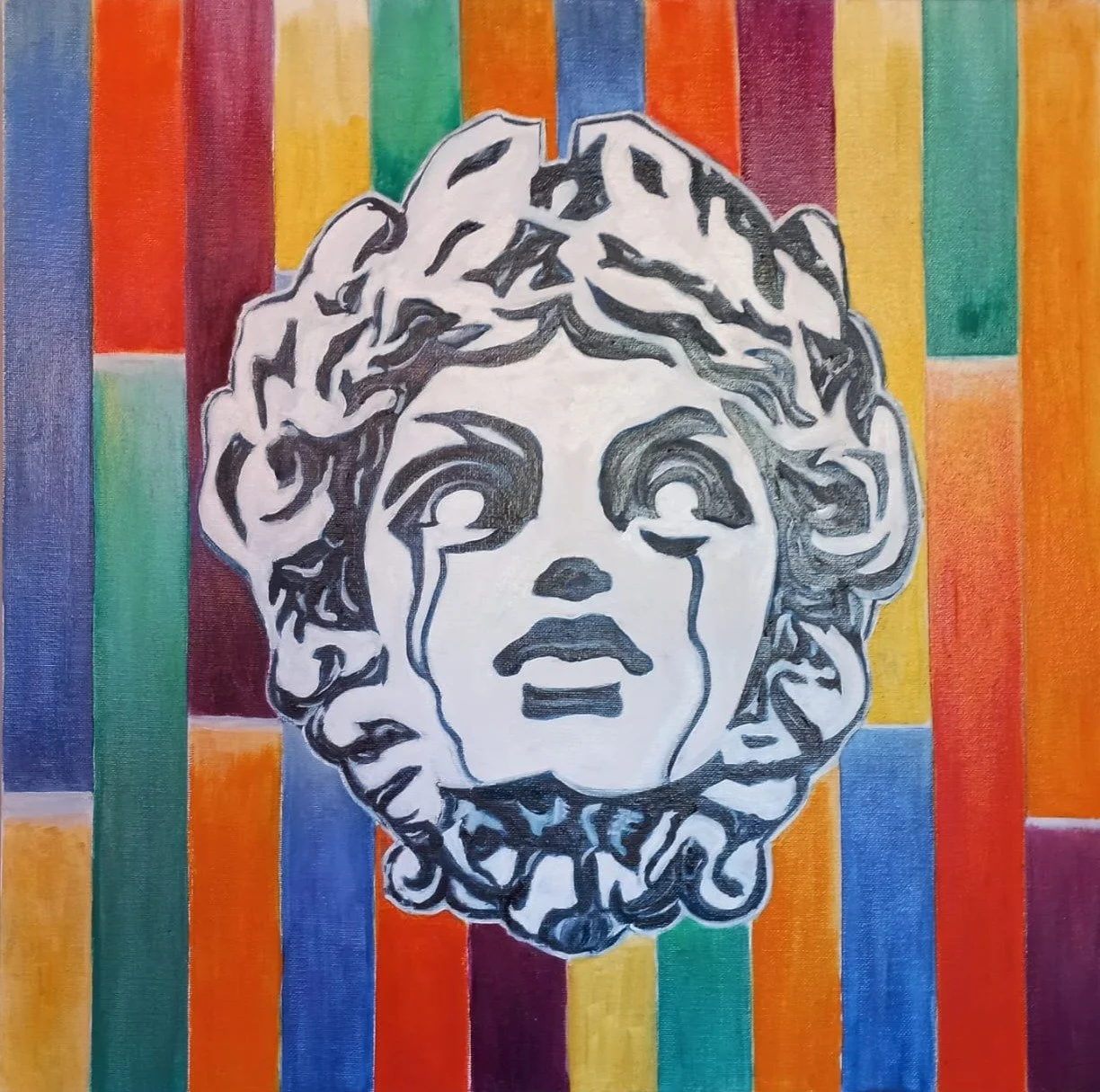
Apollo in Tears (2023)
From the heights of heaven, Apollo watches mankind’s self-destruction. He weeps over a world unraveling—his creation undone by the very hands he shaped. The Earth groans beneath humanity’s fury, and even a god is powerless to intervene.
Behind him, a vibrant rainbow of twelve vertical stripes evokes the passage of time. Their complementary colours collide in a kaleidoscopic arrangement. Beauty and despair coexist in a world at risk, where even divine power is powerless to prevent humanity from tearing itself apart.
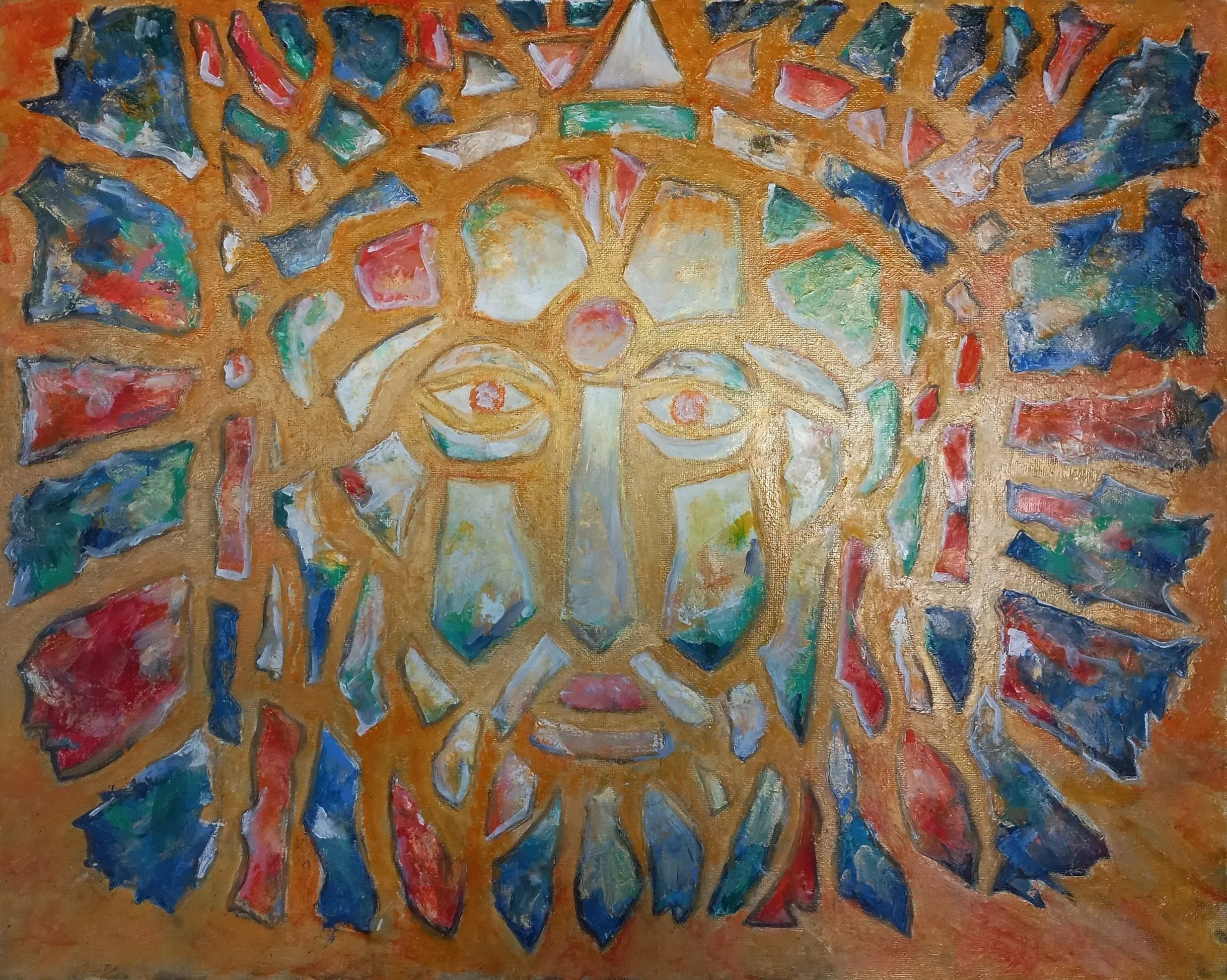
Shards of Divinity (2024)
“Oh Lord, where have you been?” “I have been walking here and there, roaming across the Earth, observing all that unfolds”, replied Satan.
If God embodies light, order, and creation, then where does the shadow dwell?
Set against a gold background reminiscent of sacred icons, a fractured visage – seemingly divine - questions divine presence and human faith in a world where God’s presence is questioned and the devil walks freely.